


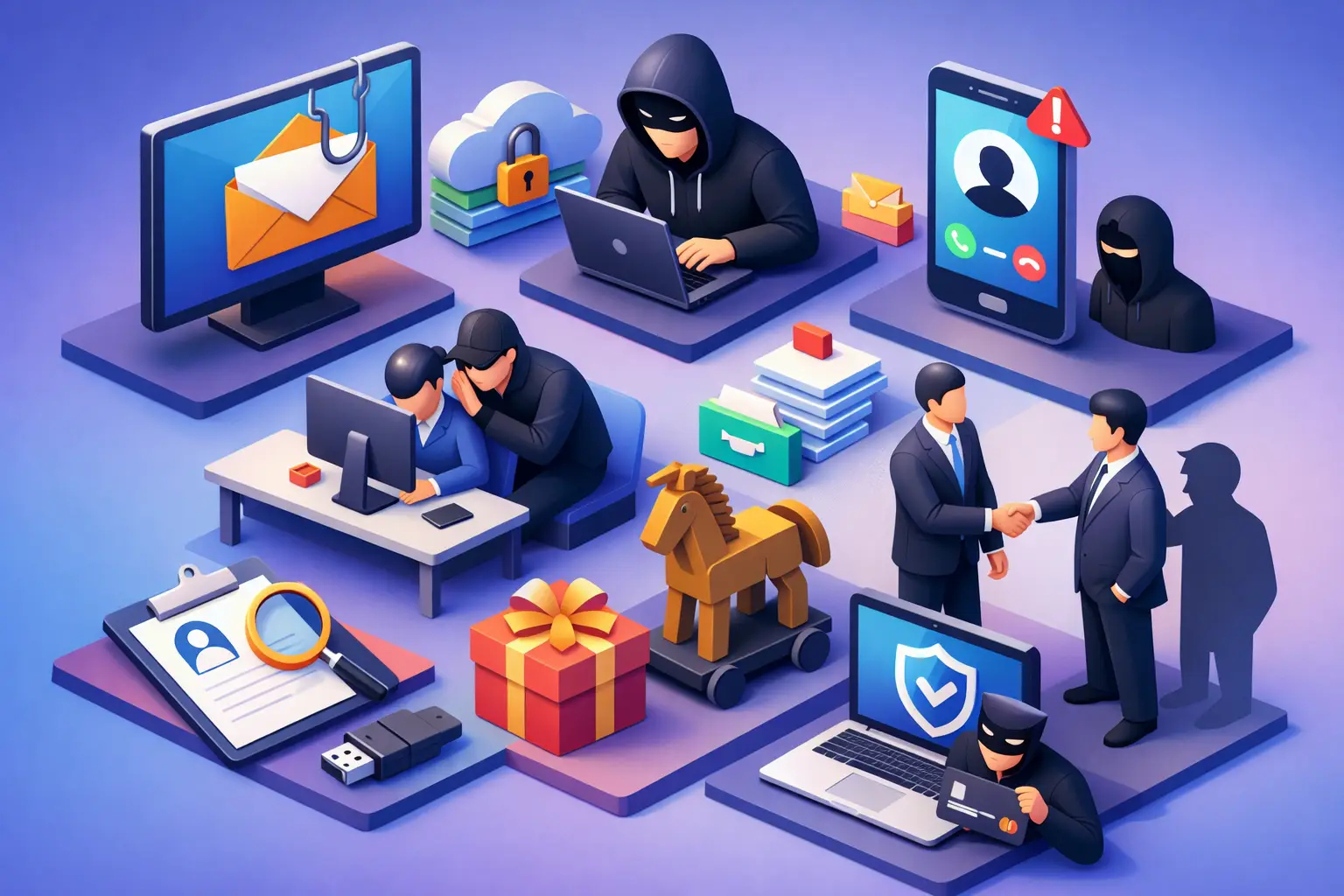
9 Examples of Social Engineering Training
Social engineering attacks succeed because they exploit human behavior, not technical vulnerabilities. Employees are pressured into approving fake invoices, resetting passwords for impersonated colleagues, sharing credentials through fake Microsoft 365 portals, or responding to urgent internal requests that appear legitimate. This is why practical social engineering training matters — it helps employees recognize manipulation patterns before a security incident occurs.
Modern cybersecurity awareness training is no longer limited to basic phishing examples. Organizations operating under NIS2 requirements increasingly use role-based simulations, real-world attack scenarios, and employee-focused cybersecurity education to prepare staff for attacks delivered through email, chat platforms, phone calls, text messages, collaboration tools, and trusted business workflows.
For security leaders, the challenge is not whether employees have heard of phishing attacks. The real challenge is whether employees can identify social engineering attempts under pressure, during daily operations, and within the systems they use every day. Effective security awareness programs close that gap by transforming abstract cybersecurity concepts into practical decision-making employees can apply in real situations.
What Effective Social Engineering Training Examples Actually Teach
The best training examples do more than warn employees to be careful. They recreate the logic of the attack. They show the emotional trigger, the business context, and the small decision point where a user either stops the threat or lets it in.
That matters because social engineering succeeds by exploiting normal behavior. People want to be helpful. They respond to urgency. They trust familiar brands and senior titles. If training ignores that reality and stays too generic, it will not change behavior in a measurable way.
Strong examples are also role-aware. A finance team member should see invoice fraud and payment diversion attempts. HR teams should see benefits enrollment scams and fake candidate attachments. IT and help desk staff need scenarios involving password resets, MFA fatigue, and impersonated executives requesting access changes. Compliance-driven organizations should go one step further and map examples to regulatory obligations, reporting paths, and documentation expectations.
Social engineering training examples worth using
1. Phishing email with urgent account action
This is still the foundation because email remains the easiest route into most organizations. A good scenario uses a familiar sender profile, a plausible pretext, and a request tied to urgency. The employee receives a message that claims their password will expire within hours unless they sign in through a provided link.
The training value comes from what happens next. Learners should identify subtle indicators like a mismatched domain, unusual grammar, or a request that bypasses the company’s normal sign-in process. Just as important, they should practice the correct response: do not click, verify through approved channels, and report the message.
If this scenario is too easy, it teaches false confidence. Mature programs vary the difficulty. Some messages should be obvious. Others should be realistic enough to test judgment, not just attention.
2. Business email compromise targeting finance
A finance-specific example has direct business relevance because the financial impact can be immediate. In this scenario, an attacker impersonates a senior executive or vendor and requests an urgent wire transfer, bank detail update, or invoice payment change.
This is where training must connect awareness to process. Employees need to know that recognizing the scam is only half the job. They also need a clear verification workflow, such as callback procedures, dual approval rules, and out-of-band confirmation for any payment detail change. Without that operational control, awareness alone will fail when pressure rises.
3. Vishing call to the help desk
Phone-based deception is often undertrained even though it works well against support functions. A convincing caller claims to be a remote employee locked out before an executive meeting and asks for a password reset or MFA bypass.
This example is especially useful because it tests empathy against procedure. Help desk teams are measured on responsiveness, so attackers exploit that service mindset. Training should reinforce scripts for identity verification and normalize slowing down the interaction. Fast support is valuable. Unauthorized access is far more expensive.
4. Smishing message about payroll or benefits
Text-based attacks have become more effective because employees are used to quick mobile interactions. A training scenario might involve a text that appears to come from HR, warning the employee to confirm direct deposit details or health plan information immediately.
The lesson is not just “do not tap suspicious links.” It is to recognize channel misuse. If the organization does not manage payroll changes by text, that inconsistency itself is a red flag. This is one reason localized and policy-aligned training performs better than generic content. Employees need examples grounded in how their own company actually works.
5. Collaboration tool impersonation
Many attacks now happen in Teams, Slack, or project tools because those channels carry built-in trust. A user receives a direct message from someone who appears to be a colleague asking them to open a file, share a one-time code, or approve a login request.
This type of example is critical for modern workforces. Employees may be more skeptical in email but less guarded in internal messaging platforms. Training should teach them to verify unusual requests even when they come from known names and familiar avatars. Trust in the channel is exactly what the attacker is counting on.
6. MFA fatigue attack simulation
Not every social engineering attack starts with a message asking for credentials. In an MFA fatigue scenario, the attacker already has a username and password and repeatedly triggers push notifications until the user accepts one out of confusion or frustration.
This is a strong training example for organizations using mobile authentication. Employees should learn what an unexpected approval request means and what action to take next, including denying the request and alerting security. It also opens a broader discussion about stronger authentication design, number matching, and risk-based access controls. Training should support technical controls, not pretend to replace them.
7. Physical tailgating or visitor impersonation
Human risk is not limited to screens. A well-designed in-person scenario involves someone following an employee into a restricted area by carrying boxes, claiming to be a contractor, or saying they forgot their badge.
This example matters most in offices, manufacturing environments, healthcare, and other regulated facilities. Employees need permission to challenge politely, escort properly, or redirect visitors to check-in procedures. If the workplace culture treats every challenge as rude, people will default to convenience. Training should make secure behavior socially acceptable and operationally expected.
8. QR code scam in the office or at events
QR codes are useful, which is exactly why they are abused. A scenario might place a fake code near a shared printer, conference check-in desk, or break room notice, directing employees to a malicious login page or fake survey.
This works well because it breaks the assumption that cyber threats only arrive through inboxes. It also reflects hybrid work and event-heavy business environments where scanning codes feels normal. Good training explains how to pause before scanning and how to verify destination legitimacy on mobile devices.
9. Deepfake or executive impersonation scenario
As attackers get better at mimicking voice and identity, leadership-focused examples are becoming essential. Imagine a finance director receiving a voice message that sounds like the CFO, asking for a confidential transfer before a board call.
This is not a future problem. It is a present control issue. Training should not create panic, but it must reinforce that authority is never a substitute for verification. Executives also need training here, because senior leaders are both targets and high-value impersonation assets.
How to use social engineering training examples effectively
Examples only work when they are part of a system. If you show a scenario once a year and call the job done, you will get compliance activity, not behavior change. The stronger approach is ongoing and measurable.
Start by aligning examples to the most likely attack paths in your environment. A hospital, logistics provider, manufacturer, and SaaS company will not face the same lures. Then match scenarios to roles. Security awareness becomes much more credible when employees can say, “Yes, this is exactly how someone would try to trick our team.”
Delivery matters too. Interactive modules, short scenario-based lessons, and simulated exercises usually outperform passive reading because they force a decision. Quizzes help reinforce pattern recognition, but they should test judgment rather than trivia. Certifications can support compliance goals, especially where documentation and audit readiness matter, but certification should be evidence of learning, not a substitute for it.
You also need a reporting culture. Employees should know how to escalate suspicious emails, calls, texts, and physical incidents without hesitation. Fast reporting reduces dwell time and gives security teams a chance to contain threats early. If reporting is confusing or punitive, people will stay quiet.
Finally, measure outcomes that matter. Click rates in phishing simulations can be useful, but they are incomplete. Track reporting rates, repeat failures by attack type, role-based gaps, and time-to-report. For compliance-driven organizations, connect those metrics to broader resilience objectives, policy adherence, and incident reduction. That is where training moves from awareness spend to business control.
The trade-off between realism and trust
There is one balance every program has to manage carefully: realism versus employee trust. If simulations are too simplistic, they waste everyone’s time. If they are overly deceptive or punitive, they damage credibility and create resentment.
The right approach is demanding but fair. Test realistic scenarios. Use them to coach, not embarrass. Give employees immediate feedback and explain what they missed. When training feels relevant and respectful, people engage. When it feels like a trap, they only learn how to avoid being caught.
That is why organizations increasingly choose structured programs built around role, region, and regulatory needs. A platform like CISO EDU fits this model because it connects practical awareness, measurable learning, and compliance readiness instead of treating them as separate problems.
Cybersecurity starts with people - not tools. The right examples make that real by teaching employees what manipulation looks like before a real attacker tests them.
Ready to strengthen employee awareness before a real attack happens? Contact the CISO EDU team or complete the form below to build a practical cybersecurity training program aligned with real-world social engineering threats and NIS2 compliance requirements.
ADVANCED VISION IT - MALTA Address: Suite 8, Ta’ Mallia Buildings, Triq In‑Negozju, Zone 3, Central Business District, Birkirkara, CBD 3010, Malta
Registration number: C111282, VAT Number: MT31713827
Phone:+35679224404
Email: office@advisionit.com
ADVANCED VISION IT - BULGARIA
Address: 35 Dimitar Hadzhikotsev str. Ent A, Lozenets, Sofia, Bulgaria
ID No: 205789039, VAT No: BG205789039
Phone: +359 888 258 530
Email: office@advisionit.com