


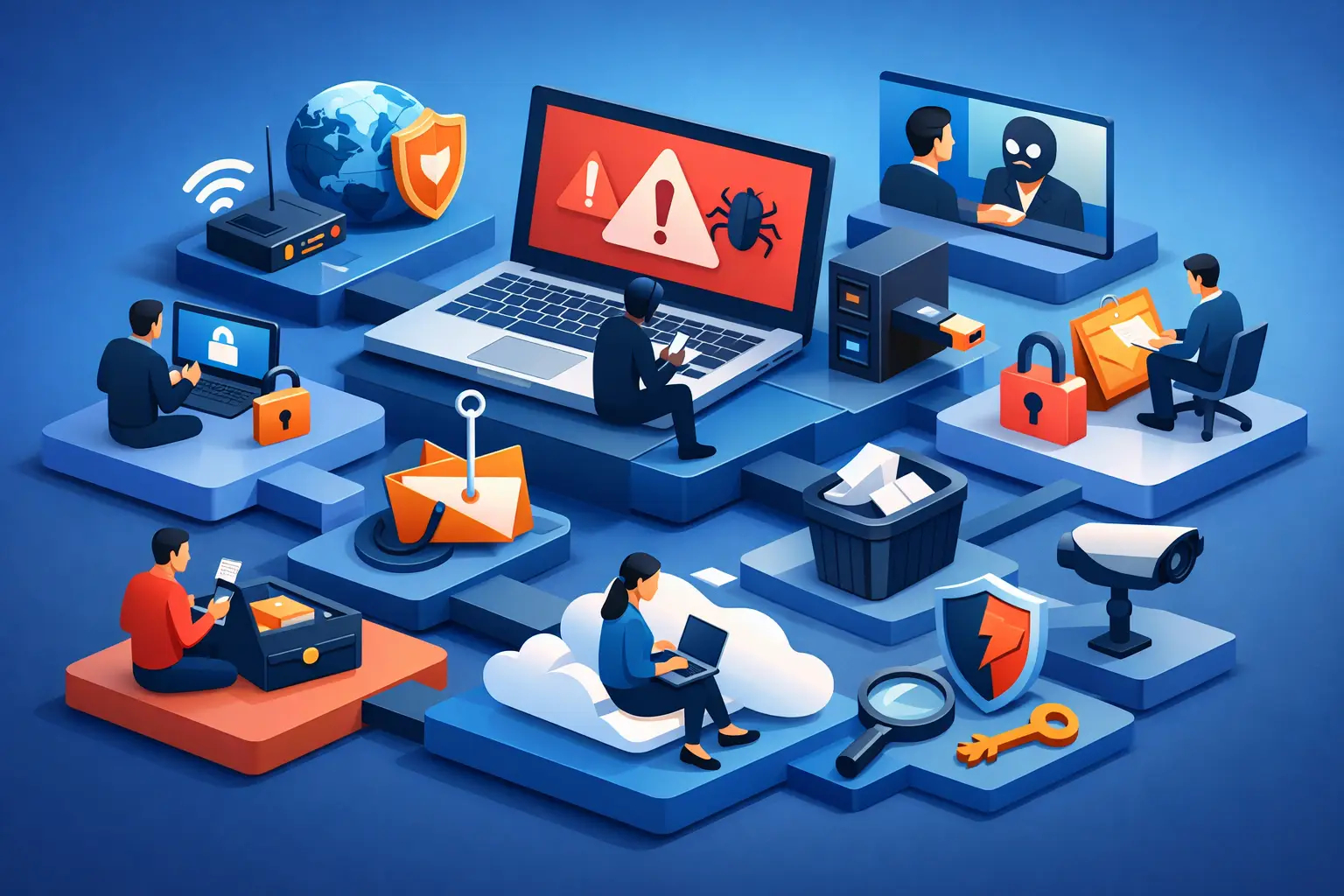
9 Top Employee Cyber Risk Behaviors
A single rushed click can trigger a ransomware event, expose regulated data, or hand an attacker the foothold they need. That is why identifying the top employee cyber risk behaviors matters so much for security leaders, compliance teams, and business executives. Most organizations do not fail because people are careless by default. They fail because risky behavior goes uncorrected, training is too generic, and controls do not match how work actually gets done.
Cybersecurity starts with people - not tools. If you want fewer incidents, stronger compliance outcomes, and better resilience, you need to know which behaviors create the most exposure and why employees keep repeating them.
Why top employee cyber risk behaviors deserve executive attention
Security teams already understand that human error is a major breach driver. What often gets missed is the business impact of specific behaviors. Clicking a phishing link is not just a security awareness issue. It can become a business email compromise loss, a reportable incident, an audit finding, or a disruption to operations.
That is the real challenge for CISOs and operational leaders. Employee behavior sits at the intersection of cyber risk, regulatory pressure, and day-to-day productivity. If you treat it as a simple training problem, you will miss the larger issue. Behavior is shaped by process design, management expectations, tool friction, and role-specific pressure.
The highest-performing programs do not just tell employees what not to do. They identify the moments where risk shows up, then build training, policy, and reinforcement around those moments.
1. Clicking on phishing and social engineering messages
This remains one of the most common and costly behaviors because attackers keep improving. Messages now look like invoices, HR updates, MFA prompts, vendor requests, and executive instructions. The problem is no longer limited to poorly written scam emails. It now includes convincing texts, collaboration platform messages, and voice calls.
Employees usually do not click because they are uninformed. They click because they are busy, interrupted, or responding to a message that appears operationally urgent. In finance, procurement, HR, and executive support roles, that urgency is constant.
Reducing this risk requires more than annual awareness content. Teams need repeated exposure to realistic scenarios, clear reporting workflows, and reinforcement that rewards caution instead of speed alone.
2. Reusing passwords or choosing weak credentials
Password reuse is still one of the easiest ways for attackers to turn a third-party breach into an internal compromise. Employees often use the same or similar passwords across personal and business accounts, especially if password requirements are complex and login fatigue is high.
This is where behavior and system design collide. If your environment still depends heavily on passwords without strong MFA, employees are carrying too much of the security burden themselves. Training helps, but it cannot compensate for weak authentication architecture.
The practical answer is layered. Enforce MFA, promote password managers, and teach employees why credential stuffing is effective. People are more likely to change behavior when they understand how attackers actually exploit it.
3. Mishandling sensitive data
Employees create cyber risk when they store, share, download, or transmit data in ways that bypass policy. That may look like sending regulated information through personal email, uploading business files to unauthorized cloud apps, or keeping customer data on local devices for convenience.
In many organizations, this behavior is not malicious. It is a workaround. Employees move data unsafely because approved methods feel too slow or too restrictive for the pace of work. That is why data handling risk is often highest in teams under pressure to serve customers quickly or collaborate across departments.
This is also where compliance exposure grows fast. A single poor data-handling decision can create issues tied to privacy rules, contractual obligations, and sector-specific regulations. Training should be role-based, not generic. A salesperson, HR manager, and engineer do not handle data in the same way, so they should not receive the same examples.
4. Using unauthorized apps and shadow IT
Shadow IT is one of the top employee cyber risk behaviors because it often starts with good intentions. A team adopts a file-sharing tool to move faster. A manager uses a free AI assistant with sensitive content. A department signs up for a SaaS platform without security review because procurement takes too long.
From the employee perspective, the decision may feel efficient. From the security perspective, it creates unknown data flows, weak vendor controls, and serious governance gaps.
The trade-off here is real. If security processes are too rigid, employees will route around them. If they are too loose, risk spreads quietly. Mature organizations handle this by making secure choices easier to adopt than unapproved ones. They also explain the business reason behind software review, especially for teams buying tools directly.
5. Ignoring software updates and device hygiene
Unpatched endpoints, outdated mobile devices, and unmanaged home systems continue to create avoidable exposure. Employees delay updates because they interrupt work, restart devices at inconvenient times, or break workflows they depend on.
That makes this behavior partly cultural. If the organization signals that uptime and responsiveness matter more than security maintenance, employees will postpone updates. Over time, those delays create a large attack surface.
Security leaders should not frame patching as a technical housekeeping issue. It is a business continuity issue. The employee needs to understand that delayed updates are not harmless. They extend the life of exploitable vulnerabilities and increase the odds of a preventable incident.
6. Oversharing on public platforms
Attackers do not rely only on malware. They study people. Public posts on social media, corporate websites, event pages, and professional networks can give away reporting lines, technology stacks, project names, travel plans, and internal language that make spear phishing far more believable.
Employees rarely see this as cybersecurity behavior. They see it as networking, recruiting, marketing, or personal brand building. That is why awareness content needs to connect the dots clearly. Seemingly harmless details can fuel impersonation, pretexting, and targeted fraud.
This area requires nuance. You do not want to shut down legitimate public engagement or employer branding. You do want employees, especially leadership and customer-facing teams, to recognize how much context an attacker needs to sound credible.
7. Bypassing security controls for convenience
When employees disable MFA prompts, share accounts, leave devices unlocked, or use personal messaging apps for business tasks, they are often choosing convenience over control. That choice may save a few minutes in the moment, but it increases exposure dramatically.
This behavior is common in fast-moving operational environments where people are measured on output first. If a control feels like friction and managers do not reinforce its importance, employees start treating workarounds as normal.
The answer is not just stricter policy language. It is better alignment between security and operations. Controls must support the business, and business leaders must visibly support the controls. Without that partnership, bypass behavior keeps returning.
8. Failing to report suspicious activity quickly
Many incidents become worse because employees hesitate to report them. They worry they are overreacting, they do not know the process, or they fear blame for having clicked something they should not have.
Speed matters here. A suspicious login alert reported in five minutes is very different from one reported the next morning. Early reporting can contain account compromise, isolate devices, and reduce impact before a small event becomes a major incident.
Organizations need to make reporting simple, visible, and psychologically safe. If employees think reporting leads to embarrassment or punishment, they will stay quiet. One of the strongest signals of security maturity is a culture where people report early and often.
9. Trusting authority without verification
Fraudsters know how to exploit hierarchy. They imitate executives, vendors, legal counsel, and internal stakeholders to pressure employees into sending funds, sharing credentials, or disclosing confidential information.
This behavior is especially dangerous because it targets professionalism. Employees are taught to be responsive, respectful, and helpful. Attackers use those traits against them.
That is why verification habits matter. Payment changes, urgent gift card requests, sensitive document access, and unusual executive asks should trigger a secondary check. The strongest teams normalize verification, even when the request appears to come from senior leadership.
How to reduce employee risk without slowing the business
The top employee cyber risk behaviors rarely disappear through one-time training. They improve when awareness, controls, and accountability work together.
Start with role-based education. Finance teams need different scenarios than developers or HR staff. Then align policy with real workflows. If your approved path is too slow, employees will create an unofficial one. Reinforce critical behaviors consistently through simulations, manager messaging, and short training tied to actual incidents or seasonal threats.
Measurement also matters. Track phishing report rates, repeat risky behaviors, policy exceptions, and training completion by role. Do not focus only on failure rates. Look for evidence that employees are recognizing threats earlier, asking better questions, and using secure processes more consistently.
For organizations facing growing regulatory pressure, this approach has another benefit. It strengthens the link between security awareness, compliance readiness, and operational resilience. That is where workforce education becomes more than a checkbox. It becomes a control that helps reduce both incident likelihood and audit exposure.
At CISO EDU, this is the standard organizations should aim for: practical, measurable education that changes behavior where risk actually lives.
The goal is not to build a perfect workforce. It is to build a workforce that spots risk sooner, makes better decisions under pressure, and knows that cybersecurity is part of how the business operates every day.
FAQ
1. What are the most common employee cyber risk behaviors?
The most common employee cyber risk behaviors include clicking phishing links, reusing passwords, mishandling sensitive data, using unauthorized applications, ignoring software updates, oversharing information online, bypassing security controls, failing to report suspicious activity, and trusting authority requests without proper verification.
2. Why do employees engage in risky cybersecurity behavior?
Employees rarely take risks intentionally. Most risky behavior is driven by workload pressure, convenience, lack of awareness, unclear processes, or the need to complete tasks quickly. Effective cybersecurity programs address both employee behavior and the underlying business processes that influence it.
3. How can organizations reduce employee cyber risk?
Organizations can reduce employee cyber risk through role-based cybersecurity awareness training, multi-factor authentication, regular phishing simulations, clear security policies, secure technology controls, and a culture that encourages employees to report suspicious activity without fear of blame.
4. Which employee cyber risk behavior causes the greatest security threat?
Phishing and social engineering attacks remain among the most significant employee-related cybersecurity risks. A single successful phishing attempt can lead to credential theft, ransomware infections, data breaches, financial fraud, or unauthorized access to critical business systems.
5. How should businesses measure employee cyber risk?
Businesses should measure employee cyber risk using metrics such as phishing simulation results, suspicious activity reporting rates, policy violations, repeat risky behaviors, security training completion rates, and overall improvements in security awareness and compliance over time.

Written by: Ivan Energiev

IT Project Coordinator · Operations Excellence & Service Delivery Leader at Advanced Vision IT Ltd | Published on September 03 2026
Ivan advises insights on IT project coordination, operations excellence, and service delivery leadership.