


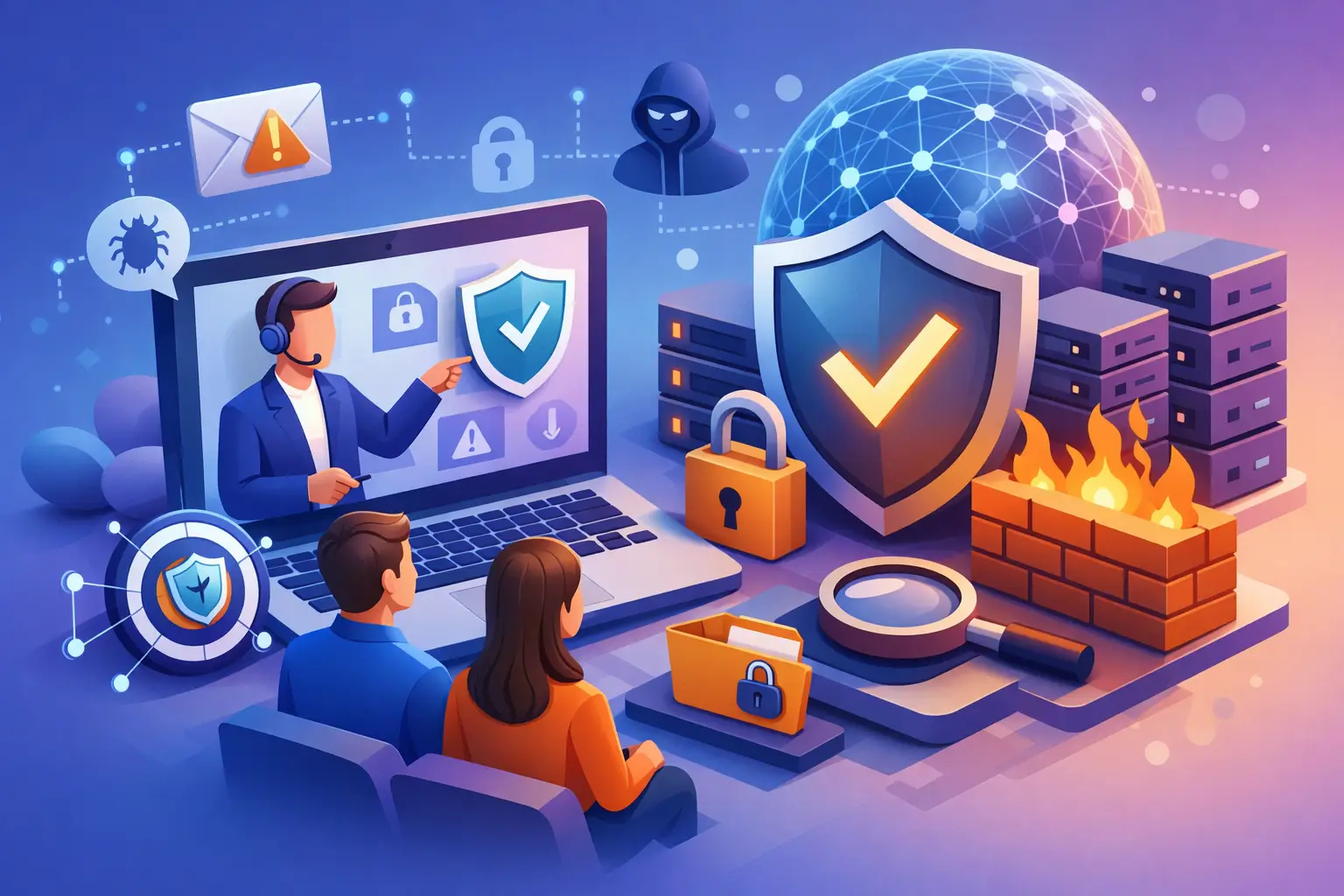
Cyber Awareness Training That Reduces Risk
One employee clicks a fake invoice. Another reuses a password across business apps. A manager shares sensitive data over the wrong channel because the request looked urgent and legitimate. Most security incidents do not begin with a sophisticated exploit. They begin with ordinary behavior under pressure. That is why cyber awareness training is not a nice-to-have for modern organizations. It is a control that directly affects risk, resilience, and compliance.
For security leaders, HR teams, and executives, the real question is not whether to train employees. It is whether the training changes behavior when it counts. Too many programs exist to satisfy an audit checkbox. They deliver generic content once a year, track completion, and call it done. That approach may help with documentation, but it rarely improves decision-making across the workforce.
What cyber awareness training should actually do
Effective cyber awareness training gives people the judgment to spot risk before it becomes an incident. It should help employees recognize phishing attempts, protect credentials, handle sensitive data correctly, and respond quickly when something feels wrong. More importantly, it should teach them how cyber risk appears in their specific role.
An accounts payable team sees different threats than a software developer. A senior executive faces different social engineering tactics than a customer support rep. A distributed workforce in Europe may also need training aligned with regional privacy and resilience expectations, while teams operating in regulated sectors may need content mapped to specific obligations. If the program ignores those differences, employees tune out because the material does not feel relevant to the work they do.
That is where many organizations lose momentum. They invest in broad awareness but miss practical context. Security improves when training connects directly to daily decisions, business processes, and the threats most likely to reach that audience.
Why annual training alone falls short
Cyber risk does not move on a yearly schedule. Attackers change tactics quickly, employees change roles, and business systems change constantly. A single annual session creates a weak memory trace and a false sense of completion.
People do not need more theory. They need reinforcement. Short, role-based modules delivered throughout the year tend to outperform one-time awareness events because they keep security visible without overwhelming the workforce. Quizzes, scenario-based lessons, and simulated phishing can strengthen retention if they are used well. If they are used poorly, they create resentment and teach employees to fear punishment instead of reporting concerns.
That trade-off matters. Pressure-based training may improve short-term click rates while damaging trust. A stronger model treats employees as part of the defense strategy, not as the problem to be managed. The goal is to build confident reporting behavior, better judgment, and faster escalation.
Cyber awareness training and compliance are connected
For many organizations, training starts as a compliance requirement. That is understandable. Regulatory frameworks, cyber insurance expectations, and customer due diligence increasingly require evidence that employees receive structured cybersecurity education.
But compliance-driven training only adds value when it also supports operations. Completion reports and certificates have a place, especially for audits and board reporting. Still, those artifacts should be byproducts of a real program, not the program itself.
This is especially relevant for organizations navigating frameworks tied to resilience, governance, and incident readiness. Requirements connected to NIS2, sector-specific rules, or internal control environments often demand more than a policy acknowledgment. They require organizations to demonstrate that people understand their responsibilities. That means training must be current, measurable, and aligned to the regulatory environment employees actually work within.
What strong cyber awareness training looks like
The best programs are built around business risk, not generic content libraries. They begin with a simple question: what human behaviors create the most exposure for this organization?
For one company, the biggest issue may be business email compromise tied to invoice fraud. For another, it may be unsafe handling of customer data, weak password habits, or delayed reporting of suspicious activity. A healthcare provider, manufacturer, financial services firm, and public sector entity all face different combinations of threat, regulation, and operational pressure.
A strong program reflects that reality. It uses targeted learning paths, practical examples, and content calibrated to the audience. Executives need concise, high-impact education focused on decision-making, brand risk, and incident leadership. Technical teams need content that supports secure behavior within operational workflows. General staff need plain-language guidance that helps them make safer choices quickly.
Good training is also localized where necessary. Language, regional regulation, and cultural context affect how well employees absorb material. Global organizations often underestimate this point. A single English-only course may satisfy central administration but fail to reach business units effectively. If the goal is risk reduction, accessibility is not optional.
How to measure whether training is working
Completion rates are easy to report and easy to misread. They show participation, not behavior change. Organizations need a broader view.
Look at phishing simulation trends, but do not stop there. Measure reporting rates, repeat mistakes, time to report suspicious messages, policy acknowledgment quality, and incident patterns linked to human error. Review whether high-risk teams are improving in the areas that matter most to their roles. If password resets from compromised credentials drop, reporting increases, and unsafe data handling declines, training is doing its job.
Qualitative feedback matters too. Employees should be able to say the training was relevant, clear, and usable. If they describe it as repetitive or disconnected from reality, the program needs adjustment. Effective awareness programs are not static. They evolve with threat intelligence, business change, and learner feedback.
Common mistakes that weaken outcomes
One of the biggest mistakes is treating all employees the same. Uniformity is administratively convenient, but security risk is not evenly distributed. High-risk functions need more attention, and leadership teams need content designed for the decisions only they can make.
Another mistake is overloading people with jargon. Employees do not need to sound like security analysts. They need to know what to do when they see something suspicious, receive a fraudulent request, or handle regulated information. Clarity beats complexity every time.
There is also a timing issue. Organizations often deploy training only after an incident, which is better than doing nothing but still reactive. The stronger posture is continuous education tied to key moments such as onboarding, role changes, policy updates, and emerging threat campaigns.
And then there is the checkbox problem. If the procurement goal is simply to prove a course exists, the organization may buy low-engagement content that creates little operational value. That saves time upfront and costs more later in preventable incidents, user frustration, and weak audit confidence.
Building a program leaders can defend
Security leaders are under pressure to show outcomes, not activity. That makes cyber awareness training a strategic issue, not just an HR or compliance task. The program should be easy to assign, easy to track, and credible in front of auditors, executives, and employees.
That means choosing training that is interactive, role-aware, and current. It means mapping learning to policy and regulatory needs without making the experience feel legalistic. It also means giving leadership visibility into trends, gaps, and business impact.
When done well, awareness training lowers avoidable risk and strengthens security culture at the same time. Employees report faster. Managers make better judgment calls. Compliance teams gain cleaner evidence. Executives get more confidence that the organization is building resilience where attacks often start - with people.
For organizations that need both workforce readiness and governance alignment, providers such as CISO EDU reflect where the market is heading: practical education, localized delivery, and measurable outcomes tied to real business exposure.
Cyber awareness training is part of operational resilience
The most useful way to view training is not as a course catalog, but as a business control. It reduces the frequency of preventable mistakes. It improves incident detection. It supports compliance. And it helps turn employees into an active line of defense rather than a recurring source of avoidable exposure.
No training program eliminates human error completely. People are busy, attackers are persuasive, and business pressure creates shortcuts. But that is exactly why awareness matters. Organizations do not need perfect employees. They need prepared employees who can recognize risk, pause when something feels off, and know what action to take next.
The companies that get this right do not treat awareness as a once-a-year requirement. They treat it as part of how the business operates, grows, and protects itself.
FAQ
1. Why is cyber awareness training important for organizations?
Cyber awareness training helps employees recognize and respond to common threats such as phishing, social engineering, password attacks, and data handling risks. By improving security behavior across the workforce, organizations can reduce the likelihood of incidents caused by human error and strengthen overall resilience.
2. How often should employees complete cyber awareness training?
Annual training alone is rarely enough. Effective programs combine onboarding training, ongoing microlearning, periodic refreshers, and simulated exercises throughout the year to keep security awareness current and relevant.
3. Should cyber awareness training be different for different roles?
Yes. Employees face different risks depending on their responsibilities. Executives, finance teams, HR professionals, IT staff, and customer-facing employees encounter different types of cyber threats, so training should be tailored to their specific roles and risk exposure.
4. How can organizations measure the effectiveness of cyber awareness training?
Beyond completion rates, organizations should track metrics such as phishing simulation results, suspicious email reporting rates, incident reporting speed, reductions in human-error-related incidents, and employee feedback to assess whether behavior is improving.
5. Can cyber awareness training help with compliance requirements?
Yes. Many regulations, industry standards, cyber insurance policies, and governance frameworks require organizations to provide cybersecurity training. A structured and documented awareness program can support compliance while also helping employees understand their security responsibilities in practice.
Author: Ivan Energiev - Account Manager
Date: 28.06.2026