


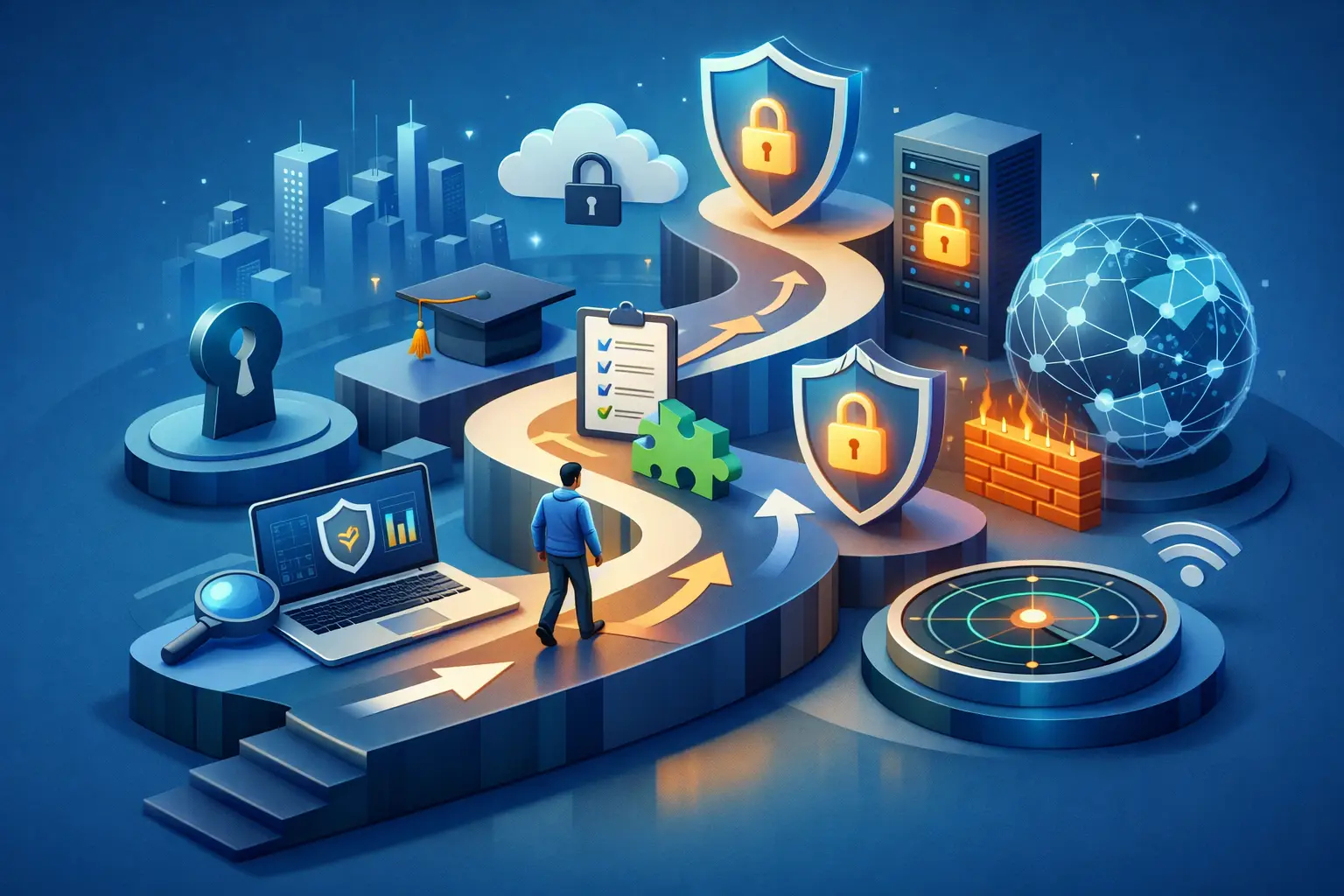
Cyber Resilience Learning Roadmap That Works
A security program usually breaks in the same place first: not at the firewall, but at the moment an employee has to make a decision under pressure. A cyber resilience learning roadmap exists to reduce that gap between policy and behavior. It gives organizations a structured way to build judgment, improve response, and align workforce knowledge with real business risk.
For most companies, the problem is not a lack of training. It is fragmented training. The compliance team runs annual modules. IT sends phishing reminders. Security leadership delivers policy updates after an incident. HR owns onboarding. None of that is useless, but it rarely adds up to a measurable resilience program.
A roadmap fixes that by connecting training to outcomes. The goal is not to make employees memorize threats. The goal is to make the organization more difficult to disrupt, faster to recover, and better prepared to meet regulatory expectations.
What a cyber resilience learning roadmap should actually do
A strong cyber resilience learning roadmap is not a content calendar. It is an operating model for workforce readiness. That means it should answer four practical questions: who needs to learn, what they need to know, when they need to know it, and how the business will prove the training changed something that matters.
That last point is where many programs stall. Completion rates are easy to report, but they do not tell you whether a finance manager will spot an invoice fraud attempt, whether an executive will escalate a suspected compromise quickly, or whether a regional business unit understands its obligations under NIS2 or similar frameworks.
The roadmap needs to connect learning with operational resilience. In practice, that means mapping training to user roles, likely attack paths, incident response responsibilities, and the regulatory environment your business operates in. A global manufacturer in Europe has different priorities than a US software company selling into regulated sectors. A hospital has different exposure than a retail chain. The structure should stay consistent, but the content and pace must reflect actual risk.
Start with business risk, not generic awareness
Most organizations begin with broad awareness because it is easy to deploy at scale. That is fine as a baseline, but it should not be the center of the roadmap. If every employee gets the same training, the business usually ends up overtraining low-risk groups and underpreparing the people whose decisions carry the most consequence.
Start with your top risk scenarios. Business email compromise, credential theft, ransomware, third-party compromise, data mishandling, and executive impersonation are common starting points. Then identify which roles have the greatest influence over prevention, detection, escalation, and recovery.
This is where the roadmap becomes useful to leadership. It reframes learning as a control that supports risk reduction, not just awareness. If payroll staff face social engineering risk weekly, they need scenario-based practice, not a once-a-year slide deck. If senior leaders may be targeted for account takeover or deepfake fraud, their training should reflect decision-making under pressure, not entry-level cyber basics.
Build the roadmap in layers
The most effective programs use layers rather than one-size-fits-all curricula. Every organization needs a baseline layer for all staff. This covers password hygiene, phishing recognition, secure use of devices, data handling, reporting channels, and common attacker tactics. It should be concise, repeatable, and easy to localize.
The next layer is role-based learning. Finance, HR, legal, procurement, developers, IT admins, executives, and customer-facing teams each face different threats and policy obligations. Training should match the systems they access, the decisions they make, and the fraud patterns they are likely to encounter. That is how learning becomes relevant enough to change behavior.
Then comes event-driven learning. This is often the missing piece. New regulations, M&A activity, changes in cloud tooling, expansion into Europe or the GCC, or a rise in supplier attacks should trigger targeted education. Waiting for the next annual cycle leaves the business exposed during the period when people are adjusting to new risk.
Finally, there is resilience leadership training. This is not the same as security awareness for executives. It should focus on governance, reporting obligations, risk appetite, crisis communications, vendor exposure, and how leadership decisions affect response speed and business continuity. Decision-makers do not need more jargon. They need clarity on accountability and consequence.
Compliance matters, but it should not drive the whole design
Compliance is a valid reason to invest in learning. It creates budget, urgency, and executive attention. But when compliance becomes the only design principle, training turns into checkbox behavior. People complete modules, auditors get evidence, and the organization still struggles during a live incident.
A better approach is to treat compliance as a floor, not a ceiling. If your organization is affected by NIS2, sector-specific requirements, or internal governance controls, your roadmap should map training evidence to those obligations. But it should also go further by preparing employees for realistic decisions that regulations assume your organization can handle.
That balance matters because regulators increasingly care about more than documented intent. They want to see repeatable processes, accountability, and readiness. A learning program that supports incident reporting, role clarity, and measurable behavior is far more defensible than a library of generic training records.
Format matters more than most teams expect
How training is delivered affects whether people retain it. Long modules once a year are administratively tidy, but they are weak at reinforcing action. Shorter interactive lessons, knowledge checks, simulations, and certifications tend to perform better because they create repetition without overwhelming staff.
There is a trade-off here. More frequent training can create fatigue if it is badly timed or irrelevant. That is why role alignment and pacing matter. A frontline employee does not need the same cadence as a privileged administrator. An executive team may need fewer touchpoints, but each one should be higher consequence and more scenario-based.
For global organizations, localization is another major factor. A message that works in one region may fail in another due to language, legal context, reporting expectations, or cultural norms around escalation. If the business operates across the US, Europe, and the GCC, the roadmap should reflect those realities directly. That is not a nice-to-have. It affects whether training is understood and acted on.
How to measure whether the roadmap is working
If your only success metric is course completion, you are measuring administrative activity, not resilience. Better indicators depend on role and objective. Phishing reporting rates, reduced click rates over time, faster escalation of suspicious activity, fewer repeat policy violations, stronger assessment results in high-risk teams, and better participation in incident exercises all offer more value.
Some outcomes are less direct but still important. Audit readiness improves when training records are role-mapped and current. Cross-functional coordination improves when HR, legal, IT, and security share a common understanding of response responsibilities. Executive engagement improves when reporting shows business impact instead of learning vanity metrics.
The most mature programs tie learning to control performance. If vendor risk remains high, procurement training may need work. If incident reviews show delayed escalation, reporting education may be unclear or inaccessible. The roadmap should evolve from these signals. Static programs drift. Threats do not
Common mistakes that weaken the roadmap
The first mistake is treating all employees as the same audience. The second is buying content without mapping it to business risk. The third is assuming annual awareness satisfies resilience requirements. It may satisfy a policy line item. It rarely prepares people for stress, ambiguity, or deception.
Another common problem is excluding leadership. Boards and executives are often briefed on cyber risk, but not trained on their role in resilience. That gap becomes obvious during a crisis, when decisions about disclosure, operations, customer communication, and third-party coordination need to happen fast.
Finally, many organizations separate workforce awareness from strategic security education. That creates a disconnect between what leadership funds and what employees are asked to do. The stronger approach is to align them. When the board understands risk exposure and the workforce receives targeted, practical training, resilience improves across the organization.
Turning the roadmap into a business asset
A cyber resilience learning roadmap should not sit inside security alone. It should be visible to compliance, HR, L&D, legal, and executive stakeholders because each of those functions influences how the organization prepares for disruption. Security may own the framework, but resilience is shared work.
That is also why the roadmap needs a clear operating rhythm. Quarterly reviews, role updates, post-incident adjustments, and alignment with regulatory changes keep the program current. Platforms like CISO EDU are valuable in this context because they bring together awareness training, compliance alignment, localized learning, and leadership-level education instead of forcing organizations to stitch together disconnected pieces.
The strongest programs do one thing exceptionally well: they make secure decisions easier to repeat under real conditions. That is what resilience looks like in practice. Build for that standard, and training stops being a checkbox and starts becoming part of how your business holds the line.
FAQs
1. What is a cyber resilience learning roadmap?
A cyber resilience learning roadmap is a structured plan that helps organizations develop the knowledge, skills, and decision-making capabilities needed to prevent, detect, respond to, and recover from cyber incidents. It aligns workforce training with business risks, operational responsibilities, and regulatory requirements.
2. How is a cyber resilience learning roadmap different from traditional security awareness training?
Traditional security awareness training typically focuses on general topics delivered on a fixed schedule. A cyber resilience learning roadmap goes further by providing role-based education, scenario-driven exercises, leadership training, and continuous learning aligned with evolving threats and business priorities.
3. Which employees should receive role-based cyber resilience training?
Role-based training should be provided to employees whose responsibilities expose them to specific cyber risks. This often includes finance teams, HR professionals, procurement staff, legal departments, developers, IT administrators, customer-facing employees, executives, and board members.
4. How can organizations measure the success of a cyber resilience learning program?
Organizations should measure outcomes beyond course completion rates. Useful metrics include phishing reporting rates, reduction in risky behavior, incident escalation times, assessment scores, participation in simulations, audit readiness, and improvements identified during incident response exercises.
5. How often should a cyber resilience learning roadmap be reviewed and updated?
Most organizations should review their roadmap quarterly and update it whenever significant changes occur, such as new regulations, business acquisitions, major technology deployments, changes in threat activity, or lessons learned from security incidents.
Author: Ivan Energiev - Account Manager
Date: 19.06.2026