


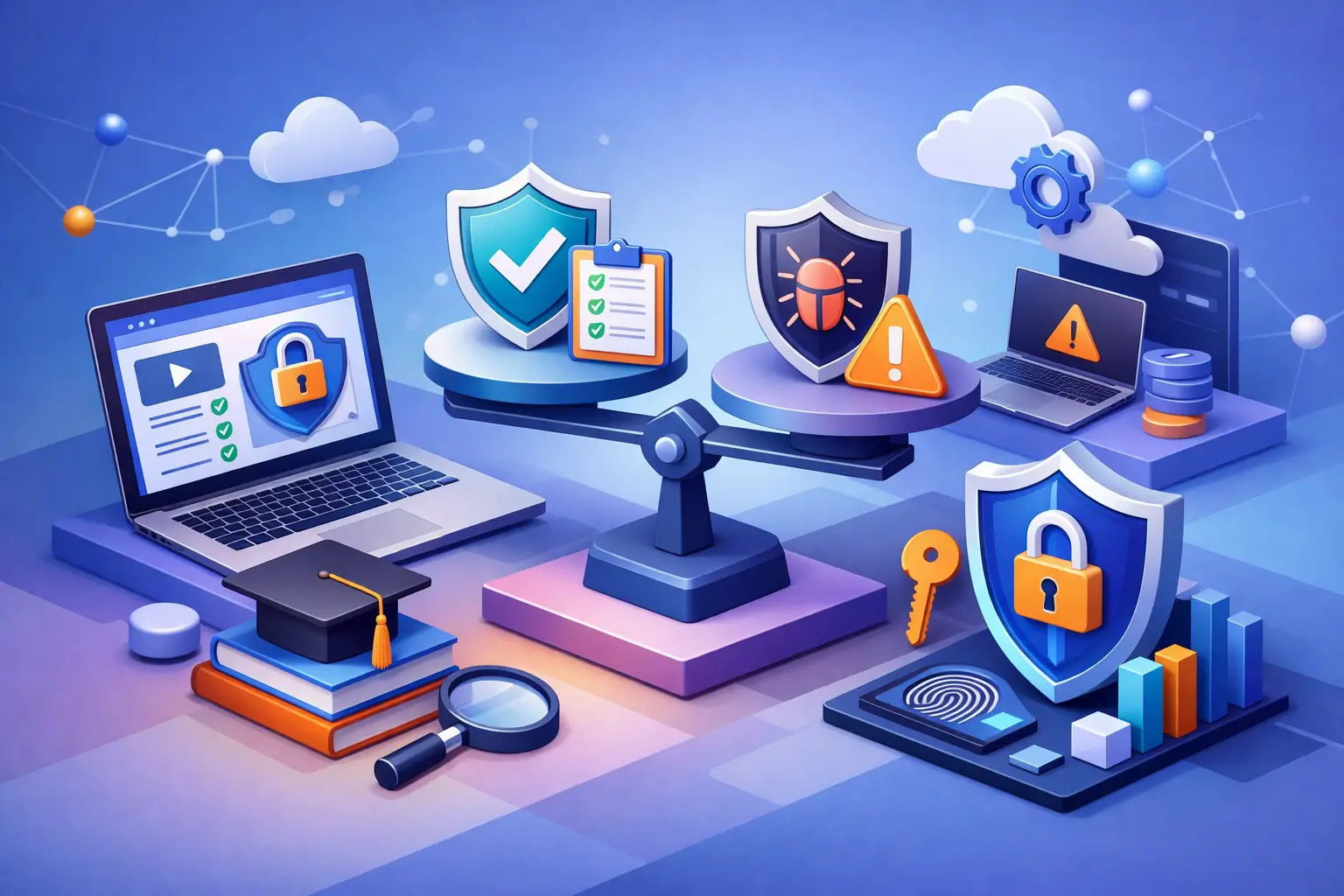
Cybersecurity LMS Comparison What Actually Matters
A cybersecurity LMS comparison should not start with course catalogs or flashy dashboards. It should start with the risks your people create, the regulations your organization must meet, and the evidence leadership will need when an auditor, customer, or insurer asks whether training is actually working. Cybersecurity starts with people - not tools. The right learning platform turns that principle into repeatable behavior across the business.
For CISOs, compliance leaders, HR teams, and L&D owners, the decision is rarely about finding an LMS that can assign a course. Most platforms can do that. The real question is whether the platform can reduce human-layer risk while giving the organization credible proof of readiness.
What a Cybersecurity LMS Must Deliver
A general-purpose learning management system can host security content, track completions, and issue certificates. That may be enough for a small organization with simple requirements. But security training has a different job from most corporate learning programs: it must change decisions made under pressure.
Employees need to recognize a phishing attempt in a crowded inbox, question an urgent payment request, report a suspicious login prompt, and handle sensitive information correctly. Executives need to understand their accountability for cyber resilience. Technical teams need training that reflects their privileged access and operational responsibilities. A cybersecurity LMS should support that range without treating every employee as the same user.
The strongest platforms connect five operational needs: relevant content, targeted delivery, engagement, measurement, and compliance evidence. If one is missing, the program can look complete on paper while leaving preventable risk in place.
Relevant content beats a large library
A library with thousands of courses is not automatically a better security program. In fact, excessive choice can create a training experience that feels generic, repetitive, and disconnected from real work.
Look for content that addresses common employee risks such as phishing, password security, social engineering, data handling, secure remote work, and incident reporting. Then assess whether the provider can support role-based learning for finance, HR, executives, IT administrators, developers, and customer-facing teams.
Localization matters just as much. A US headquarters may need one baseline program, while European operations need training tied to NIS2 expectations, local privacy practices, and regional threat patterns. Organizations operating in the GCC may require a different regulatory and cultural context. Translation alone is not localization. Employees need examples, terminology, and scenarios that make sense in their working environment.
Engagement is a security control
Mandatory annual training that employees click through at speed is a compliance artifact, not a meaningful defense. The platform should use short, practical modules, realistic decision points, quizzes, and knowledge checks that reinforce the behavior the organization expects.
This does not mean every lesson needs gamification. For some audiences, especially leaders and technical staff, clear, scenario-led instruction carries more weight than points or badges. The trade-off is audience fit. A distributed frontline workforce may respond well to mobile-friendly, short-form learning, while an executive group may need concise training tied to business impact, legal exposure, and crisis decisions.
Cybersecurity LMS Comparison: Evaluate the Evidence
When comparing platforms, avoid letting feature checklists decide the outcome. A completion dashboard may look impressive but reveal little about whether employees understood the material or can apply it. Ask each vendor how its system measures learning quality, not just participation.
A useful platform should let administrators see completion status, quiz performance, overdue learners, certification records, and reporting by department, region, and role. It should also make it easy to export evidence for internal reviews, external audits, and customer questionnaires.
More mature programs need a clearer view of where risk is concentrated. If one business unit repeatedly underperforms on phishing-related lessons, that is not simply an L&D metric. It is a risk signal that should inform follow-up education, manager accountability, and potentially more focused controls.
Do not assume that more reporting is always better. A small security team may not have time to interpret dozens of dashboards. Prioritize reports that answer direct operational questions: Who has not completed required training? Which teams are struggling? Which certifications are expiring? Can we demonstrate compliance by the requested date?
Integrations and administration affect adoption
An LMS can be excellent for learners and still fail administrators if it creates too much manual work. Confirm how users are added, removed, grouped, and assigned training. Organizations with frequent hiring, contractor access, seasonal staffing, or acquisitions need automation that keeps training assignments current.
Integration requirements depend on your environment. Some organizations need identity provider support and single sign-on. Others need HR system synchronization, API access, or exports that fit into existing compliance workflows. The goal is not to buy every integration available. It is to prevent training administration from becoming a spreadsheet-driven process with unreliable records.
Ask about reminder workflows, escalation paths, and manager visibility. Training accountability often improves when managers can see their team's status without waiting for a monthly report from security or HR.
Do Not Confuse Awareness With Resilience
Awareness training is essential, but it is only one part of cyber resilience. Employees must know what to do after they identify a threat. A training program should reinforce reporting pathways, escalation expectations, and the organization's policy for handling suspicious activity.
This is where scenario design matters. A lesson that asks, "Can you spot a phishing email?" is useful. A stronger lesson asks what the employee should do next, who should be notified, and what information should not be shared. The best programs make secure actions feel normal and achievable, rather than making employees afraid of making mistakes.
Leaders should also resist the temptation to frame training as a one-time annual event. Threats change, employees forget, and business processes evolve. A better model combines core annual requirements with shorter reinforcement throughout the year. Training can be triggered by role changes, policy updates, emerging fraud tactics, or recurring weaknesses in assessment results.
Match the Platform to Your Operating Reality
There is no universal winner in a cybersecurity LMS comparison. A 200-person professional services firm may need quick deployment, strong baseline awareness content, and audit-ready certificates. A multinational organization subject to NIS2 may need deeper regional localization, role-based assignments, and reporting across entities. A regulated enterprise may prioritize integration, custom policies, governance workflows, and detailed evidence retention.
Budget also needs context. The lowest-cost platform may meet minimum completion requirements but require more internal effort to organize content, chase learners, and prepare audit records. A more specialized provider may cost more per learner while reducing administrative overhead and improving participation. Compare total program cost, not subscription price alone.
Before signing, run a practical evaluation. Ask to see the learner experience on desktop and mobile. Review a sample compliance report. Test how an administrator assigns a program to a new department. Examine whether the content reflects the threats and regulations relevant to your organization. If the platform cannot demonstrate these basics clearly, implementation will not improve the answer.
CISO EDU is built around this operational standard: practical, localized cybersecurity education that supports workforce behavior, compliance readiness, and leadership accountability. The objective is not to create more training activity. It is to build cyber-smart teams that recognize risk, respond correctly, and help protect the business every day.
The One Question Most Organizations Never Ask
When comparing cybersecurity LMS platforms, ask yourself one simple question:
If an employee receives a highly convincing phishing email tomorrow, will your training help them make the right decision?
If the answer is unclear, you may be measuring the wrong things.
A successful cybersecurity training program is not defined by course completions, certificates issued, or participation rates. It is defined by how people behave when they are under pressure. Can employees recognize risk? Do they know what to do next? Will they report suspicious activity before it becomes an incident?
The best cybersecurity LMS platforms do more than deliver training. They build habits, reduce human risk, and create measurable resilience across the organization. When training starts influencing everyday decisions, it stops being a compliance exercise and becomes a genuine layer of business protection.
FAQ
1. What is the difference between a general LMS and a cybersecurity LMS?
A general LMS can deliver courses and track completion, but a cybersecurity LMS is specifically designed to reduce human-related cyber risk. It typically includes security-focused content, role-based learning paths, compliance reporting, phishing awareness topics, and evidence that supports audits and regulatory requirements.
2. What features should I prioritize when comparing cybersecurity LMS platforms?
Focus on content relevance, role-based training, compliance alignment, reporting capabilities, localization options, learner engagement, automation, and integrations. The best platform is not necessarily the one with the most features, but the one that helps employees make safer decisions and provides measurable proof of training effectiveness.
3. Is annual cybersecurity awareness training sufficient?
No. While annual training may satisfy minimum compliance requirements, effective security programs reinforce learning throughout the year. Short, targeted modules, policy updates, emerging threat briefings, and ongoing assessments help employees retain knowledge and adapt to new risks.
4. Why is localization important in cybersecurity training?
Employees learn more effectively when training reflects their language, regulations, culture, and day-to-day work environment. Localized content helps users relate to realistic scenarios and understand the compliance obligations that apply in their specific region.
5. How can organizations measure whether cybersecurity training is working?
Training effectiveness should be measured through more than completion rates. Organizations should evaluate assessment scores, knowledge retention, reporting behavior, certification status, department trends, and improvements in employee decision-making. The strongest programs can demonstrate both participation and measurable risk reduction over time.

Written By
Yavor Y. Zlatev
CEO & Executive Director at Advanced Vision IT
Yavor leads strategic growth and technology operations at Advanced Vision IT, specializing in enterprise cybersecurity, cloud infrastructure, NIS2 compliance, and managed security service delivery. Find out more about me