


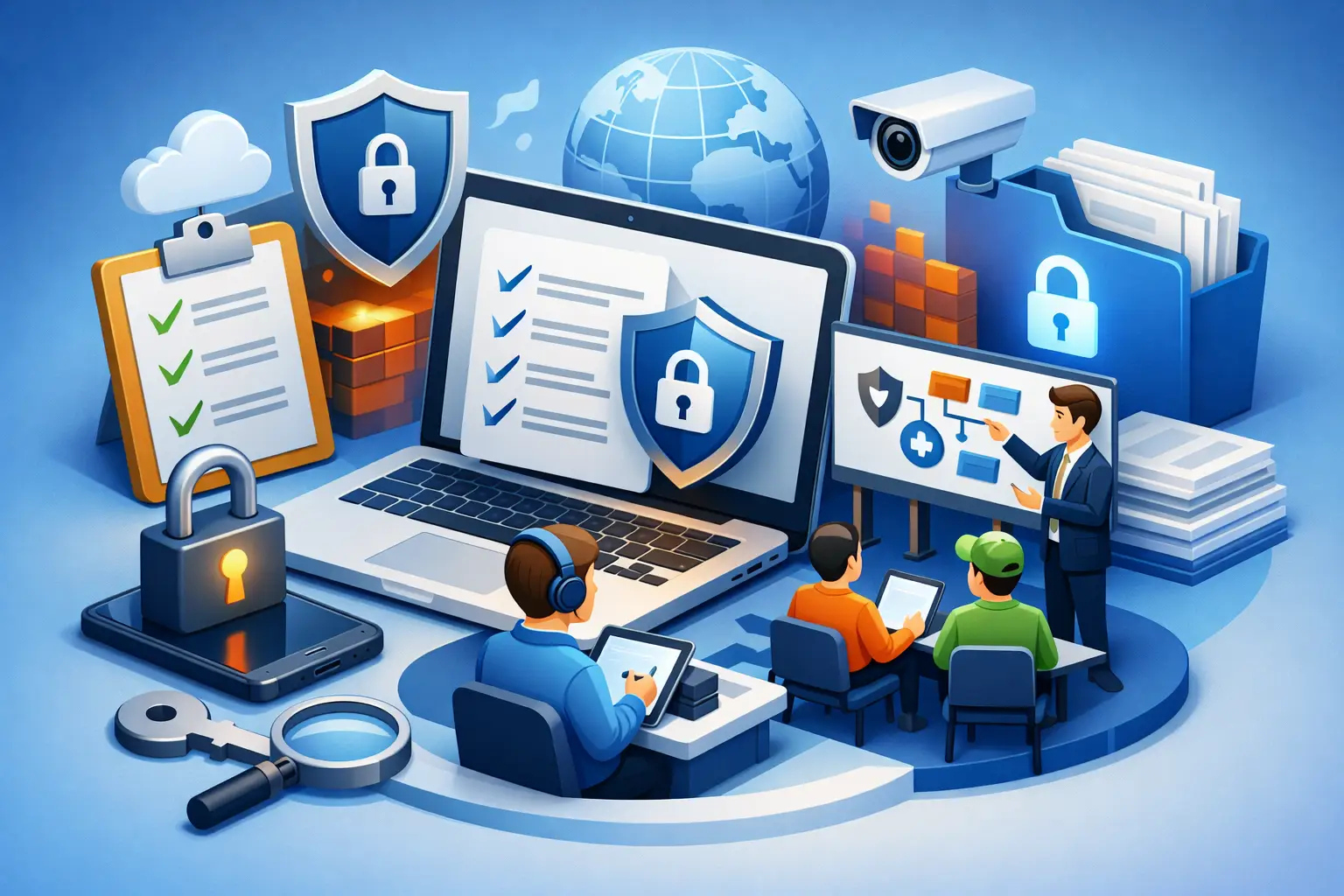
Cybersecurity Policy Training Template That Works
A policy sitting in a shared drive does not reduce risk. Employee behavior does. That is why a strong cybersecurity policy training template matters - it turns written expectations into repeatable actions people can follow under pressure, not just rules they acknowledge once a year.
For security leaders, HR teams, and compliance owners, the gap is rarely policy creation. The gap is translation. Your acceptable use policy may be sound. Your password rules may align with standards. Your incident reporting process may be documented. But if employees do not understand what those policies mean in their daily work, your organization is carrying compliance paperwork, not real protection.
What a cybersecurity policy training template should actually do
A useful cybersecurity policy training template is not a slide deck outline with a few legal reminders. It is a framework for converting policy language into training that employees can understand, remember, and apply. The best templates connect each policy area to a specific behavior, a realistic scenario, and a measurable outcome.
That distinction matters. Many organizations treat policy training as a disclosure exercise. Employees review a document, click acknowledge, and move on. That may satisfy a narrow administrative checkbox, but it does little to reduce phishing susceptibility, improve reporting speed, or prevent risky workarounds.
A stronger approach starts with a simple question: what should this group do differently after the training? If the answer is vague, the training will be vague too. If the answer is specific, such as report suspicious emails within five minutes, avoid uploading business data to unapproved AI tools, or use MFA without exception, then the template can drive meaningful content design.
The core sections of a cybersecurity policy training template
The structure should be consistent enough to scale and flexible enough to reflect role, geography, and regulation. Most organizations do not need more policy content. They need cleaner mapping between policy, audience, and action.
1. Policy scope and business purpose
Start with the policy name, owner, version, and the business reason it exists. Do not open with legal jargon. Explain the operational risk the policy addresses. Employees are more likely to comply when they understand the threat, the business impact, and what is expected of them.
For example, a data handling policy exists to prevent unauthorized disclosure, customer harm, regulatory exposure, and costly recovery work. Framing the policy in business terms creates context that sticks.
2. Audience segmentation
Not everyone needs the same level of detail. A generic companywide lesson often leaves frontline employees confused and privileged users undertrained. Your template should identify who needs the training and what changes by role.
That may include all staff, managers, developers, finance teams, customer support, executives, contractors, and third-party users. It may also vary by region if your organization operates across the US, Europe, or the GCC and must reflect local obligations.
3. Required behaviors
This is the most important section. Convert policy statements into direct actions. If your policy says users must protect sensitive information, spell out what that means. Employees need practical instruction such as classify files correctly, store data only in approved systems, confirm recipients before sending, and escalate suspected exposure immediately.
A policy written for legal clarity is not automatically written for learning clarity. The template should bridge that gap.
4. Real-world scenarios
Scenarios make policy operational. Include short examples that reflect actual work conditions, not abstract security theater. Show what a phishing email looks like in finance. Show how a sales employee should handle customer data on a mobile device. Show when a manager must escalate a suspected insider threat concern instead of trying to handle it quietly.
This is where training becomes credible. Employees recognize their own workflows, and leaders get stronger evidence that the program is designed for behavior change rather than annual completion rates.
5. Decision rules and reporting paths
People often fail policy requirements because they are unsure when to act or where to report. A template should clearly define triggers, escalation channels, and response expectations. If a suspicious link is clicked, what happens next? If data is sent to the wrong recipient, who must be informed? If an employee sees shadow IT, what is the approved path for reporting it?
Clarity reduces hesitation. Hesitation expands incidents.
6. Knowledge checks and proof of understanding
Training should validate comprehension, not just exposure. Include short quizzes, branching questions, or scenario-based checks that test whether employees can apply the policy correctly. If your workforce passes every question without effort, the assessment may be too easy to be meaningful.
For regulated organizations, proof matters. Completions, scores, timestamps, and certifications create a stronger compliance record and support audits, internal reviews, and board-level reporting.
How to build a training template that people will actually use
The most effective template is not the most detailed one. It is the one your organization can use consistently across multiple policy areas without creating unnecessary friction.
Start with your highest-risk policies. That usually includes acceptable use, phishing and email security, password and authentication rules, data classification and handling, remote work, incident reporting, and mobile device use. If your environment includes OT, privileged access, or heavy vendor dependence, those may need dedicated treatment too.
Then standardize the learning flow. A strong sequence is simple: why this policy exists, what employees must do, what good and bad behavior look like, how to report issues, and how understanding will be measured. This structure works because it respects how adults learn under operational constraints. People need relevance before retention.
Keep modules short enough to complete without disrupting work, but not so compressed that nuance disappears. Ten to fifteen minutes is often enough for a focused policy topic. Some issues, such as secure software development or regulated data handling, may require deeper role-based sessions. It depends on the risk, the audience, and the regulatory consequences of failure.
Common mistakes that weaken policy training
One of the biggest failures is using policy text as training content with minimal adaptation. Written policy is designed for governance. Training is designed for understanding and action. Those are related, but they are not interchangeable.
Another common mistake is treating all employees the same. A board member, a help desk technician, and a warehouse employee face different cyber risks. If the content ignores context, attention drops and retention follows.
Timing is another issue. Annual training alone is rarely enough for meaningful resilience. High-risk behaviors need reinforcement throughout the year, especially when threats shift quickly or policies change because of new tools, acquisitions, or regulations.
Metrics can also mislead. Completion rates are useful, but they are not the finish line. Stronger signals include phishing report rates, incident escalation speed, repeat failure patterns, policy exception trends, and quiz results by role or business unit. If the only metric improving is completion, your program may be efficient without being effective.
Where compliance fits into the template
Compliance should shape the template, not dominate it. Regulations and frameworks matter because they create obligations, but employees do not change behavior because a control exists in a framework. They change when expectations are clear, training feels relevant, and accountability is real.
That said, your cybersecurity policy training template should support evidence collection. If you operate in sectors touched by NIS2, state privacy requirements, customer security reviews, or contractual audit demands, your training records need to show more than attendance. They should show scope, audience, frequency, and validation.
This is where a mature training platform adds real value. Organizations working with CISO EDU, for example, often need localized, regulation-aware programs that scale across different teams without losing business relevance. The principle is simple: align to compliance, but train for behavior.
A practical way to evaluate your current template
Ask four questions. Can employees explain the policy in plain language? Can they identify the right action in a realistic scenario? Do managers know what to reinforce? Can you prove completion and understanding to an auditor or executive stakeholder?
If the answer to any of those is no, the template needs work.
The good news is that improvement does not require rewriting every policy from scratch. In many cases, it means restructuring how the content is taught. Strip out unnecessary language. Add real examples. Segment the audience. Make reporting paths obvious. Test for application, not memorization.
Cybersecurity starts with people, not tools. A well-built cybersecurity policy training template gives your policies a job to do inside the business. It helps employees act faster, leaders measure what matters, and compliance teams show evidence that stands up under scrutiny. Build it around behavior, and your policies stop being static documents. They become part of how your organization operates when risk is real.
ADVANCED VISION IT - MALTA Address: Suite 8, Ta’ Mallia Buildings, Triq In‑Negozju, Zone 3, Central Business District, Birkirkara, CBD 3010, Malta
Registration number: C111282, VAT Number: MT31713827
Phone:+35679224404
Email: office@advisionit.com
ADVANCED VISION IT - BULGARIA
Address: 35 Dimitar Hadzhikotsev str. Ent A, Lozenets, Sofia, Bulgaria
ID No: 205789039, VAT No: BG205789039
Phone: +359 888 258 530
Email: office@advisionit.com