


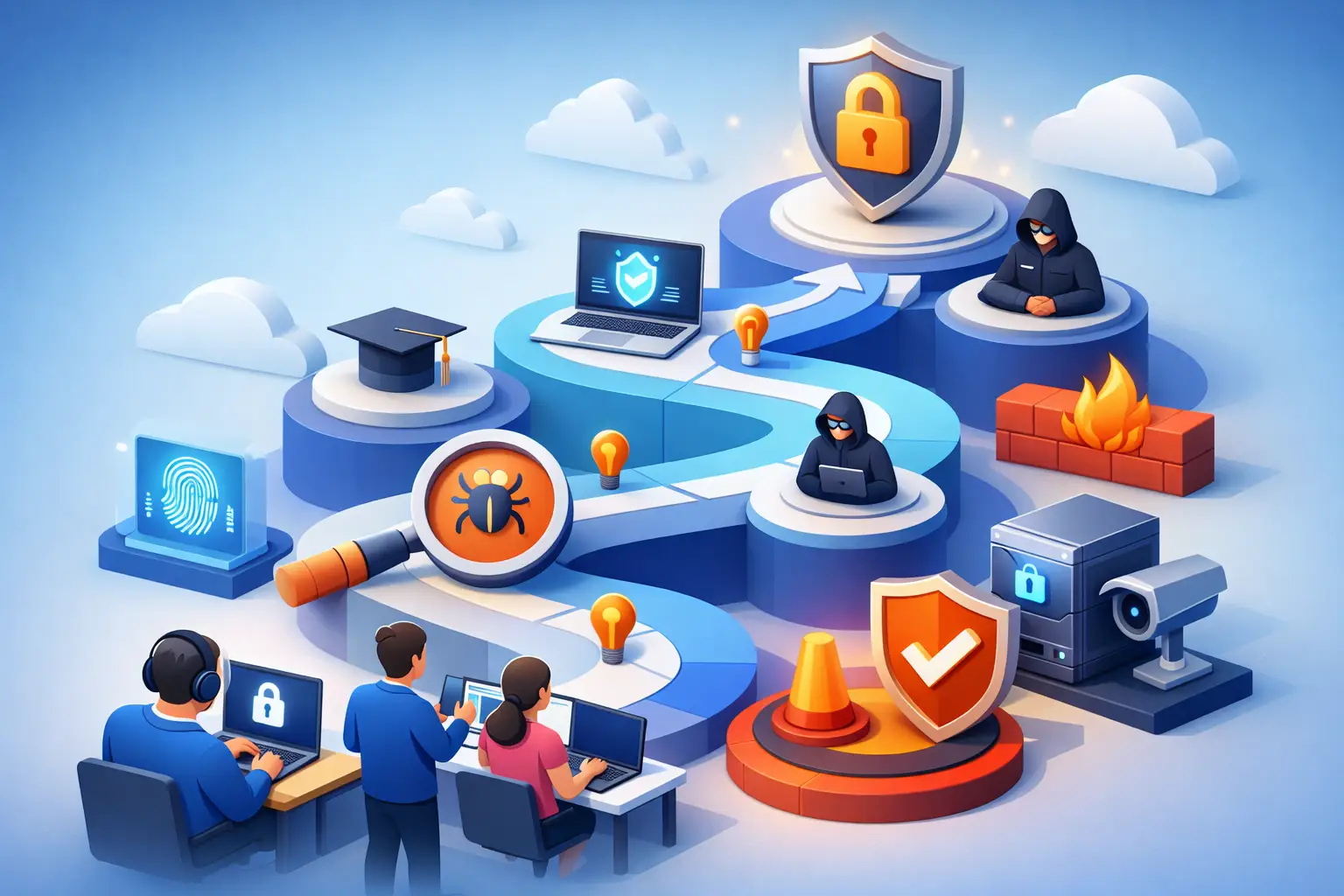
Design Cyber Training Roadmap That Reduces Risk
A mandate to “design cyber training roadmap” can look like an L&D assignment. It is not. It is a risk-management decision that determines whether employees recognize a credential-harvesting email, report a suspicious payment request, protect sensitive data, and respond correctly during a real incident. A library of generic annual courses will not deliver that outcome. Your roadmap must connect business risk, employee behavior, regulatory duties, and measurable improvement.
Cybersecurity starts with people - not tools. The right roadmap turns every employee into an active line of defense while giving leadership evidence that training is reducing exposure rather than simply generating completion records.
Start With the Risks That Matter to Your Business
Do not begin by selecting courses. Begin with the scenarios that could interrupt operations, trigger reporting duties, create financial loss, or damage customer trust. Review recent phishing reports, help desk patterns, audit findings, incident postmortems, vendor risk assessments, and compliance obligations. These sources show where knowledge is missing and where behavior is failing.
A financial services team may need greater emphasis on payment fraud, account takeover, and secure handling of customer data. A manufacturer may prioritize operational technology access, third-party connections, and ransomware response. A business affected by NIS2 needs training that supports risk management, incident awareness, governance, and role-specific accountability. The topic list should follow the risk profile, not a standard course catalog.
This is also where leaders should distinguish between likely events and high-impact events. Phishing may be frequent and easy to measure. A privileged-account compromise may be less frequent but far more damaging. Both belong in the roadmap, but they need different audiences, learning depth, and testing methods.
Define the Outcomes Before Building Content
Training objectives should describe observable behavior, not broad intentions such as “raise awareness.” For example, a frontline employee should be able to identify and report a suspicious message using the company’s defined channel. A finance approver should independently verify changed banking details. A manager should know how to escalate a suspected breach without delaying the response team.
Clear outcomes make content decisions easier. If learners need to report phishing within minutes, an interactive scenario and a short reporting drill are more useful than a 45-minute presentation on email threats. If executives must oversee cyber risk, they need concise, decision-focused education on accountability, material risk, resilience, and incident governance. They do not need the same lesson as new hires.
Set objectives at three levels: what people need to know, what they need to do, and what the organization needs to prove. That final level matters in regulated environments. Completion, assessment scores, certification status, and evidence of recurring training may all support audit readiness. Evidence alone, however, is not proof of resilience. Pair it with behavioral measures.
Segment Training by Role, Access, and Region
One-size-fits-all awareness training creates two problems. It wastes time for employees who receive irrelevant material, and it leaves high-risk groups underprepared. A strong cyber training roadmap uses a common foundation, then adds focused paths based on responsibility and exposure.
Every employee should understand core practices such as phishing recognition, password and authentication hygiene, data handling, device security, remote-work risks, and incident reporting. From there, create role-based modules for groups with distinct risk profiles. Finance teams need business email compromise and invoice fraud training. HR teams need to protect sensitive personnel records. Developers need secure coding and secrets management practices. IT administrators need privileged access, patching, logging, and escalation discipline.
Executives and board members require their own track. Their responsibility is not to configure controls. It is to make informed decisions about investment, risk acceptance, supplier exposure, reporting obligations, and crisis leadership. Training for this group should be brief, relevant, and tied to business scenarios.
Localization is not just translation. A workforce operating across the United States, Europe, and the GCC may face different regulations, reporting expectations, cultural norms, and examples of fraud. Use locally meaningful scenarios and align content with applicable requirements. This improves comprehension and shows employees that security guidance applies to their real work.
Build the Roadmap in Layers, Not One Annual Event
Annual training has a place, especially when compliance requires it. But a single yearly course cannot prepare people for threats that evolve weekly. Build a cadence that combines onboarding, recurring reinforcement, targeted campaigns, and event-driven training.
New hires should receive foundational training early, before they gain access to critical systems or sensitive data. Core awareness can then be refreshed through short, spaced modules across the year. These sessions should focus on a small number of decisions employees are likely to face, using realistic examples and interactive questions.
Targeted campaigns should follow the threat landscape and internal signals. If the organization sees an increase in QR-code phishing, train employees on that tactic immediately. If a merger brings new systems and data-sharing workflows, deliver training before those workflows become routine. After a simulated phishing exercise or a real incident, reinforce the specific behavior that would reduce recurrence.
A practical annual rhythm may include a baseline assessment, mandatory core training, quarterly microlearning, periodic phishing simulations, role-based modules, and an executive session. The precise schedule depends on your risk level, regulatory environment, workforce size, and operational capacity. High-risk teams may need monthly reinforcement, while lower-risk groups can benefit from shorter quarterly touchpoints.
Make Learning Interactive Enough to Change Decisions
Employees rarely make poor security choices because they have never heard the rule. They make them when they are rushed, distracted, uncertain, or pressured by someone who appears legitimate. Training must prepare them for that moment.
Use scenario-based lessons that mirror real decisions: a CEO requests an urgent wire transfer, a supplier changes payment details, an employee receives a file-sharing invitation, or a coworker asks for access to confidential data. Ask learners to choose an action, explain the consequence, and show the correct reporting path. Quizzes should test judgment, not memory of policy language.
Keep the experience practical. Long modules can be appropriate for specialized subjects, but most general awareness content works better in focused sessions that respect employee time. Accessibility, mobile compatibility, and clear language matter because training that cannot be completed easily will not reach the people who need it.
Measure Behavior, Not Just Completion
A completion rate is an administrative metric. It tells you who opened a course, not whether the organization is safer. To measure impact, establish a baseline and track indicators that reflect real behavior over time.
Useful measures include reporting rates for simulated phishing, repeat click rates, assessment performance by role, time to report suspicious activity, policy exceptions, help desk trends, and recurring audit findings. Review the data by department, location, seniority, and risk group. A company-wide average can hide a high-risk team that needs immediate attention.
Use measurement carefully. Phishing simulations should educate, not shame. If employees fear blame, they may stop reporting suspicious activity. The better signal is a culture where people report quickly, ask questions when uncertain, and understand that early reporting protects the business.
Govern the Program Like a Security Control
A cyber training roadmap needs an owner, decision rights, and regular review. Security should define risk priorities and threat intelligence. Compliance should map regulatory requirements. HR and L&D should coordinate enrollment, accessibility, and learner experience. Business leaders should reinforce participation and address gaps within their teams.
Document the program scope, target audiences, required modules, completion deadlines, escalation process, evidence retention, and review cycle. This creates operational clarity and makes it easier to demonstrate due diligence during an audit or customer review. It also prevents training from becoming a project that disappears after launch.
Review the roadmap at least annually and after meaningful changes: a new regulation, a major incident, an acquisition, a shift to new technology, or a pattern of employee errors. Threats change. Business processes change. Training must change with them.
The best roadmap does not ask employees to become cybersecurity experts. It gives each person the confidence to make the next safe decision, recognize when something is wrong, and act before a small mistake becomes a business incident. That is how training earns its place in your security program.
FAQ
1. What is a cyber training roadmap?
A cyber training roadmap is a structured plan that aligns cybersecurity education with business risks, employee responsibilities, compliance requirements, and security objectives. It helps organizations develop workforce behaviors that reduce security incidents, improve resilience, and strengthen overall risk management.
2. How do you create an effective cybersecurity training roadmap?
An effective cybersecurity training roadmap starts with identifying the organization's key risks, defining measurable learning outcomes, segmenting training by role, implementing continuous learning activities, and tracking performance through behavioral and risk-based metrics instead of completion rates alone.
3. Why is role-based cybersecurity training important?
Role-based training ensures employees receive education relevant to their responsibilities and risk exposure. For example, finance teams focus on fraud prevention, IT teams on secure administration and incident response, HR teams on protecting employee data, and executives on governance and risk oversight.
4. How often should cybersecurity training be delivered?
Cybersecurity training should be an ongoing process that includes onboarding training, annual awareness programs, quarterly microlearning sessions, phishing simulations, role-specific modules, and targeted training following incidents, regulatory changes, or emerging threats.
5. What metrics should organizations use to measure training effectiveness?
Organizations should measure reporting rates for phishing emails, phishing simulation results, assessment scores, time to report suspicious activity, policy violations, audit findings, help desk trends, and overall improvements in employee security behavior.

Written By
Yavor Y. Zlatev
CEO & Executive Director at Advanced Vision IT
Yavor leads strategic growth and technology operations at Advanced Vision IT, specializing in enterprise cybersecurity, cloud infrastructure, NIS2 compliance, and managed security service delivery. Find out more about me