


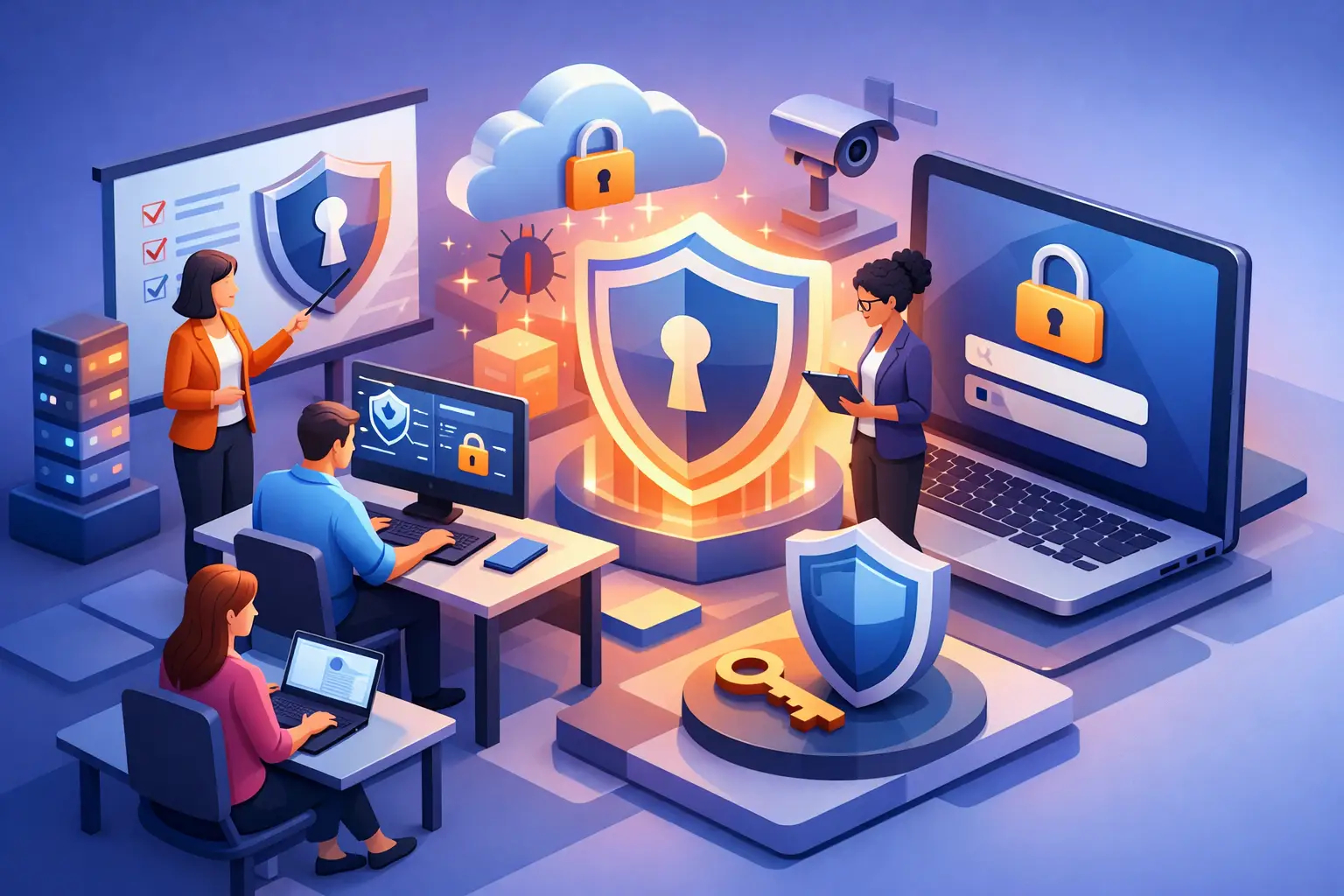
Employee Cybersecurity Awareness Program Guide
One click on a fake invoice can do more damage than a missing firewall rule. That is why an employee cybersecurity awareness program guide matters to security leaders, compliance owners, HR teams, and executives alike. If your workforce is exposed to phishing, credential theft, data mishandling, and social engineering every day, awareness cannot be treated as a once-a-year checkbox. It has to function as an operational control.
What an employee cybersecurity awareness program guide should actually solve
Most organizations do not struggle because they lack training content. They struggle because their program is disconnected from business risk. Employees sit through generic modules, pass an easy quiz, and return to the same unsafe habits. Leadership gets a completion report, but not meaningful risk reduction.
A strong program should solve three problems at once. It should reduce preventable incidents caused by human error, support compliance and audit requirements, and build a security culture that employees can act on under pressure. If one of those three is missing, the program will feel either performative, overly legalistic, or too abstract to change behavior.
That is the first design principle: awareness training is not an HR exercise with a security label. It is part of your defense strategy.
Start with risk, not content
Before choosing modules, simulations, or certifications, define what employee behavior is putting the business at risk. For one company, the biggest issue may be business email compromise targeting finance. For another, it may be poor handling of sensitive customer data, weak password practices, or remote workers using unmanaged devices.
This risk-first approach changes the entire program. It shapes what employees need to learn, how often they need reinforcement, and which teams require deeper instruction. It also helps you avoid a common mistake: rolling out the same awareness training to every employee, regardless of role, access, or threat exposure.
A practical baseline usually includes phishing awareness, password and authentication hygiene, safe data handling, device security, reporting procedures, and basic social engineering defense. But that baseline is only the start. Finance teams need stronger fraud awareness. Executives need targeted training on spear phishing, impersonation, and sensitive communications. Developers may need secure coding awareness tied to their daily work. Customer support teams often need guidance on identity verification and manipulation tactics.
When you map training to risk, the program starts making sense to employees because it reflects how they actually work.
The core elements of an effective employee cybersecurity awareness program guide
An effective program has structure. It is not a pile of videos or a monthly phishing test with no larger plan.
The first element is role-based learning. Generic awareness has value, but it does not go far enough for organizations with regulated environments, distributed teams, or elevated risk profiles. Role-based learning lets you align training to job function, access level, region, and regulatory exposure.
The second element is frequency. Annual training alone is too weak for modern threat patterns. Threats change quickly, and employees forget quickly. Short, recurring lessons outperform one long compliance session because they reinforce behavior over time.
The third element is realism. If the content does not resemble real attacks, employees will not connect it to their inbox, phone, chat app, or daily workflow. Interactive modules, scenario-based exercises, and phishing simulations make the material practical rather than theoretical.
The fourth element is measurement. Completion rates matter, but they are not enough. A mature program tracks phishing susceptibility, reporting rates, repeat failures, manager-level engagement, and improvement over time. Security awareness should produce evidence, not assumptions.
The fifth element is executive support. If leadership treats awareness as mandatory admin work, employees will do the same. If leadership frames it as part of business resilience, customer trust, and operational discipline, adoption improves. That message matters more than many teams realize.
Build for compliance without reducing training to compliance
Many buyers start this process because of an audit, a customer requirement, cyber insurance pressure, or regulatory obligations. That is valid. In sectors affected by NIS2, sector-specific privacy rules, or contractual security controls, workforce education is not optional.
Still, there is a trade-off. If you build the program only to satisfy auditors, employees will sense it immediately. Training becomes passive. Retention drops. Risk remains.
The better path is to design a program that is compliance-aligned but behavior-focused. That means documenting training completion, keeping records for audits, and aligning content to policy requirements, while also making sure the material teaches employees what to do when something suspicious happens. Compliance wants evidence. Security needs action. A good program delivers both.
For multinational organizations, localization is also a serious factor. Regulatory expectations, phishing styles, language nuance, and reporting procedures differ by region. A one-size-fits-all awareness program may meet a minimum standard, but it often misses the context that drives behavior. Regionalized training is more credible and more effective.
How to launch without losing momentum
The fastest way to weaken a security awareness initiative is to make launch feel like a side project. Employees should understand why the program exists, what is expected of them, and how it connects to the business.
Start with a clear internal message from leadership. It should be direct: cybersecurity starts with people, not tools. Explain that the goal is not to catch employees making mistakes. The goal is to help them recognize threats earlier, report them faster, and protect the company, customers, and themselves.
Then keep the program manageable. A long rollout with heavy content often leads to low engagement and weak retention. Short modules, practical examples, and a predictable cadence work better. Pair formal learning with periodic phishing simulations and targeted refreshers based on current threats.
Managers also need a role. Employees take cues from their immediate leaders, not just from security. If department heads reinforce reporting behavior and complete training on time, adoption improves. If they ignore it, the program becomes another policy nobody takes seriously.
Metrics that prove the program is working
If you cannot show movement in behavior, budget conversations become harder. Security leaders need metrics that translate training into business value.
Start with foundational data such as completion rates, overdue assignments, and quiz performance. Then move to operational indicators. Track who clicks on phishing simulations, who reports them, how quickly reports come in, and whether repeat offenders improve after targeted coaching. Measure reporting volume for suspicious emails or messages after awareness campaigns. In some environments, you can also connect training trends to incident trends, especially in areas like credential theft, accidental data exposure, or payment fraud attempts.
Be careful with one metric in isolation. A lower click rate is good, but it is not the whole story. Some organizations see improved skepticism but poor reporting habits. Others see good completion rates but no meaningful change in risky behavior. The point is to measure awareness as a pattern of behavior, not a single score.
For leadership, frame results in terms they care about: reduced human-driven risk, stronger audit readiness, faster incident reporting, and more consistent policy adherence.
Common mistakes that weaken the program
The most common mistake is treating awareness as a yearly event. The second is using generic content that ignores role, geography, and threat profile. The third is assuming employees who fail a simulation are the problem, when the real issue is often weak reinforcement, poor communication, or unrealistic expectations.
Another mistake is making training punitive. Employees should feel responsible, not afraid. If they believe reporting a suspicious message will lead to blame, they will stay quiet. That silence is expensive.
It is also a mistake to separate awareness from broader security operations. Reporting workflows, escalation paths, acceptable use policies, and incident response plans should all connect back to what employees are taught. If the training says “report suspicious emails immediately” but the reporting process is unclear or slow, behavior will break down.
Choosing the right delivery model
Some organizations can manage awareness internally. Others need a structured platform that supports interactive training, automated assignments, localization, certifications, and measurable reporting. The right choice depends on team capacity, regulatory complexity, and how mature your security program already is.
If you operate across regions or need role-based compliance alignment at scale, manual delivery becomes difficult fast. In those cases, a dedicated training partner can reduce operational overhead while improving consistency. For organizations balancing workforce readiness with executive education and compliance pressure, that integrated model is often where the real value appears.
CISO EDU reflects that approach by connecting practical employee training with compliance relevance and leadership-level cybersecurity education. That matters because awareness works best when the workforce, managers, and decision-makers are not learning in isolation.
A strong employee cybersecurity awareness program guide is not about teaching people to fear technology. It is about teaching them how to recognize risk, respond with confidence, and support the business every day they log in.
FAQ
1. What is an employee cybersecurity awareness program?
An employee cybersecurity awareness program is a structured initiative designed to help employees recognize, prevent, and report cybersecurity threats such as phishing, social engineering, malware, credential theft, and data breaches. Its goal is to reduce human-related security risks and strengthen the organization's overall security posture.
2. Why is cybersecurity awareness training important for employees?
Cybersecurity awareness training helps employees identify common threats, follow security best practices, and respond appropriately to suspicious activities. Since human error remains one of the leading causes of security incidents, well-trained employees serve as an important layer of defense.
3. How often should employees receive cybersecurity awareness training?
Cybersecurity awareness should be an ongoing process rather than a once-a-year event. Organizations typically achieve better results through regular training sessions, periodic refreshers, phishing simulations, and timely updates that reflect emerging threats and changing business risks.
4. What topics should be included in a cybersecurity awareness program?
A comprehensive program should cover phishing awareness, password security, multi-factor authentication, safe data handling, device security, social engineering, remote work security, incident reporting procedures, and organizational security policies. Additional role-specific training may be required for high-risk departments.
5. How can organizations measure the effectiveness of a cybersecurity awareness program?
Organizations can evaluate effectiveness by tracking training completion rates, phishing simulation results, incident reporting rates, employee engagement, policy adherence, and reductions in security incidents caused by human error. The most successful programs focus on measurable behavioral improvements rather than training completion alone.

Written by: Ivan Energiev

IT Project Coordinator · Operations Excellence & Service Delivery Leader at Advanced Vision IT Ltd | Published on September 03 2026
Ivan advises insights on IT project coordination, operations excellence, and service delivery leadership.