


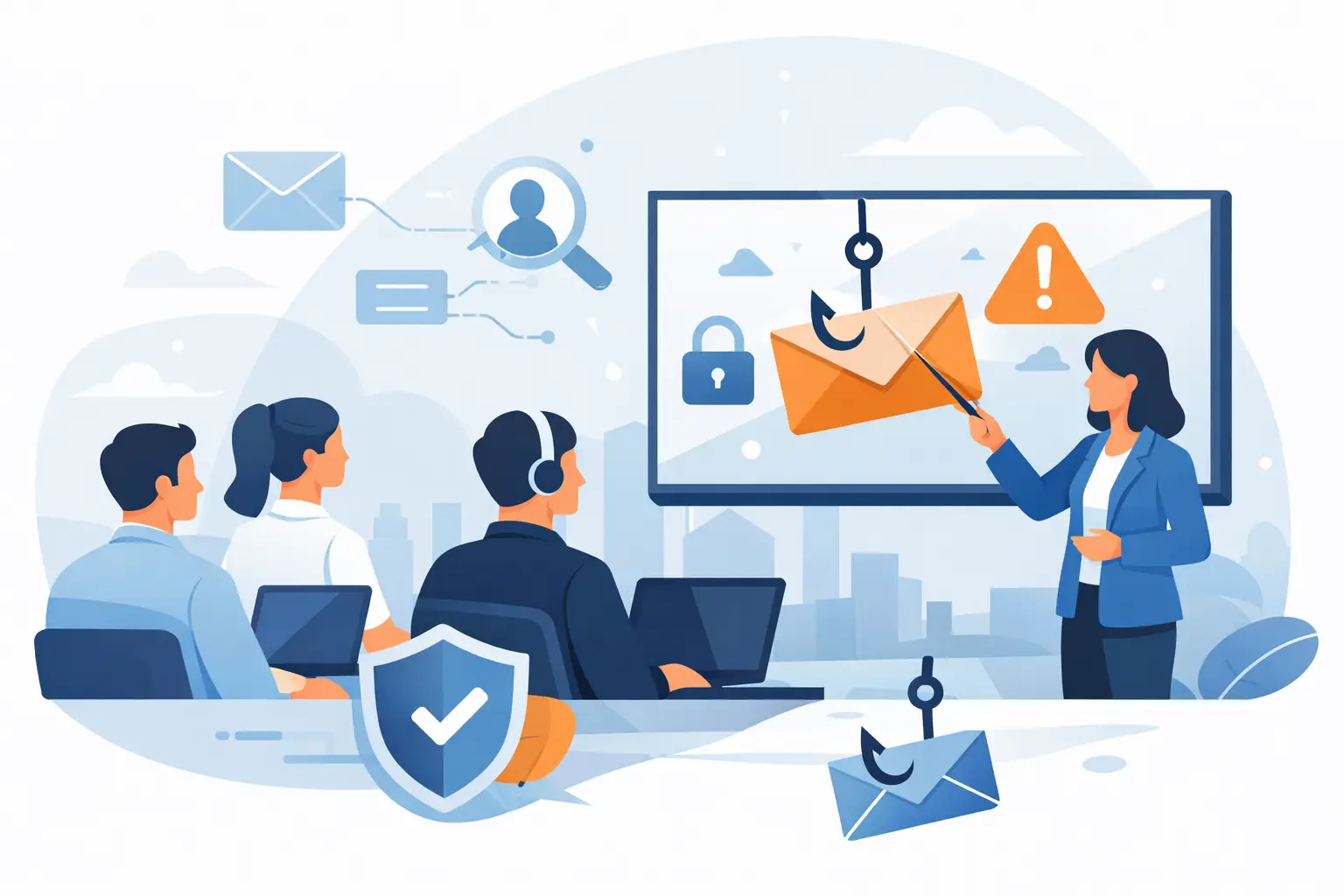
Employee Phishing Awareness Training That Works
One successful phishing email can bypass expensive security controls in minutes. That is why employee phishing awareness training is not a nice-to-have for modern organizations - it is a core risk reduction function. When employees know how phishing actually looks, how attackers create urgency, and how to report suspicious messages fast, the business becomes harder to exploit.
For security leaders, compliance teams, HR, and executives, the real question is not whether to train. It is whether the training changes behavior under pressure. Too many programs check the compliance box, deliver a generic annual module, and move on. That approach may satisfy documentation requirements in the short term, but it rarely improves resilience when a real phishing campaign hits.
What employee phishing awareness training should accomplish
Good employee phishing awareness training does more than teach people to avoid clicking bad links. It builds a repeatable response pattern. Employees should know how to pause, inspect, verify, and report. That sounds simple, but it requires more than a slideshow and a quiz.
The best programs are designed around business outcomes. First, they reduce the chance of credential theft, malware delivery, wire fraud, and data exposure. Second, they improve reporting speed, which gives security teams earlier visibility into active attacks. Third, they support compliance expectations in industries and regions where workforce training is part of cyber resilience obligations.
Training also needs to reflect the reality that phishing is no longer limited to poorly written emails. Attackers now use brand impersonation, QR codes, cloud file-sharing notifications, internal spoofing, text messages, and voice pretexts. If your training still focuses on obvious spelling mistakes, your workforce is being prepared for yesterday's threat model.
Why most phishing training underperforms
The biggest failure is treating all employees the same. A finance manager approving invoices faces different phishing risks than a developer with privileged access or an executive assistant handling calendar requests and sensitive documents. Generic content may raise awareness, but it rarely addresses the decisions employees actually make in their roles.
Another common issue is cadence. Annual training creates a short-term memory event, not a durable habit. Phishing works because it catches people when they are busy, distracted, or pressured. Awareness has to be reinforced over time with practical exercises, short refreshers, and simulation-based learning tied to current attack methods.
There is also a measurement problem. Many organizations track completion rates because they are easy to report. Completion matters, but it does not prove reduced risk. If employees finish the course and still enter credentials into a fake Microsoft 365 page, the program is not working where it counts.
How to design employee phishing awareness training for real risk reduction
Start with role context. Training should show employees the types of phishing attempts they are most likely to encounter based on their job function, access level, and decision authority. Finance teams should see invoice fraud and payment diversion scenarios. HR teams should face fake resumes, benefits updates, and payroll requests. Executives and their support staff need exposure to impersonation, travel disruption scams, and urgent approval requests.
Next, keep the content practical. Employees do not need a technical lecture on threat actor infrastructure. They need to recognize signals they can act on. That includes mismatched sender domains, unexpected file-sharing invitations, login prompts that break normal workflows, requests to bypass process, and emotional manipulation such as fear, urgency, authority, or curiosity.
Simulation matters, but the quality of the simulation matters more. If every phishing test is obvious, employees learn to spot the training email, not the real threat. If every simulation is designed to trick people without teaching them anything, trust drops and reporting suffers. The right balance is realistic, fair, and followed by immediate coaching.
Microlearning is especially effective here. Short, targeted modules are easier to retain than long annual sessions. A three-minute lesson on QR phishing before a company event may have more value than a broad one-hour module employees barely remember a month later.
What to measure beyond completion rates
If you want executive support, show progress in business terms. Report rates are a strong signal. When employees report suspicious messages quickly and in larger numbers, your detection window improves. That can reduce dwell time, limit lateral movement, and help security teams respond before damage spreads.
Failure rates in phishing simulations are useful too, but only when interpreted correctly. A higher click rate in one department does not automatically mean the people are careless. It may reveal process pressure, poor tooling, or a high-risk workflow that needs extra controls. Metrics should guide intervention, not blame.
Time to report, repeat failure patterns, credential submission rates, and manager-level participation all provide better insight than course completion alone. For regulated environments, documented training frequency, role mapping, and assessment records also support audit readiness.
The compliance angle is real, but it is not the whole story
Many organizations first invest in training because of regulatory pressure. That is reasonable. Workforce awareness is increasingly tied to broader governance and resilience expectations, especially in sectors facing stricter cyber oversight. But compliance-led training has a ceiling if the only goal is passing an audit.
The stronger model is compliance plus operational readiness. In that model, training content aligns with policy, legal requirements, and reporting obligations, while still preparing employees for real-world decisions. This is where localized and regulation-aware programs matter. A multinational organization may need consistent global standards while still addressing regional threats, local language needs, and specific frameworks that affect business units in Europe, the GCC, or the US market.
That trade-off deserves attention. Standardization makes reporting easier and simplifies administration. Localization improves relevance and engagement. Most large organizations need both.
Building a culture where reporting is normal
Phishing awareness fails when employees are afraid of being wrong. If reporting a suspicious email feels risky, people stay silent. That silence helps attackers.
Security leaders should make one message clear: reporting is a positive action, even when the email turns out to be harmless. Employees should not need perfect certainty before escalating. They need a simple process, visible support from management, and fast feedback when they do the right thing.
This is where training and internal communications should work together. Awareness modules teach recognition. Managers reinforce expectations. Security teams close the loop by acknowledging reports and sharing lessons from real incidents or near misses. Over time, employees stop seeing phishing as an abstract IT issue and start recognizing it as part of their job responsibility.
Executive buy-in changes the quality of the program
If leadership treats phishing training as mandatory admin work, the workforce will do the same. If leadership frames it as a business protection measure tied to fraud prevention, uptime, customer trust, and regulatory exposure, participation changes.
Executives do not need to become phishing experts. They do need to sponsor the program, complete the training themselves, and support the policies behind it. The same applies to business unit leaders. Employees notice very quickly whether security expectations are universal or optional.
For organizations looking to scale, this is where a structured platform approach helps. Providers such as CISO EDU focus on turning awareness into measurable readiness through interactive lessons, quizzes, certifications, and role-based learning that align with compliance and operational risk goals.
Employee phishing awareness training is a program, not a campaign
A single annual course will not keep pace with a threat that changes every quarter. Effective employee phishing awareness training is continuous. It evolves with attacker tactics, business processes, regulatory demands, and workforce behavior.
That means reviewing simulation outcomes, updating examples, segmenting audiences, and coordinating with HR, compliance, and technical security teams. It also means accepting that no program eliminates all mistakes. The objective is not perfection. The objective is a workforce that is harder to deceive, faster to report, and better prepared to support incident response when something slips through.
Cybersecurity starts with people - not tools. When training is relevant, measurable, and backed by leadership, employees stop being the easiest way into the business and start becoming one of the strongest layers of defense. That shift is where awareness stops being a requirement and starts delivering real security value.
ADVANCED VISION IT - MALTA Address: Suite 8, Ta’ Mallia Buildings, Triq In‑Negozju, Zone 3, Central Business District, Birkirkara, CBD 3010, Malta
Registration number: C111282, VAT Number: MT31713827
Phone:+35679224404
Email: office@advisionit.com
ADVANCED VISION IT - BULGARIA
Address: 35 Dimitar Hadzhikotsev str. Ent A, Lozenets, Sofia, Bulgaria
ID No: 205789039, VAT No: BG205789039
Phone: +359 888 258 530
Email: office@advisionit.com