


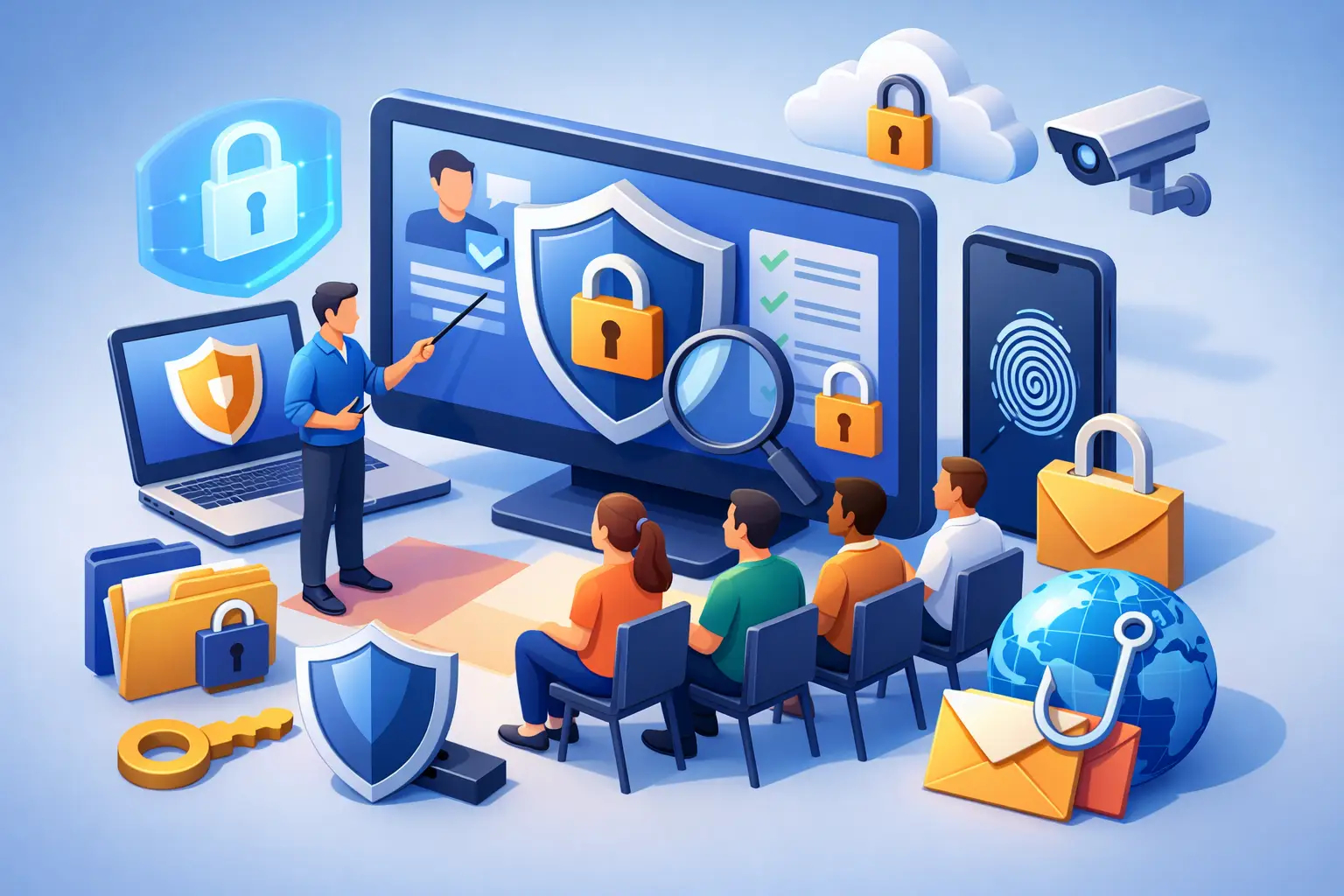
Employee Security Training Guide for Teams
One click on a fake invoice can trigger a legal issue, an outage, and a week of executive firefighting. That is why an employee security training guide matters far beyond awareness. It is a risk reduction program, a compliance control, and a way to turn everyday decisions into a stronger security posture.
Most companies already know employees are a common attack path. The gap is not awareness of the problem. The gap is execution. Too many programs still rely on annual slide decks, generic phishing videos, and checkbox completion rates that say nothing about whether behavior changed. If you want fewer incidents, faster reporting, and stronger audit readiness, training has to be built around business risk.
What an employee security training guide should actually do
A useful employee security training guide should help leaders answer five practical questions. What behaviors create the most risk in our environment? Which employees need which training? How often should we train? How do we measure whether it works? And how do we align it with legal and regulatory expectations without making the program feel like compliance theater?
That last point matters. Security awareness and compliance education overlap, but they are not the same thing. A company may satisfy a policy requirement by assigning annual training. That does not mean employees can identify a consent phishing attack, protect sensitive data while traveling, or escalate a suspected business email compromise fast enough to contain damage. Training should support compliance, but the real goal is operational resilience.
Start with your risk profile, not a generic course library
The fastest way to waste budget is to give every employee the same material at the same depth. Different roles create different exposure. Finance teams face invoice fraud and impersonation. HR handles sensitive personal data and recruiting scams. Executives are prime targets for spear phishing and social engineering. Developers need secure coding context. Customer-facing teams often handle account verification and data access requests that can be manipulated.
A better program starts by mapping your most likely incidents to the groups most likely to face them. Look at recent internal events, industry attack trends, third-party risk, remote work patterns, and regulatory exposure. If your organization operates in sectors influenced by NIS2, privacy obligations, or contractual customer requirements, your training topics should reflect that reality.
This is also where regional nuance matters. A multinational workforce should not receive a one-size-fits-all message about reporting obligations, privacy expectations, or local threat patterns. Localized training improves relevance, and relevance improves retention.
The core topics every program should cover
Every organization needs a baseline curriculum, even if role-based modules come later. Employees should understand phishing, credential theft, password hygiene, multifactor authentication, safe browsing, malware, data handling, device security, and incident reporting. They should also know how attackers use urgency, authority, and curiosity to bypass technical controls.
That baseline, however, is only the starting point. Mature programs also include business email compromise, ransomware precursors, mobile security, collaboration tool abuse, deepfake-enabled impersonation, physical security, and secure use of AI tools. For regulated organizations, privacy, records handling, and reporting obligations belong in the same conversation because employees experience them together in real work.
The right depth depends on role. An executive does not need the same content as a developer, but both need more than generic reminders. The common thread is decision quality. Good training improves the decisions people make when they are busy, distracted, or under pressure.
Format matters as much as content
If training is long, passive, and disconnected from daily work, employees will forget it quickly. Security leaders know this, but many programs still default to annual completion targets because they are easy to administer. Easy to administer is not the same as effective.
Short, focused modules usually outperform marathon sessions. Scenario-based lessons work better than abstract definitions because they mirror the way risk shows up in real inboxes, chat tools, and workflows. Quizzes help reinforce understanding, but only if they test judgment rather than memorization. Certifications can add accountability, especially in regulated environments, but they should confirm practical understanding, not just attendance.
Phishing simulations can also be useful, though they are often mishandled. If simulations are designed to embarrass employees, trust drops. If they are used to identify patterns, coach teams, and reinforce reporting habits, they can improve resilience. The difference is whether the program is punitive or educational.
Build a cadence employees can absorb
Annual training alone is rarely enough. Threats change too quickly, and people forget what they do not practice. A stronger model combines onboarding, recurring microlearning, event-driven refreshers, and role-specific updates.
New hires should receive baseline training early, before they are fully exposed to systems and data. After that, short quarterly or monthly modules keep security visible without overwhelming productivity. Event-driven training becomes critical after policy changes, major incidents, new tool rollouts, or emerging threats such as AI-driven impersonation campaigns.
There is no perfect schedule for every organization. Highly regulated companies, distributed workforces, and teams with elevated access often need more frequent touchpoints. The right cadence is the one employees can consistently complete and leaders can meaningfully reinforce.
Measure behavior, not just completion
Completion rates are easy to report and almost useless on their own. They tell you whether content was assigned and opened. They do not tell you whether employees are less likely to cause an incident.
Better metrics connect training to outcomes. Track phishing reporting rates, repeat click behavior, time to report suspicious activity, policy acknowledgment, quiz performance by topic, and incident trends tied to human error. Watch for leading indicators, such as whether managers reinforce training expectations and whether employees ask better questions about data sharing, payment requests, or unusual access changes.
For leadership teams, the strongest reporting ties training to business impact. Has the organization reduced preventable incidents? Improved response speed? Closed audit gaps? Increased policy adherence in high-risk functions? Those are the measures that support continued investment.
Keep ownership cross-functional
Security should lead the program, but it should not own it alone. HR, compliance, legal, IT, and learning teams all have a role. HR can support onboarding and policy workflows. Compliance can align training evidence with audit needs. Legal can validate privacy and reporting content. Managers can reinforce expectations where behavior actually happens.
This cross-functional model also prevents a common failure point: security writes training that makes sense to security, but not to the rest of the company. Employees do not need a threat intelligence briefing. They need clear guidance on what to do when something feels off, what to avoid, and how quickly to escalate.
Common mistakes that weaken training
The most common mistake is treating awareness as a yearly obligation instead of a business control. The second is using generic content with no role, region, or regulatory context. The third is measuring success by completion alone.
Another problem is tone. If the program sounds like legal fine print or fear-based scolding, employees tune out. Effective training is direct, practical, and tied to consequences people understand. Protect customer trust. Prevent downtime. Avoid financial loss. Meet regulatory expectations. Those outcomes are easier to rally around than abstract cyber slogans.
Technology can help, but it does not replace design. A polished learning platform will not fix irrelevant content, poor timing, or weak reporting. What works is a program that respects employee time while taking business risk seriously.
How to choose an employee security training guide for your organization
When evaluating your approach, ask whether the program supports role-based learning, localization, compliance alignment, and measurable outcomes. Ask whether content can be updated quickly as threats change. Ask whether the reporting is useful to both frontline managers and executive stakeholders. And ask whether employees will remember the training when they face a real decision at speed.
That last test is the most important. Training is not successful because it was assigned. It is successful because an employee pauses before sending sensitive data, challenges a suspicious request, or reports a phishing attempt before it spreads.
Organizations that get this right treat security education as part of operational readiness. They do not train employees once and hope for the best. They build habits, reinforce judgment, and align learning with risk. That is the standard companies should expect from modern providers, including platforms such as CISO EDU that connect workforce awareness, regulatory readiness, and measurable business outcomes.
Cybersecurity starts with people, not tools. If your training program changes how people think and act under pressure, it is doing its job. If it only produces a completion certificate, it is time to rebuild it.
FAQ
1. What is employee security training and why is it important?
Employee security training is a structured program that teaches employees how to identify, avoid, and report cybersecurity threats such as phishing attacks, social engineering, malware, and data breaches. It is important because human error remains one of the leading causes of security incidents, making employee awareness a critical part of an organization's overall security strategy.
2. How often should employees complete cybersecurity training?
Most organizations should provide security training during onboarding and reinforce it through regular updates throughout the year. Quarterly or monthly microlearning sessions, combined with periodic phishing simulations and policy refreshers, are generally more effective than relying solely on annual training.
3. What topics should be included in employee security training?
A comprehensive employee security training program should cover phishing awareness, password security, multifactor authentication, safe internet browsing, data protection, mobile device security, incident reporting, social engineering tactics, and the secure use of collaboration and AI tools. Additional topics may be required based on industry regulations and employee roles.
4. How can organizations measure the effectiveness of security training?
Training effectiveness should be measured using multiple indicators, including phishing simulation results, security incident trends, policy compliance rates, assessment scores, employee reporting activity, and response times to suspicious events. Completion rates alone do not provide a complete picture of employee preparedness.
5. What are the biggest mistakes organizations make with employee security training?
Common mistakes include treating training as a once-a-year compliance exercise, using generic content that is not tailored to specific roles, measuring success only through completion rates, and failing to update training as threats evolve. Effective programs focus on real-world behavior change, continuous learning, and alignment with organizational risk.
Author: Ivan Energiev - Account Manager
Date: 24.06.2026