


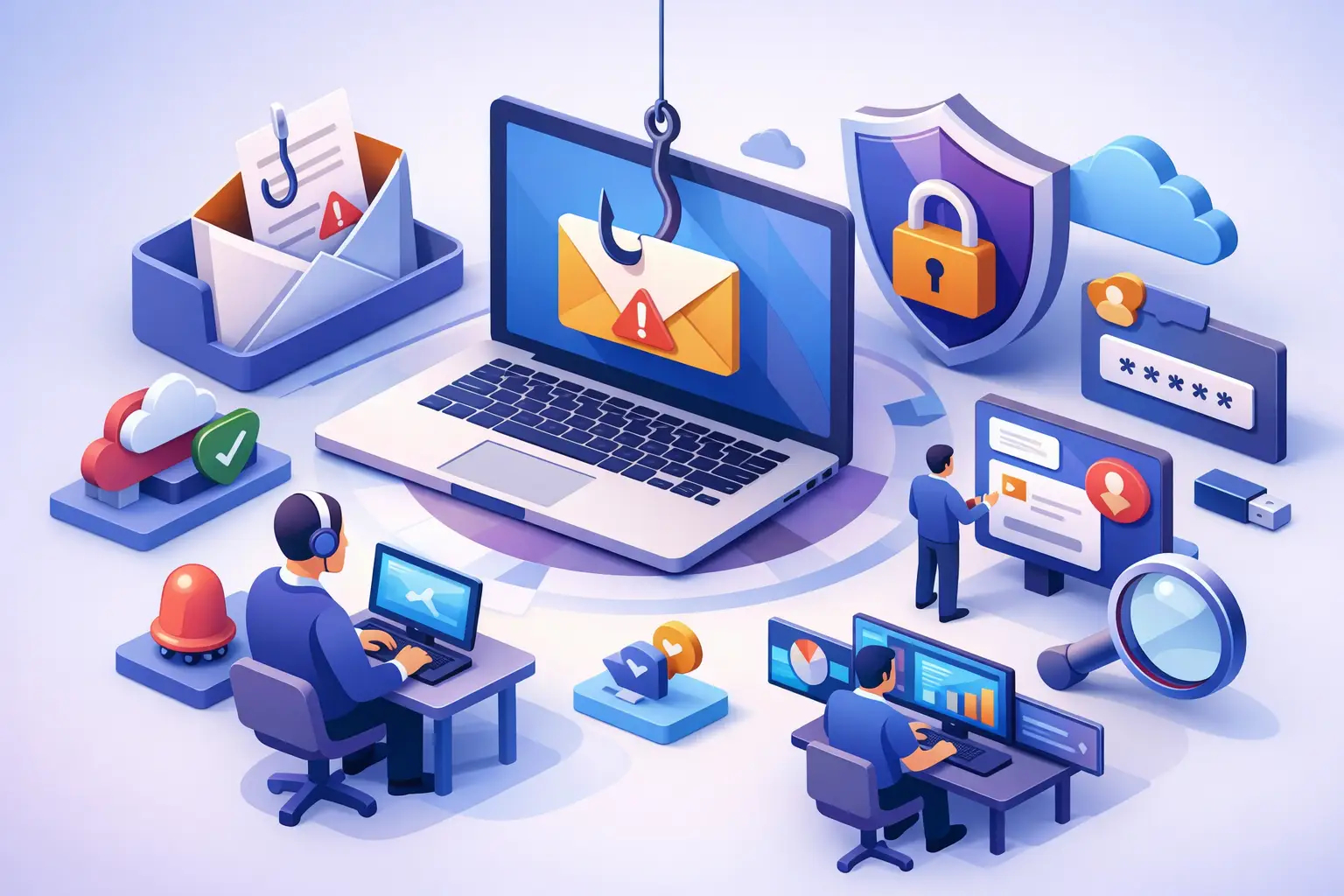
How to Create a Phishing Simulation Program
A phishing test should never feel like theater. If your employees can spot the pattern after two rounds, or if your program is built to shame clickers instead of reduce risk, you are not improving security - you are just generating metrics. To create a phishing simulation program that actually changes behaviour, you need more than fake emails and a monthly report. You need governance, relevance, training follow-through, and a clear connection to business risk.
Why create a phishing simulation program at all?
Most organizations do not have a phishing problem because staff are careless. They have a phishing problem because attackers are persistent, messages are more convincing than ever, and employees are making decisions under pressure. That is why a simulation program matters. It gives you a safe way to measure susceptibility, improve reporting habits, and identify where awareness training is too generic to help.
For CISOs, compliance leaders, and operational owners, the value goes beyond awareness. A strong program creates evidence. You can show regulators, auditors, executives, and board stakeholders that your organization is testing human-layer controls, not just assuming they work. In sectors affected by NIS2, contractual security requirements, or internal control frameworks, that distinction matters.
Still, a simulation program is not automatically effective. Poorly designed campaigns create resentment, train people to distrust every internal message, or produce inflated success metrics that have little connection to real-world attacks. The point is not to trap employees. The point is to build a workforce that pauses, verifies, and reports.
How to create a phishing simulation program with the right scope
Start with the scope before content. Many programs fail because they begin with templates and tooling instead of governance. Decide what the program is intended to accomplish in its first 12 months. That could mean reducing click rates in high-risk departments, increasing user-reported phishing messages, aligning with policy and compliance requirements, or establishing a baseline across regions.
Then define ownership. Security may lead the effort, but HR, legal, compliance, and communications often need a voice. If your organization operates across Europe, the GCC, and the US, localized review is not optional. Language, labor expectations, privacy concerns, and regulatory posture vary. A campaign that feels routine in one region may create unnecessary risk in another.
It also helps to agree on what you will measure before the first test goes out. Open rates are usually less useful than click rates, credential submission rates, attachment interaction, and report rates. Over time, even those numbers need context. A lower click rate is good, but a rising report rate is often the stronger sign that security culture is improving.
Build the program around risk, not random templates
Not every employee faces the same phishing risk. Finance teams may be targeted with invoice fraud. HR may see impersonation related to benefits, resumes, or payroll. Executives and executive assistants face social engineering built around urgency, reputation, and access. IT teams may be targeted with account alerts or fake infrastructure notifications.
That means your simulations should reflect your actual threat landscape. Review recent incidents, industry attack patterns, and vendor impersonation trends. If your company regularly works with shipping providers, cloud platforms, payment tools, or regional government portals, those themes may be more realistic than generic package delivery emails.
There is a balance to strike here. If simulations are too easy, employees dismiss them. If they are too sophisticated too early, the program turns into a gotcha exercise. A better approach is progressive difficulty. Begin with recognizable warning signs, then increase realism as users improve. That gives training time to work and keeps the program credible.
Pair every simulation with immediate learning
A phishing simulation program without education is just surveillance. The moment after a user clicks is one of the few times you have their full attention. Use it well.
If someone interacts with a phishing email, the landing page should explain what cues they missed in plain language. Keep it short, practical, and role-relevant. Show them the sender mismatch, the suspicious link behaviour, the unusual request, or the urgency tactic. Then reinforce the expected action, whether that is reporting the message, verifying through another channel, or escalating to the help desk.
That learning should not stop with the click page. Short follow-up modules, microlearning, quizzes, and targeted refreshers make the lesson stick. This is where many organizations underinvest. They run campaigns consistently, but provide generic annual training that does not reflect the simulation results. If you want measurable change, connect the campaign data to the training plan.
Choose frequency carefully
More simulations do not always mean better outcomes. Too few, and employees forget the lesson. Too many, and the exercise becomes background noise or creates fatigue.
For most organizations, a monthly or every-other-month cadence is enough to build awareness without overwhelming teams. High-risk groups may need more frequent targeted testing. New hires should usually be included after onboarding so the simulation program becomes part of the organization’s normal security expectations.
Randomization matters too. If employees know tests always land on the first Tuesday of the month, you are measuring pattern recognition, not judgment. Vary timing, themes, and user groups. Keep the program predictable in governance, but not in execution.
Avoid the mistakes that undermine trust
If you want employees to report suspicious messages, they need to believe the program is fair. Public leaderboards of failure, punitive language, and manager shaming are short-term tactics that damage long-term culture. People who fear embarrassment report less, hide mistakes, and disengage from training.
You should also be careful with emotionally sensitive themes. Fake layoff notices, payroll errors during holidays, or medical emergencies may drive clicks, but they also damage credibility. The trade-off is simple: a campaign can be realistic without being manipulative.
Another common mistake is treating the simulation as a stand-alone awareness exercise. It should connect to reporting workflows, incident triage, help desk readiness, and policy reinforcement. If employees correctly report a suspicious email but the response process is slow or unclear, the program loses momentum.
What good measurement actually looks like
A mature program tracks behaviour change, not just failure. Yes, you should monitor clicks and submissions. But if that is all you show leadership, you miss the larger story.
Better measurement includes reporting rates, repeat offenders by risk tier, improvement by department, time-to-report, and training completion after simulation events. It should also account for false positives. If reporting increases but employees start flagging every routine email, the organization may need better guidance on what suspicious looks like.
For leadership, translate these metrics into business impact. Are high-risk functions improving? Are users escalating faster? Are repeat clickers receiving targeted support? Is the organization building evidence of due care for audit and compliance purposes? These are the outcomes executives understand.
If your company operates under multiple regulatory expectations, document your rationale and your actions. Keep records of campaign schedules, target groups, educational interventions, and trend reporting. A simulation program can support compliance posture, but only if it is governed and defensible.
How to create a phishing simulation program that scales
Scaling is where many promising programs stall. The pilot works. The first dashboards look good. Then the organization expands across geographies, business units, and languages, and the content no longer fits everyone.
To scale well, standardize the framework and localize the experience. Your policy, metrics, and governance model should be consistent. Your email themes, learning assets, and communication style should reflect the local business context. A US workforce, a German operational team, and a GCC-based regional office may all need the same security outcome, but not the same examples or wording.
This is also where role-based education becomes more valuable than one-size-fits-all awareness. Finance, HR, leadership, and technical teams benefit from simulations tied to their daily decisions. The closer the scenario is to the real pressure they face, the more useful the training becomes.
Platforms like CISO EDU fit naturally into this model because the strongest simulation programs do not end at the inbox. They connect testing, localized training, compliance needs, and measurable workforce education into one repeatable system.
The standard to aim for
A strong phishing simulation program does not try to catch employees making mistakes. It teaches them how to interrupt an attack path before it becomes an incident. That shift matters. It changes the program from a testing exercise into a business control.
If you build it with realistic scenarios, clear governance, targeted learning, and respectful measurement, you get more than lower click rates. You get a workforce that participates in defence, a cleaner compliance story, and better visibility into where human risk is actually changing.
Start small if you need to, but start with intent. The best programs are not the ones with the most campaigns. They are the ones employees remember when a real phishing email lands in the inbox.
FAQ
1. What is the main goal of a phishing simulation program?
The main goal is to improve employee behaviour by helping them recognize, verify, and report suspicious emails, rather than simply measuring click rates or catching mistakes.
2. How often should phishing simulations be conducted?
Most organizations benefit from running simulations monthly or every other month, with additional targeted testing for high-risk groups and new employees.
3. What metrics should be used to evaluate success?
Key metrics include click rates, credential submissions, reporting rates, time-to-report, and behavioural improvement across departments—not just failure rates.
4. Why is training important in phishing simulations?
Training ensures employees learn from mistakes. Immediate feedback, microlearning, and role-based education help reinforce correct actions and improve long-term awareness.
5. What are common mistakes to avoid in phishing simulation programs?
Avoid shaming employees, using overly sensitive or manipulative scenarios, running predictable campaigns, and failing to connect simulations with training and real security processes.
ADVANCED VISION IT - MALTA Address: Suite 8, Ta’ Mallia Buildings, Triq In‑Negozju, Zone 3, Central Business District, Birkirkara, CBD 3010, Malta
Registration number: C111282, VAT Number: MT31713827
Phone:+35679224404
Email: office@advisionit.com
ADVANCED VISION IT - BULGARIA
Address: 35 Dimitar Hadzhikotsev str. Ent A, Lozenets, Sofia, Bulgaria
ID No: 205789039, VAT No: BG205789039
Phone: +359 888 258 530
Email: office@advisionit.com