


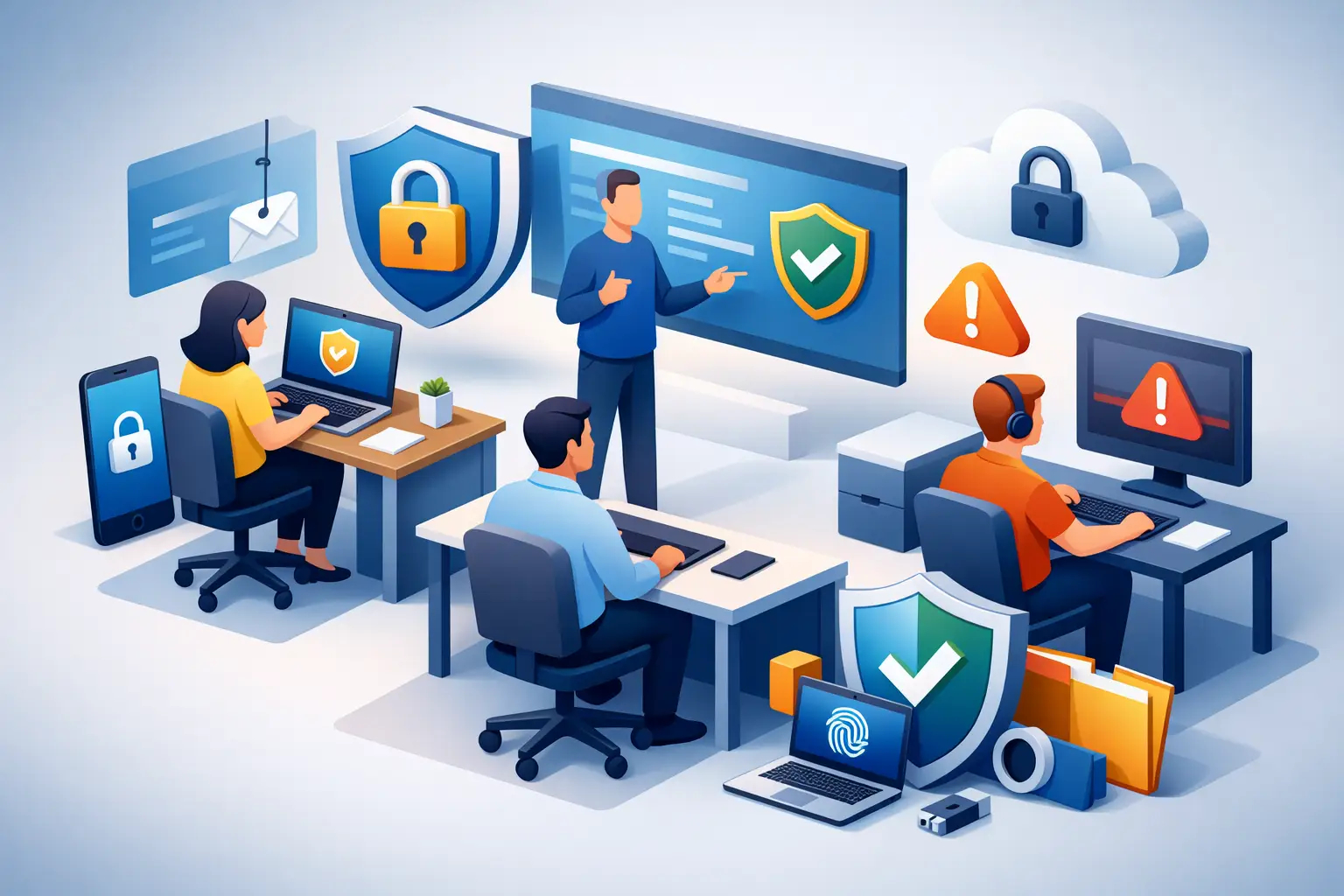
How to Improve Employee Cyber Behavior at Work
A single rushed click can bypass millions of dollars in security technology. An invoice-themed phishing email reaches an accounts payable employee, a password is reused on a personal service, or a suspicious prompt goes unreported because the employee fears being blamed. That is why leaders asking how to improve employee cyber behavior need more than an annual awareness course. They need a system that makes secure decisions practical, expected, and measurable.
Cybersecurity starts with people - not tools. But expecting employees to act as a line of defense without giving them relevant knowledge, safe habits, and clear support is not a strategy. It is a risk transfer.
Start With the Behaviors That Create Business Risk
“Be more cyber aware” is too vague to change behavior. Employees need to know what they are expected to do differently in the moments that matter: when a message looks urgent, a login page requests credentials, a vendor changes payment details, or a device is lost.
Start by identifying the few employee actions most closely connected to your organization’s risk profile. Review phishing reports, help desk tickets, incident investigations, audit findings, and the controls required by your industry or regulatory obligations. A healthcare organization may prioritize secure handling of sensitive records. A finance team may need stronger defenses against payment fraud and business email compromise. An engineering group may require clear rules for source code, privileged access, and approved AI tools.
Then translate technical controls into observable behaviors. Instead of telling employees to “protect credentials,” establish expectations such as using the approved password manager, never approving an unexpected multifactor authentication request, and reporting suspected account compromise immediately. Instead of “watch for phishing,” teach employees to pause, inspect unusual requests, verify payment changes through a trusted channel, and report the message.
This focus matters because training cannot cover every cyber threat with equal depth. Prioritize the behaviors that reduce the most likely and most damaging failures.
Make Training Relevant to Each Role
Generic awareness training has a place, particularly for baseline policy and compliance education. It is not enough on its own. A CEO, payroll specialist, developer, frontline worker, and system administrator face different threats, use different tools, and make different decisions.
Role-based training makes the lesson credible because it mirrors work employees actually do. Finance teams should practice identifying fraudulent invoices and altered bank details. HR teams should recognize impersonation attempts that target employee records. Executives should understand how attackers use travel, public disclosures, and authority to craft convincing requests. Technical teams need practical guidance on secure configuration, access management, and escalation paths.
Localization also affects behavior. Training should reflect the employee’s language, regional regulations, and workplace context. For organizations operating across the United States, Europe, and the GCC, this is not a cosmetic change. Privacy expectations, compliance obligations, common scam patterns, and reporting processes can vary significantly.
Short, interactive modules are often more effective than long presentations because they fit into operational reality. Employees retain more when they must make a decision, see the consequence, and receive immediate feedback. Quizzes and certifications help confirm completion, but the objective is not a completed course. It is better judgment under pressure.
Build Practice Into the Workday
People do not develop secure habits by reading policies once a year. They improve through repetition and feedback, much like safety procedures, quality controls, or emergency response.
Use realistic phishing simulations and scenario-based exercises to test decisions in context. The simulation should resemble threats your workforce could genuinely encounter, not trick employees with obscure clues. If every simulation is obviously malicious, the exercise measures attention to training rather than readiness for a real attack.
When someone clicks, avoid public shaming or punitive messaging. A click is a signal: the employee may have been rushed, the scenario may have exploited a normal business process, or the training may not have addressed the tactic clearly enough. Follow up with short, targeted coaching that explains what to look for and what action to take next time.
There is a trade-off. Simulations that are too frequent or too deceptive can create fatigue and resentment. Simulations that are rare and predictable create false confidence. The right cadence depends on the organization’s risk level, employee population, and recent threat activity. Track results over time, then adjust difficulty and frequency rather than treating one campaign as a verdict on employee competence.
Remove Friction From Secure Choices
Training cannot compensate for a work environment that makes the insecure path easier. If reporting a suspicious email requires searching a policy portal, filling out a form, and waiting for a response, many employees will simply delete it or ignore it. If approved collaboration tools are difficult to use, teams will move sensitive work to unapproved apps.
Make the secure choice the simple choice. Put a visible reporting option inside the email platform. Provide an easy way to verify unusual requests. Use password managers and multifactor authentication that employees can understand and access. Publish clear guidance for personal devices, file sharing, AI use, and travel. Give managers concise escalation procedures so they can support their teams without improvising.
This is where security, IT, HR, legal, and learning teams need to operate as one program. Security identifies the risk. IT enables usable controls. HR and learning teams reinforce expectations and onboarding. Legal and compliance map requirements to evidence. When these functions work in isolation, employees receive conflicting messages and security becomes harder than it needs to be.
Create a Reporting Culture, Not a Blame Culture
Fast reporting can turn a near miss into a contained event. An employee who reports a suspicious message may help protect hundreds of colleagues from the same campaign. Yet employees stay silent when they expect embarrassment, blame, or disciplinary action for an honest mistake.
Leaders should distinguish clearly between accidental error, risky behavior, and deliberate policy violations. An employee who reports that they entered credentials into a suspicious page has done the right thing by speaking up quickly. The response should focus first on containment: reset access, review activity, and determine whether others were targeted. Coaching can follow without turning the employee into a warning story.
Leadership behavior sets the standard. When executives and managers report suspicious messages, use approved tools, and acknowledge that anyone can be targeted, they make security a shared responsibility. When leaders bypass controls because they are inconvenient, employees receive a different message.
Recognition also helps. Share anonymized examples of well-handled reports, thank employees who raise concerns, and show what happened after a report was made. People are more likely to act when they can see that their action matters.
Measure Behavior, Not Just Completion
Completion rates are useful for compliance evidence, but they do not prove reduced risk. A workforce can reach 100% completion and still reuse passwords, approve fraudulent requests, or fail to report incidents.
Measure a combination of learning, action, and operational outcomes. Look at phishing reporting rates alongside failure rates. Track how quickly employees report suspected compromise, whether repeat errors decline after coaching, and how different roles perform on scenarios relevant to their work. Review help desk trends, policy exceptions, and incident root causes for behavioral patterns.
Avoid using a single metric to rank individuals or departments. A team that reports more phishing emails may be more engaged, not less secure. Data needs context. Compare trends over time, investigate outliers, and use findings to improve training and controls.
For compliance-driven organizations, retain evidence that connects training to the applicable requirement: who completed it, what topics were covered, how competence was assessed, and what remediation occurred when gaps appeared. This creates a stronger audit trail while giving leadership a clearer view of human risk.
Treat Cyber Behavior as a Leadership Discipline
The most effective programs are ongoing, targeted, and connected to business priorities. They do not ask employees to memorize technical jargon. They prepare them to recognize risk, make a safer choice, and report quickly when something feels wrong.
CISO EDU approaches workforce education through interactive lessons, role-relevant scenarios, quizzes, and certifications that help organizations connect cyber awareness with compliance readiness. The larger goal is straightforward: turn employees from an unmanaged source of exposure into an active layer of defense.
Secure behavior grows when employees know what good looks like, have the tools to act on it, and trust the organization to support them when they raise a hand. Build that environment deliberately, and every reported email, verified request, and paused click becomes evidence that your security culture is working.
FAQ
1. Why is employee cyber behavior important?
Employee actions play a critical role in organizational cybersecurity. A single mistake, such as clicking a phishing link, reusing passwords, or failing to report suspicious activity, can lead to security incidents, data breaches, and financial losses. Strong cyber behavior helps reduce human risk and strengthens overall security resilience.
2. What is the most effective way to improve employee cyber behavior?
The most effective approach combines role-based training, realistic phishing simulations, ongoing awareness activities, easy reporting mechanisms, and leadership support. Employees are more likely to develop secure habits when learning is relevant to their daily responsibilities.
3. How often should cybersecurity awareness training be conducted?
Organizations should provide cybersecurity training throughout the year rather than relying solely on an annual course. Regular microlearning sessions, phishing simulations, onboarding training, and targeted refreshers help reinforce secure behaviors and keep employees informed about evolving threats.
4. How can organizations measure improvements in employee cyber behavior?
Beyond training completion rates, organizations should track metrics such as phishing reporting rates, simulation results, incident reporting speed, repeat mistakes, policy compliance, and trends in security-related incidents. These indicators provide a more accurate picture of behavioral change and risk reduction.
5. How can leaders encourage employees to report security concerns?
Leaders can encourage reporting by creating a blame-free culture where employees feel comfortable speaking up about suspicious activity or mistakes. Recognizing positive reporting behavior, providing timely feedback, and demonstrating secure behavior at the leadership level help build trust and participation.

Written By
Yavor Y. Zlatev
CEO & Executive Director at Advanced Vision IT
Yavor leads strategic growth and technology operations at Advanced Vision IT, specializing in enterprise cybersecurity, cloud infrastructure, NIS2 compliance, and managed security service delivery. Find out more about me