


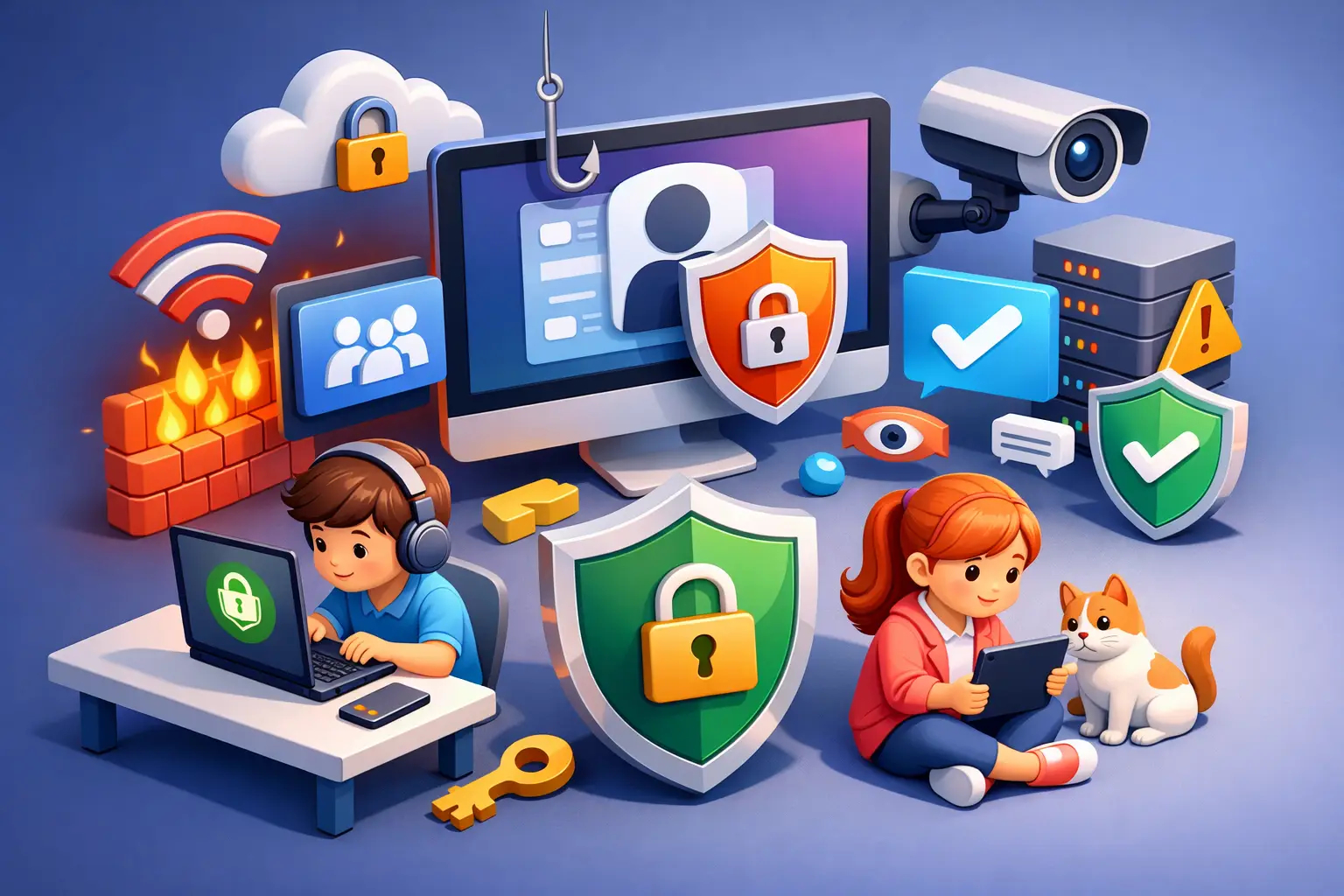
Internet Safety Lessons for Children That Work
A child gets a message in a game, clicks a video a friend shared, or installs a free app without thinking twice. That is usually how online risk begins - not with a dramatic breach, but with one small decision made too quickly. Effective internet safety lessons for children are not about scaring kids away from technology. They are about building judgment early, so children can recognize risk, pause, and make smarter choices.
For organizations that care about cyber resilience, this topic matters more than it may seem. Parents are employees. Family cyber habits spill into workplace behavior. And companies that invest in digital safety education are not just checking a box - they are strengthening a broader culture of security awareness that starts with people.
Why internet safety lessons for children need a different approach
Children do not process online risk the way adults do. They are curious, impulsive, and often more focused on speed and rewards than on consequences. A lesson that works for an employee completing compliance training will not automatically work for a 9-year-old using a tablet after school.
That is why the strongest programs focus less on technical jargon and more on recognizable situations. A child needs to know what to do when a stranger starts chatting in a game, when a pop-up asks for personal information, or when a video encourages a risky challenge. The goal is practical pattern recognition.
There is also an age factor. Younger children need simple rules they can remember and repeat. Preteens need more context because they are starting to use social platforms, messaging apps, and multiplayer games with greater independence. Teenagers need honest conversations about reputation, privacy, manipulation, and permanence. One-size-fits-all training sounds efficient, but it usually misses the mark.
What children actually need to learn
The best internet safety lessons for children centre on a small set of high-value behaviours. These are the habits that reduce risk across devices, apps, and platforms, even as technology changes.
Personal information is valuable
Children need a clear definition of personal information. Many know not to share a home address with a stranger, but they may not realize that a school name, daily routine, phone number, photo in uniform, or location-enabled post can reveal just as much. Teaching this well means using examples from their daily digital life, not abstract warnings.
They also need to understand that people online are not always who they claim to be. That lesson should be direct, not theatrical. Kids do not need to panic. They need a rule they can act on: if someone asks personal questions, asks to move to a private chat, or says "don't tell your parents," stop and tell a trusted adult.
Passwords and accounts need protection
Children should learn early that passwords are not random school rules. They are digital keys. If a child uses the same password everywhere, shares it with friends, or stores it carelessly, account compromise becomes much more likely.
For younger children, the lesson can be simple: use strong passwords created with a parent and never share them except with trusted caregivers. For older children, it makes sense to explain account takeover in plain language. If someone gets into a gaming, email, or social account, they can impersonate the child, steal items, message friends, or lock the child out.
Not every click is safe
Phishing is not just an enterprise problem. Children encounter scams in games, videos, text messages, and social platforms. Free currency offers, fake giveaways, cheat downloads, and urgent account warnings are common lures because they target exactly how kids behave online.
This is where realistic examples matter. Show children what a suspicious message looks like. Teach them to slow down when something promises a reward, demands urgent action, or asks them to log in again. The habit you want is simple: pause, check, ask.
Kind behaviour is also a safety issue
Cyberbullying, exclusion, and pressure to share embarrassing content are not separate from internet safety. They are part of it. A child who feels trapped socially online is more likely to make risky choices, hide incidents, or stay engaged in harmful spaces.
Good instruction should tell children what respectful behaviour looks like, but it should also give them permission to exit, block, report, and speak up. If a child thinks the only acceptable response is to "handle it alone," the damage often grows.
How to teach internet safety lessons for children effectively
The delivery matters as much as the content. If the lesson is too abstract, children tune out. If it is too alarmist, they hide mistakes. If it is too long, they remember almost nothing.
Use scenarios, not speeches
Scenario-based learning works because children understand stories faster than policy statements. A short example like "someone in a game asks for your real name and school" gives them something concrete to process. Then you ask, what would you do next? That creates active thinking instead of passive listening.
This is also where interactive learning has a clear advantage. Short quizzes, guided choices, and repeated exposure build memory better than a single annual conversation. The same principle applies in workforce training. People retain more when they practice decisions.
Repeat the lesson in small doses
Internet safety is not a one-time talk. Children need reinforcement because apps change, habits drift, and confidence can outpace judgment. A short monthly discussion is often more effective than one long session after a problem occurs.
This is especially true for families balancing work, school, and screen time. The most sustainable model is lightweight and consistent. One topic at a time. One realistic example. One rule to practice that week.
Make reporting safe
Many children hide online problems because they fear losing device access. That is a predictable failure point. If the response to every mistake is punishment, children stop reporting. Then parents and caregivers lose visibility into risk.
A better approach is to separate the incident from the follow-up. If a child clicks something suspicious or shares too much, address the problem first and the discipline second, if discipline is even needed. The priority is early reporting. Fast reporting reduces harm.
What parents and organizations often get wrong
One common mistake is focusing only on stranger danger while ignoring platform design. Children are influenced by recommendation engines, in-app purchases, addictive mechanics, and social pressure from known peers. Risk does not only come from unknown outsiders.
Another mistake is assuming device controls solve the problem. Filters, parental controls, and screen time settings help, but they are guardrails, not judgment. Children still need decision-making skills because no technical control catches everything.
There is also a tendency to overestimate maturity. A child may be highly capable with devices and still be poor at recognizing manipulation. Digital fluency is not the same as digital judgment. That distinction matters.
For employers and training leaders, the missed opportunity is treating child-focused digital safety as unrelated to corporate awareness. It is related. Employees bring habits, stress, and family tech challenges into the workplace every day. Security culture gets stronger when organizations support the whole person, not just the worker account.
A stronger model for families and security-conscious organizations
The most effective model combines education, repetition, and practical controls. Teach the child what risk looks like. Reinforce it with short, recurring lessons. Support it with age-appropriate device settings and supervision. None of those elements is enough on its own.
This is where structured learning can make a difference. A program built with real scenarios, clear progression by age, and measurable comprehension is more reliable than informal advice pulled together after an incident. For organizations that already invest in awareness training, extending that mindset to family digital safety is not a side issue. It is part of building resilient behaviour at scale.
CISO EDU reflects this principle well: cybersecurity starts with people - not tools. That applies in the workplace, and it applies at home. When children learn to question, verify, and report, they are developing the same core instincts that reduce cyber risk everywhere else.
The goal is not to raise fearful kids. It is to raise capable ones - children who know when something feels wrong, know what to do next, and trust the adults around them enough to say it out loud.
ADVANCED VISION IT - MALTA Address: Suite 8, Ta’ Mallia Buildings, Triq In‑Negozju, Zone 3, Central Business District, Birkirkara, CBD 3010, Malta
Registration number: C111282, VAT Number: MT31713827
Phone:+35679224404
Email: office@advisionit.com
ADVANCED VISION IT - BULGARIA
Address: 35 Dimitar Hadzhikotsev str. Ent A, Lozenets, Sofia, Bulgaria
ID No: 205789039, VAT No: BG205789039
Phone: +359 888 258 530
Email: office@advisionit.com