


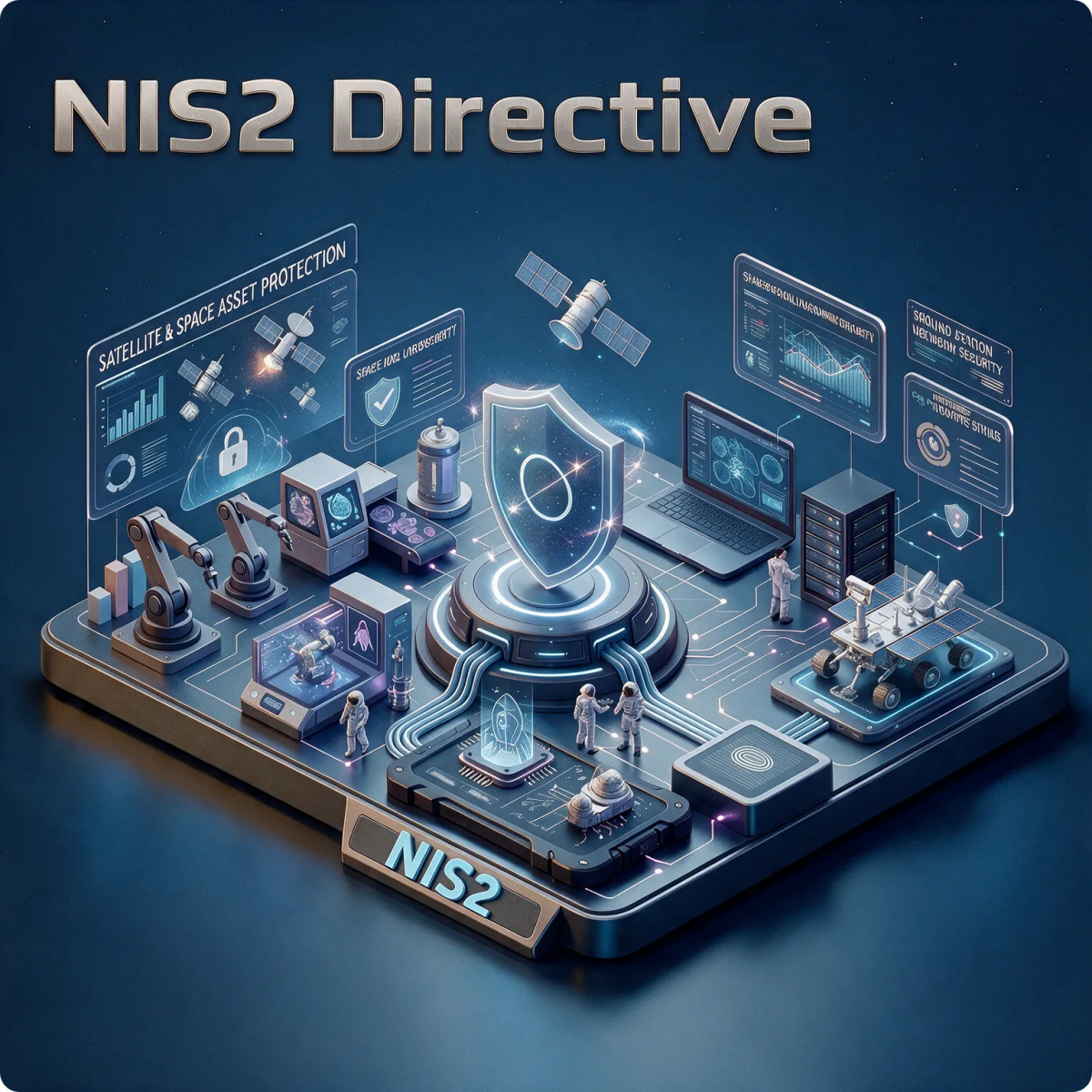
NIS2 – Cybersecurity in the Space Industry - Advanced (Monthly Subscription)
COURSE DESCRIPTION
In the space industry, a compromised account or supplier can provide access to the systems that keep satellites under control. A breached email account can expose export-controlled designs, ransomware affecting mission support systems can disrupt command operations during a communication window, and an insecure ground station or compromised firmware update can create a pathway to the TT&C link itself. Attackers exploit launch and supplier payments, remote ground stations running outdated equipment, cloud platforms and Ground Station as a Service (GSaaS) offerings, as well as the extensive multinational supply chain. A single incident can trigger regulatory obligations under NIS2, GDPR, and ITAR/EAR simultaneously.
This course builds on the beginner-level programme and moves from cybersecurity awareness to practical action. It prepares professionals responsible for mission operations, the ground segment, engineering, IT, and procurement to protect payments, mission and export-controlled data, endpoints, cloud platforms, suppliers, and recovery plans, while managing incidents in accordance with NIS2, GDPR, and ITAR/EAR requirements. Two modules are specifically tailored to the space industry: Space System Command and Control Security, and Export Control and Supply Chain Compliance.
The course is developed by the CISO Edu team – the cybersecurity training platform of Advanced Vision IT. The company has 15 years of industry experience, is certified to ISO 27001, ISO 9001, and ISO 20000-1 standards, and is an AWS Cloud Certified Partner, as well as a partner holding multiple certifications from leading cybersecurity solution providers, including Sophos, Acronis, and other established technology companies. The content is developed by specialists who work daily with NIS2 compliance requirements, Industrial Control Systems (ICS), and critical infrastructure environments.
What participants will learn
- ✓How to apply callback verification and segregation of duties to prevent fraudulent launch payments, supplier bank detail changes, and partner impersonation; identify lookalike domains; and respond to suspected Business Email Compromise (BEC).
- ✓How to classify and protect mission data, export-controlled information, personal data, and classified information; secure TT&C telemetry and command data; and share information with partners in accordance with ITAR/EAR rules and GDPR principles.
- ✓How to manage endpoints across mission control, ground stations, and engineering environments; schedule updates around satellite passes and launch campaigns; and implement compensating controls when systems cannot be patched.
- ✓How to secure cloud and SaaS platforms, including Ground Station as a Service (GSaaS), through shared responsibility models, identity and access management, controls over the location of export-controlled data, and measures against shadow SaaS usage.
- ✓How to classify incidents by severity, apply response playbooks for compromised TT&C credentials, ground station intrusions, ransomware, and export-controlled data breaches, and meet reporting obligations under NIS2, GDPR, and export control regulations.
- ✓How to assess cyber risk across the ground, space, link, and user segments, translate it into business impact for management, and evaluate governance decisions, cyber insurance, and investment priorities.
- ✓How to classify space suppliers by criticality, conduct due diligence, include security, notification, audit, and subcontractor flow-down clauses in contracts, protect hardware and software supply chains, and manage fourth-party risk.
- ✓How to define RTO and RPO for satellite command and control, ground stations, and data processing; plan redundancy across the ground and space segments; and test recovery from ransomware, TT&C compromise, and DDoS attacks.
- ✓How to secure space command and control through encryption and authentication of TT&C links, hardening of ground stations and mission control center networks, protection of satellite platforms, and countermeasures against jamming and signal spoofing.
- ✓How to apply ITAR, EAR, the Wassenaar Arrangement, the Missile Technology Control Regime (MTCR), and the EU Dual-Use Regulation in day-to-day operations; manage deemed export risks through Technology Control Plans; and protect the supply chain against counterfeit components.
ideal for
Course modules
Next Step: From Operational Readiness to Strategic Leadership
This course builds on the beginner-level programme and prepares participants for the expert-level course, which covers threat modeling, Zero Trust for space systems, incident response playbooks, digital forensics, security architecture reviews, cybersecurity governance, compliance with NIS2, ITAR/EAR, NIST, CCSDS, and the EU Space Programme Regulation, crisis management, cybersecurity roadmap development, and emerging threats.
Next Level