


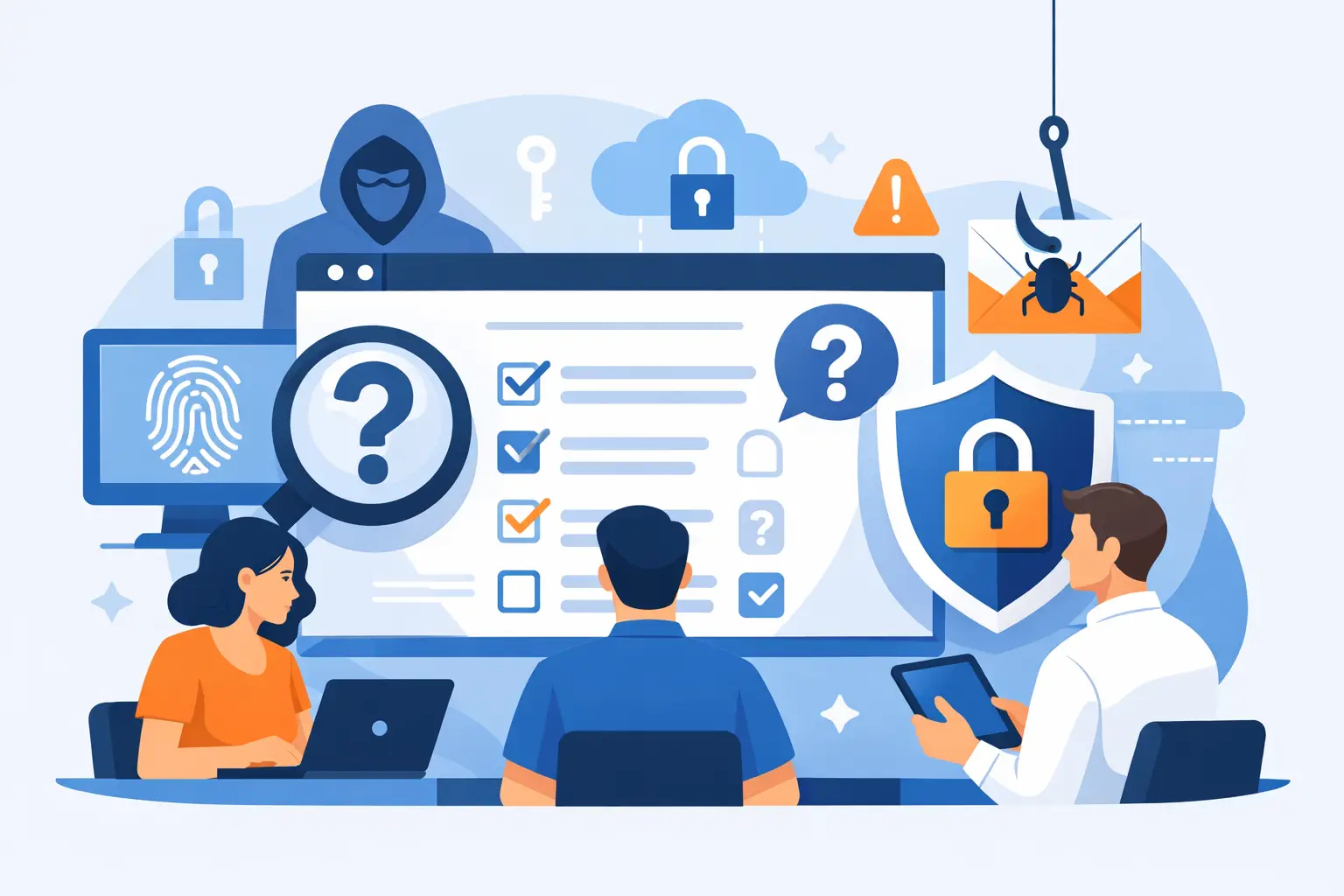
Security Awareness Quiz for Employees That Works
A phishing click during quarter-end close. A reused password on a finance app. A rushed employee sending sensitive data to the wrong contact. These are not awareness problems in theory. They are operating risks with real cost. A security awareness quiz for employees should help you detect those risks early, reinforce the right behaviors, and give leadership evidence that training is changing how people work.
Too many organizations still treat quizzes as a box to check after annual training. That approach creates completion rates, not resilience. If your quiz only proves that someone remembered a definition for five minutes, it is not reducing human risk. If it cannot show which teams are improving, where confusion remains, and how behavior maps to policy and compliance requirements, it is not doing enough.
What a security awareness quiz for employees should actually do
A useful quiz measures judgment, not just memory. Employees do not fail in real incidents because they forgot a glossary term. They fail because they misread context, trust the wrong signal, or act too fast under pressure. That is why the best quizzes focus on decisions employees make in the flow of work.
A strong quiz asks questions that mirror real conditions. The message looks almost legitimate. The request feels urgent. The attachment appears relevant. The employee has to decide what to do next, not just identify a textbook example. This matters because cybersecurity starts with people - not tools. If your people cannot recognize and respond to risk, your controls are carrying too much of the load.
For security leaders, quizzes also create a measurement layer. They help answer practical questions. Which departments struggle with business email compromise? Are managers handling data classification correctly? Do remote teams know how to report suspicious activity? Those answers support more targeted training, better policy reinforcement, and stronger audit readiness.
Why generic quizzes fail
Most weak quizzes share the same flaw. They are disconnected from business reality.
A ten-question multiple-choice test built from generic awareness content may be easy to deploy, but it rarely changes behavior. Employees learn how to pass, not how to respond. Worse, leadership gets a false sense of assurance because scores look high. A 92 percent pass rate sounds strong until someone approves a fraudulent payment request.
Generic quizzes also miss role differences. Finance teams face invoice fraud and impersonation. HR handles sensitive identity data. Executives are prime targets for social engineering and mobile compromise. Developers and IT staff need more than basic password advice. One-size-fits-all testing may satisfy a training calendar, but it does not reflect real risk exposure.
There is also a compliance issue. Regulations and frameworks increasingly expect evidence of effective security awareness, not just attendance. If an organization must demonstrate workforce preparedness under sector rules, privacy obligations, or resilience mandates such as NIS2-aligned expectations, weak quizzes create weak evidence.
The anatomy of an effective employee quiz
An effective quiz starts with relevance. Questions should reflect the threats your organization actually faces, the systems employees actually use, and the policies they are expected to follow. If your teams regularly handle wire transfers, vendor onboarding, customer records, or regulated data, the quiz should test those scenarios directly.
Difficulty matters too. If every bad email is obviously malicious, you are training employees to spot cartoons, not attacks. Good assessments include ambiguity because real threats are often subtle. The goal is not to trick employees for sport. The goal is to measure whether they can pause, verify, and escalate appropriately.
Timing matters just as much as content. Annual testing alone is not enough for most organizations. Short, recurring quizzes create better retention and better visibility into progress. A quarterly rhythm is often more useful than a single large assessment, especially when paired with targeted microlearning after common mistakes.
Feedback should be immediate and specific. If an employee gets a question wrong, the explanation should show why the choice was risky and what the safer action would be. That turns the quiz from a compliance event into a learning moment.
What to measure beyond pass rates
Pass rates are easy to report and easy to misread. They tell you something, but not enough.
What matters more is pattern data. Look for repeat failure themes, role-based gaps, reporting confidence, and changes over time. If one business unit consistently misses questions about data handling, that is not just a training issue. It may indicate unclear processes, poor policy communication, or workflow pressure that encourages shortcuts.
You should also track how quiz results align with operational indicators. Are phishing report rates improving? Are policy violations dropping? Are there fewer avoidable help desk incidents tied to credential misuse or insecure file sharing? The strongest programs connect awareness data to business outcomes.
For leadership, this shifts the conversation. Instead of saying, "95 percent of staff completed training," you can say, "Finance improved invoice fraud recognition by 28 percent, executive assistants showed a persistent escalation gap, and contractor access hygiene remains a priority." That is useful risk intelligence.
How to build quizzes employees will take seriously
Employees can tell when training is performative. If the quiz feels generic, patronizing, or disconnected from their jobs, they will treat it as background noise.
The better approach is to make the assessment credible. Use scenarios that resemble the tools, requests, and communication patterns employees see every day. Keep the language plain. Avoid security theater. Respect their time, but do not oversimplify the decision-making.
It also helps to position the quiz correctly. This is not about catching people out. It is about strengthening judgment before a real incident tests it. That framing matters for culture. Organizations that use awareness as punishment usually get minimal engagement and defensive behavior. Organizations that use it as a practical risk-reduction tool tend to get better reporting, better participation, and better outcomes.
If your workforce spans regions, functions, or regulatory environments, localization is not optional. A quiz built for a US office may not reflect the threat patterns, privacy expectations, or business processes of teams in Europe or the GCC. The same goes for language, examples, and references to local reporting procedures.
Security awareness quiz for employees by role
Role-based design is where many programs either mature or stall.
A frontline employee may need strong habits around phishing, password hygiene, mobile device use, and secure collaboration. A finance manager needs deeper testing on payment fraud, vendor impersonation, and approval workflows. HR should be tested on data sensitivity, identity verification, and document handling. Executives need concise but high-impact assessment on targeted attacks, travel risk, and privileged communications.
The point is not to create hundreds of custom tests. It is to align the core assessment with actual exposure. That makes results more meaningful and remediation more efficient. It also improves credibility with business leaders, because the training clearly reflects how their teams work.
This is where a platform built for structured, compliance-aware learning has an advantage. CISO EDU, for example, is designed around role, region, and regulatory context rather than generic awareness content. That changes the value of the quiz from a training artifact into a business control.
Common mistakes to avoid
One common mistake is overloading the quiz with technical jargon. Most employees do not need to define DNS tunneling. They need to recognize suspicious requests, handle data properly, and know when to report concerns.
Another mistake is making the quiz too easy in order to keep scores high. That may please stakeholders in the short term, but it weakens the signal. If results cannot identify real gaps, the quiz is not helping.
A third mistake is treating poor scores as the end of the process. A weak result is useful if it triggers focused follow-up. It tells you where the risk is. The failure is not in finding the gap. The failure is in doing nothing with the information.
Finally, do not separate awareness too far from policy and operations. If employees are taught one thing in a quiz but expected to follow a different process in the real world, behavior will break down under pressure.
From quiz data to stronger security culture
The best security awareness quiz for employees does more than test recall. It creates a feedback loop between workforce behavior, leadership visibility, and risk reduction.
That loop is where security culture becomes measurable. Employees learn what matters. Managers see where support is needed. Security and compliance teams get defensible evidence. Executives gain a clearer view of human risk, not just tool coverage.
A quiz will not solve culture on its own. It will not fix broken processes, weak leadership signals, or unclear reporting paths. But when it is designed well and used consistently, it becomes a practical lever. It helps organizations move from awareness as obligation to awareness as operational discipline.
If you want employees to act as a line of defense, test them in ways that reflect the decisions they actually face - then use what you learn to make those decisions easier and safer.
ADVANCED VISION IT - MALTA Address: Suite 8, Ta’ Mallia Buildings, Triq In‑Negozju, Zone 3, Central Business District, Birkirkara, CBD 3010, Malta
Registration number: C111282, VAT Number: MT31713827
Phone:+35679224404
Email: office@advisionit.com
ADVANCED VISION IT - BULGARIA
Address: 35 Dimitar Hadzhikotsev str. Ent A, Lozenets, Sofia, Bulgaria
ID No: 205789039, VAT No: BG205789039
Phone: +359 888 258 530
Email: office@advisionit.com