


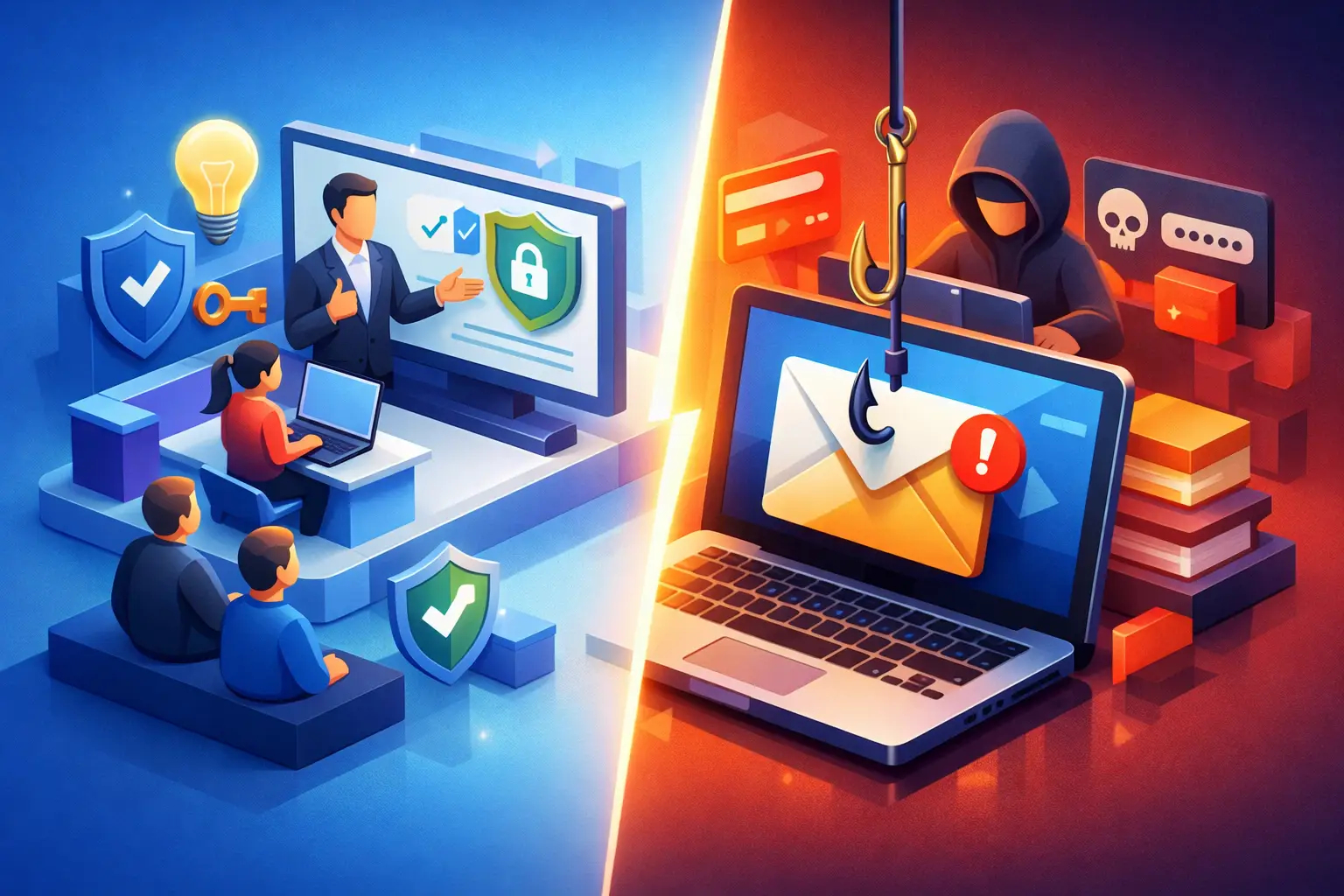
Security Awareness vs Phishing Simulations
A convincing phishing email can reach an employee who completed last year’s training, passed a quiz, and genuinely wants to do the right thing. That is why security awareness vs phishing simulations is the wrong debate for most organizations. Training builds judgment. Simulations test whether that judgment holds under realistic pressure. A mature human-risk program needs both.
For CISOs, compliance officers, IT leaders, and L&D teams, the objective is not simply to lower click rates for a quarterly report. It is to reduce the likelihood and impact of an incident, establish evidence of reasonable care, and build a workforce that recognizes when to stop, verify, and report.
Security Awareness vs Phishing Simulations: A False Choice
Security awareness training teaches people how threats work, what company policy requires, and how their decisions affect the business. It should cover the everyday behaviors that prevent incidents: strong authentication habits, safe data handling, secure use of cloud tools, reporting suspicious activity, and recognizing social engineering across email, SMS, collaboration platforms, and phone calls.
Phishing simulations are controlled tests. They send realistic but harmless messages to employees and record the response. Depending on the program design, metrics may include email opens, link clicks, credential submissions, attachment interactions, QR-code scans, reports, and time to report.
The distinction matters because the two activities answer different questions. Training asks, “Have employees been given the knowledge and context to act safely?” Simulations ask, “Can they apply that knowledge when an unfamiliar message creates urgency, authority pressure, or fear of missing out?”
Neither answer is sufficient alone. A company that trains without testing may have no evidence that lessons translate into behavior. A company that tests without teaching creates a cycle of failure, frustration, and artificial scorekeeping. Security starts with people, but people need clear expectations, relevant practice, and feedback they can use.
What Awareness Training Does Best
Effective awareness training creates a shared security baseline. Employees learn why a finance request from an executive might be fraudulent, why an MFA prompt can be an attack rather than a login issue, and why a public Wi-Fi network changes the risk of handling sensitive data. This context is especially valuable for new hires, contractors, and employees whose roles expose them to customer data, payment systems, source code, or privileged access.
Training also supports policy adoption and compliance readiness. Organizations subject to NIS2, sector-specific requirements, contractual obligations, or internal governance standards need more than a vague instruction to “be careful.” They need documented, role-appropriate education that explains responsibilities and can be demonstrated during an audit or investigation.
The quality of the learning experience determines whether training changes behavior. A generic annual slideshow followed by a predictable quiz may check a procedural box, but it rarely prepares someone for a targeted business email compromise attempt. Interactive, localized modules are more effective because they reflect the language, workflows, regulations, and threat scenarios employees actually encounter.
Role-based content is equally important. Finance teams should understand invoice fraud and payment-change verification. HR teams need to recognize recruiting scams, impersonation, and sensitive-record exposure. Developers and IT administrators require deeper instruction on credentials, access, cloud configuration, and incident escalation. Executives need concise education on high-value impersonation risks and decision-making during a cyber incident.
What Phishing Simulations Do Best
Phishing simulations reveal behavioral weak points that policy attestations and completion rates cannot show. They can identify departments that are being targeted more often, message styles that create the most confusion, and employees who need timely coaching. They also normalize reporting. When employees regularly see suspicious messages and receive constructive feedback, reporting becomes a practiced action rather than a hesitant one.
That reporting behavior may be the most valuable metric in the program. A single click can be contained. A fast report can help security teams block a malicious domain, warn other users, investigate account activity, and prevent a campaign from spreading. Measuring only failure rates misses whether the organization is developing an active line of defense.
Simulations are also useful for tracking improvement over time, but the data requires care. A lower click rate is encouraging, not definitive proof of lower risk. Employees may recognize a repeated template, warn one another before the test, or become overly suspicious of legitimate communication. A program should vary attack methods while keeping difficulty appropriate to the workforce and the organization’s current threat profile.
Testing should extend beyond email when relevant. QR phishing, credential-harvest pages, collaboration-tool messages, SMS scams, and vishing all reflect how attackers operate. Still, realism should serve a learning goal. Simulating a highly sophisticated executive impersonation campaign for every employee may create noise rather than useful insight. Match scenarios to job roles, risk exposure, and known attacker tactics.
The Risks of Treating Simulations as a Scoreboard
A phishing simulation can become counterproductive when it is designed to catch employees rather than improve them. Public leaderboards, punitive messaging, and excessively deceptive scenarios can damage trust in security and HR. Employees may hide mistakes, avoid reporting, or see the security team as an adversary.
There are legitimate situations where stronger follow-up is necessary. Repeated credential submission, risky behavior in a privileged role, or failure to complete required remediation may warrant manager involvement. But the response should be proportionate, documented, and focused on reducing risk. The purpose is not to shame someone for making a human error under pressure.
Privacy and labor considerations also vary by jurisdiction and organizational policy. Before launching a program, define what data will be collected, who can access it, how long it will be retained, and how results will be used. Security, legal, HR, compliance, and employee representatives should agree on the rules before testing begins.
Build a Program Where Training and Testing Reinforce Each Other
The most effective approach is a continuous cycle: educate, simulate, coach, measure, and improve. Start with a baseline assessment to understand current exposure and existing behavior. Then deliver foundational training that gives employees practical decision rules, such as verifying payment changes through a known channel and reporting unexpected MFA prompts immediately.
Follow training with simulations that reinforce a specific lesson. If the module covers fake document-sharing notifications, test a realistic version several weeks later. If employees struggle with QR-code phishing, provide a short targeted lesson and test that behavior again after remediation. The connection between lesson and exercise should be visible, not hidden.
When an employee clicks, the learning moment should happen immediately. A concise landing page can explain the warning signs, clarify the safe response, and direct the employee to a short remediation module when needed. When an employee reports a simulation, acknowledge the action. Positive reinforcement builds the reporting culture that security teams depend on during real incidents.
Cadence depends on risk and organizational capacity. Monthly microlearning and periodic simulations work well for many organizations because they keep security visible without overwhelming employees. High-risk groups may need more frequent, tailored scenarios. New hires should receive foundational instruction early, while annual compliance training can reinforce the wider policy framework.
Measure Outcomes That Matter to Leadership
Leadership needs metrics that connect workforce behavior to business risk. Completion rates remain useful for proving participation, but they should not be the main measure of success. Track reporting rates, median time to report, repeat-risk patterns, remediation completion, performance by role and region, and trends across different attack types.
Interpret results in context. A temporary increase in click rates after introducing more realistic scenarios may reflect better testing, not a weaker workforce. A low click rate with almost no reports may indicate employees are ignoring suspicious messages rather than escalating them. Pair quantitative metrics with qualitative feedback from employees and incident-response teams.
For regulated organizations, preserve evidence that training is current, localized where needed, role-based, and consistently administered. Document simulation methodology, remediation actions, and governance decisions. This creates a clearer compliance narrative while giving leadership a defensible view of human cyber risk.
Make Every Test a Learning Opportunity
Security awareness training gives employees the confidence to make safer choices. Phishing simulations show where confidence needs to become habit. Used together, they replace one-time compliance theater with a measurable program that strengthens detection, reporting, and resilience.
The next phishing email will not arrive on a convenient training day. Give your people the knowledge to recognize it, the practice to respond correctly, and the confidence to report it fast.
FAQ
1. What is the difference between Security Awareness Training and Phishing Simulations?
Security awareness training educates employees about cyber threats, company security policies, and safe behaviors. Phishing simulations are controlled exercises that test whether employees can apply that knowledge when faced with realistic phishing attempts. Training builds knowledge, while simulations measure behavior.
2. Are phishing simulations effective without awareness training?
Not usually. Simulations can identify risky behaviors, but without training employees may not understand why they made a mistake or how to improve. The most effective programs combine education, testing, and follow-up coaching.
3. How often should organizations run phishing simulations?
The ideal frequency depends on organizational risk and resources. Many organizations conduct phishing simulations monthly or quarterly, while high-risk departments such as Finance, HR, and IT may benefit from more frequent testing and targeted scenarios.
4. Which metric is more important: click rate or reporting rate?
Reporting rate is often the more valuable metric. While reducing clicks is important, employees who quickly report suspicious emails give security teams an opportunity to investigate threats, warn others, and limit the impact of an attack before it spreads.
5. How do phishing simulations support compliance requirements?
Phishing simulations help organizations demonstrate ongoing security awareness efforts, identify areas requiring additional training, and document continuous improvement. Combined with role-based training, they can support audits and compliance initiatives related to frameworks such as NIS2, ISO 27001, and industry-specific security requirements.

Written By
Yavor Y. Zlatev
CEO & Executive Director at Advanced Vision IT | Published on August 29, 2026
Yavor leads strategic growth and technology operations at Advanced Vision IT, specializing in enterprise cybersecurity, cloud infrastructure, NIS2 compliance, and managed security service delivery. Find out more about me