


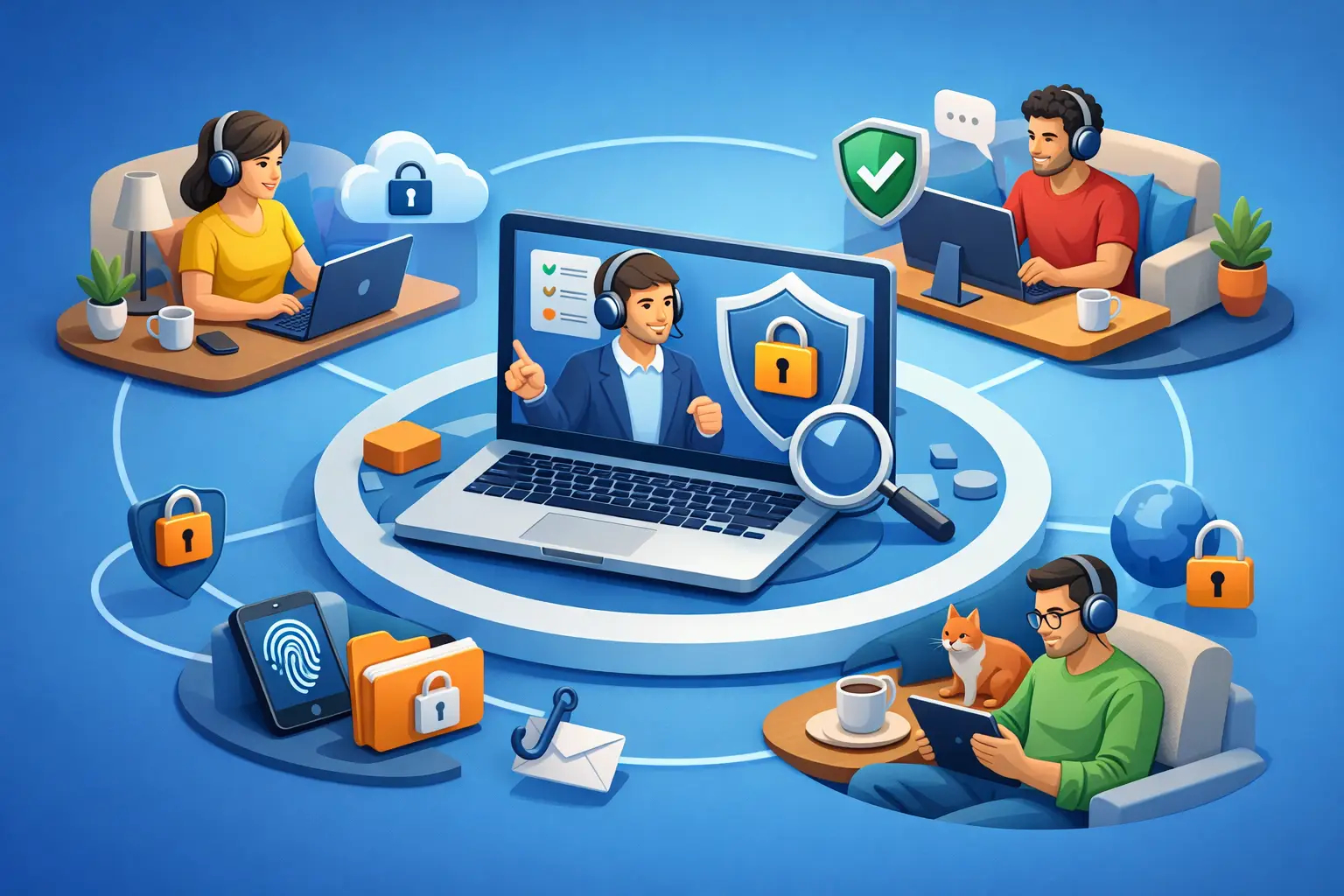
Security Training for Remote Teams That Works
A remote employee approves a login prompt during a school pickup line. A contractor uploads a file from a personal laptop. A manager joins a board call from hotel Wi-Fi and shares a screen without realizing a confidential document is open in another tab. This is why security training for remote teams cannot be treated as a yearly checkbox. The risk is constant, distributed, and tied to everyday behavior.
For security leaders, HR teams, and compliance owners, the challenge is not simply delivering content to people who work from home. It is building repeatable habits across devices, locations, time zones, and job functions without slowing the business down. Remote work expands flexibility, but it also expands the attack surface. Training has to reflect that reality.
Why security training for remote teams is different
Office-based awareness programs were built around shared networks, managed devices, in-person reinforcement, and visible supervision. Remote environments remove those controls. Employees work from home offices, kitchen tables, coworking spaces, airports, and client sites. The same user may switch between a corporate laptop, a mobile phone, and a home router in a single day.
That changes both the content and the delivery model. Remote employees face a higher volume of social engineering, more blurred boundaries between personal and business technology, and less immediate access to IT support when something looks suspicious. A training program that focuses only on generic phishing examples or password hygiene will miss the operational reality of how remote work actually happens.
There is also a leadership issue. When security expectations are not clearly defined for distributed work, employees create their own rules. They forward files to personal email to move faster. They take screenshots to share information in chat. They use unauthorized tools because approved tools feel inconvenient. Most of these decisions are not malicious. They are efficiency decisions made without enough security context.
What effective remote security training must cover
The strongest programs focus on behaviors, not just topics. People need to know what secure work looks like in the moment they are making a decision.
Start with identity threats. Remote teams live inside cloud apps, collaboration tools, and single sign-on workflows. Attackers know this. Training should teach employees how modern phishing works beyond email, including fake MFA prompts, login page spoofing, business chat impersonation, and account takeover attempts that exploit fatigue and urgency.
Then address device and environment risk. Employees need clear guidance on software updates, screen privacy, approved device use, removable media, local file storage, and what to do if a device is lost or stolen. For many organizations, home network basics matter too, but the level of detail should match the audience. A finance team does not need a networking lesson. It needs practical rules that reduce exposure.
Data handling is another major gap. Remote work increases copying, syncing, downloading, and sharing. Training should explain how to classify sensitive information, where it may be stored, how it may be transmitted, and when a workaround becomes a policy violation. If your workforce operates across regions, this must also align with relevant privacy and sector obligations.
Finally, incident reporting has to be frictionless. Many remote workers hesitate to report because they are unsure whether something is serious enough. Good training removes that uncertainty. Show what to report, how quickly to report it, and what happens next. If people believe reporting creates blame, they will stay quiet. That delay is expensive.
Build training around roles, not just risks
A generic awareness module will not prepare a distributed organization for real-world incidents. The better approach is role-based education tied to business activity.
Executives need concise guidance on travel risk, impersonation, confidential communications, and decision-making under pressure. Finance and procurement teams need stronger training on invoice fraud, vendor compromise, and approval controls. Developers and technical staff need clearer instruction on remote access, repository hygiene, secrets management, and the risks of using unapproved AI tools with proprietary data. Customer-facing teams need to recognize social engineering attempts that arrive through support channels, messaging apps, and voice calls.
This is where many programs fail. They train everyone the same way because it is easier to administer. It is easier, but it is not more effective. If the goal is measurable risk reduction, training has to reflect the actual attack paths facing each group.
Delivery matters as much as content
Remote workers are already overloaded with video calls, notifications, and mandatory learning. If training feels generic or disconnected from daily work, completion may happen, but behavior change will not.
Short, interactive modules work better than long annual sessions. Scenario-based learning is especially effective because it shows the employee the decision point, not just the theory. Quizzes help reinforce judgment, but they should test real choices rather than memorization. Certifications can add accountability, particularly in regulated environments or for higher-risk roles.
Timing also matters. Annual awareness training still has a place for policy coverage and baseline compliance, but it is not enough on its own. Remote teams benefit from a layered rhythm: onboarding training for new hires, role-based modules throughout the year, campaign-based refreshers tied to emerging threats, and periodic phishing simulations or behavioral assessments.
There is a trade-off here. More frequent training can improve retention, but too much training creates fatigue. The answer is not volume. It is relevance. Give employees fewer, sharper learning moments that map directly to what they encounter in email, chat, file sharing, mobile work, and cross-border collaboration.
Compliance pressure is raising the bar
For many organizations, security training for remote teams is no longer just a best practice. It is part of demonstrating due care, policy enforcement, and workforce readiness under growing regulatory scrutiny.
That matters in sectors influenced by frameworks and regulations such as NIS2, data protection requirements, contractual security obligations, and industry-specific cyber resilience expectations. Regulators and customers increasingly want evidence that training is not only assigned, but aligned to risk and supported by records, reporting, and repeatable governance.
This is where training strategy needs to connect with compliance strategy. A remote workforce operating across the US, Europe, and the GCC may require localized content, language support, and region-specific examples. The baseline message stays consistent, but the regulatory and operational context does not. A one-size-fits-all course library may check a box, but it rarely holds up under audit, incident review, or executive scrutiny.
How to measure whether your program is working
Completion rates are easy to report and easy to misread. They tell you who finished the course, not whether the organization is safer.
A stronger measurement model looks at behavior and operational outcomes. Are phishing reporting rates improving? Are repeat mistakes declining? Are higher-risk groups completing targeted modules on time? Are incident reports arriving faster? Are policy exceptions dropping? If you run simulations, are employees identifying the right threats, or only the obvious ones?
You should also look for signs of maturity beyond awareness. Managers should know how to reinforce secure behavior. New hires should understand remote work expectations quickly. Leaders should be able to see where risk is concentrated by role, region, and business unit. If your training platform cannot surface those insights, you are managing education but not managing risk.
Organizations that take this seriously increasingly want proof of effectiveness, not just proof of delivery. That is one reason structured programs with interactive lessons, assessments, and certifications are gaining traction. They create clearer evidence for both internal stakeholders and external requirements.
The fastest way to weaken your program
The biggest mistake is treating remote work as a temporary exception instead of a permanent operating model. When policies, training, and leadership messaging still assume office-first behavior, employees are forced to improvise.
Another common mistake is separating awareness from the rest of the security program. If IT, compliance, HR, and security each communicate different expectations, the workforce gets mixed signals. Training should reflect actual controls, approved tools, escalation paths, and leadership priorities. If it does not, employees stop trusting it.
The stronger model is integrated and business-led. Security sets the standards. Compliance maps obligations. HR and L&D support delivery. Managers reinforce expectations. Executives model the behavior. Providers like CISO EDU fit this model well when organizations need scalable, localized programs that connect workforce education with compliance readiness and measurable outcomes.
Remote work did not weaken cybersecurity. It exposed whether organizations had built it into the way people actually work. The companies that reduce risk are not the ones with the longest policies or the loudest warnings. They are the ones that teach people what to do, make that guidance usable, and keep reinforcing it until secure behavior becomes part of the culture.
FAQ
1. Why is security training important for remote teams?
Remote employees often work from various locations, networks, and devices, increasing exposure to phishing attacks, account compromise, data leaks, and other cyber threats. Effective security training helps employees recognize risks and make safer decisions in their daily work.
2. How often should remote employees receive security training?
Annual training alone is not enough. Organizations should combine onboarding training, role-specific learning modules, regular awareness refreshers, and periodic phishing simulations to reinforce secure behavior throughout the year.
3. What topics should remote security awareness training include?
A comprehensive program should cover phishing and social engineering, multi-factor authentication (MFA), password security, safe use of devices, data handling, secure collaboration tools, remote work best practices, and incident reporting procedures.
4. How can organizations measure the effectiveness of security training?
Beyond completion rates, organizations should track phishing reporting rates, simulation results, incident reporting speed, policy violations, repeat mistakes, and overall improvements in employee security awareness and behavior.
5. Should security training be customized for different roles?
Yes. Different teams face different risks. Executives, finance staff, developers, HR professionals, and customer-facing employees should receive training tailored to the threats, responsibilities, and business processes specific to their roles.

Written by: Ivan Energiev

IT Project Coordinator · Operations Excellence & Service Delivery Leader at Advanced Vision IT Ltd | Published on September 02 2026
Ivan advises insights on IT project coordination, operations excellence, and service delivery leadership.