


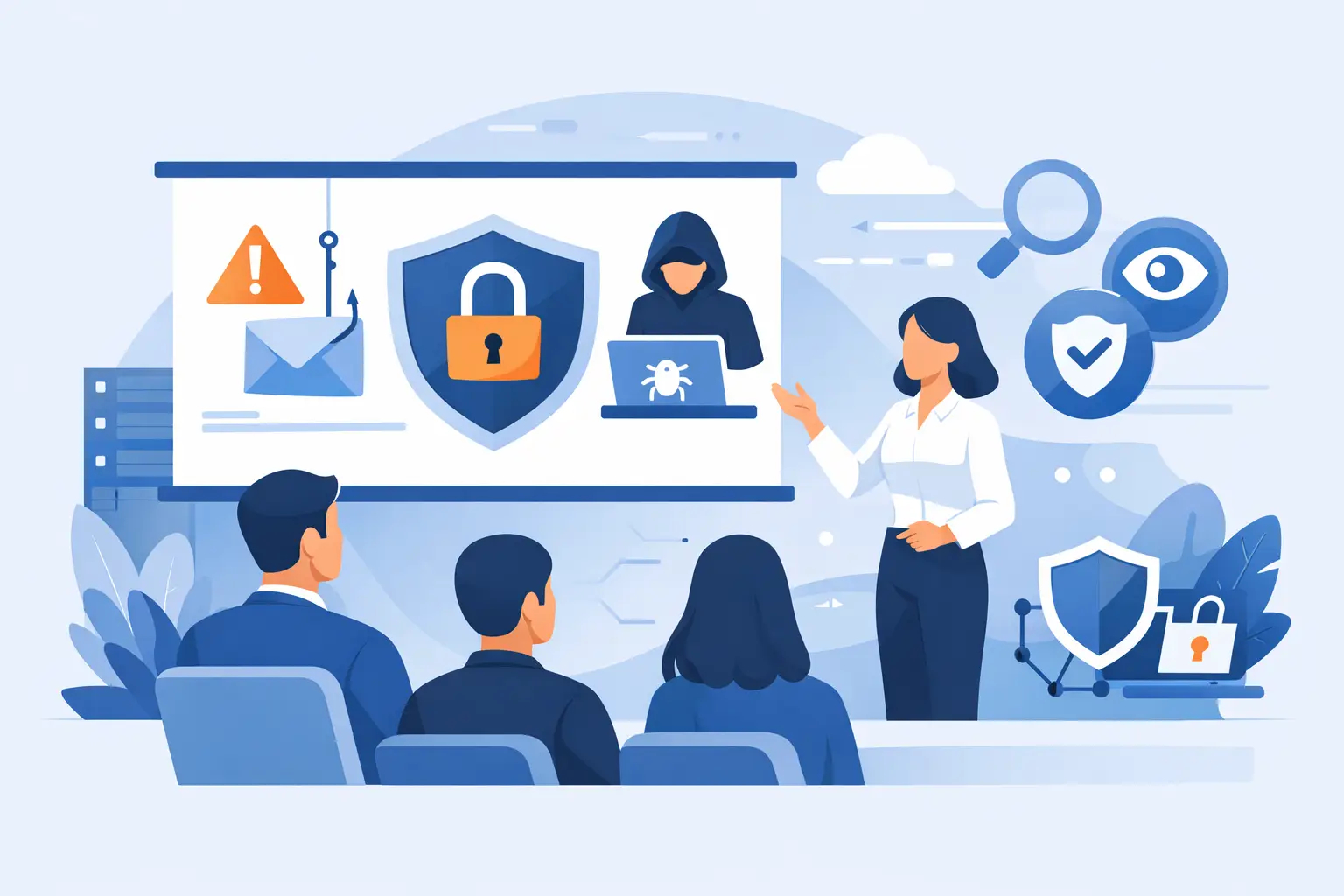
What Is Cybersecurity Awareness Training?
One employee clicks a fake invoice, another reuses a password from a breached personal account, and a third sends sensitive data to the wrong recipient. None of these incidents starts with a firewall failure. They start with human behavior. That is exactly why the question what is cybersecurity awareness training matters to every organization with staff, systems, data, and regulatory exposure.
Cybersecurity awareness training is a structured program that teaches employees, contractors, and sometimes leadership teams how to recognize threats, make safer decisions, and follow security policies in daily work. At its best, it does not function as a once-a-year checkbox exercise. It changes behavior. It helps people spot phishing, protect credentials, handle data correctly, report suspicious activity fast, and understand their role in reducing business risk.
For security leaders, this is not just an HR initiative with technical branding. It is a core control for reducing incidents caused by human error. For compliance teams, it supports regulatory readiness. For executives, it lowers the chance that a preventable mistake turns into downtime, fines, reputational damage, or customer loss.
What cybersecurity awareness training actually covers
The simplest way to think about cybersecurity awareness training is this: it teaches people how attackers really target organizations and what employees should do differently because of that reality.
Most programs cover phishing, social engineering, password hygiene, multi-factor authentication, safe browsing, device security, data handling, secure remote work, and incident reporting. More mature programs also address role-specific risks. Finance teams may need fraud and invoice manipulation training. HR may need guidance on protecting employee data. Executives often need focused education on business email compromise, mobile device exposure, and impersonation attacks.
That breadth matters because cyber risk does not hit every employee in the same way. A generic lesson may explain phishing well enough, but it will not prepare an accounts payable manager for a targeted payment redirection scam or help a developer understand secure handling of credentials in shared environments. Good training reflects real exposure, not just generic theory.
What is cybersecurity awareness training supposed to achieve?
The goal is not to turn employees into security analysts. The goal is to create a workforce that makes fewer risky decisions, spots threats earlier, and knows when to escalate concerns.
That sounds straightforward, but many organizations get this wrong. They measure completion rates and assume they are protected. Completion is easy. Behavioral improvement is harder. If employees pass a quiz and still click suspicious links, share files incorrectly, or ignore reporting procedures, the business is not materially safer.
Effective training should improve several outcomes at once. It should reduce susceptibility to common attack methods, reinforce internal policy, strengthen reporting culture, and support compliance obligations. It should also help employees understand why rules exist. People are more likely to follow security controls when the business case is clear and the training respects the reality of how they work.
Why businesses invest in cybersecurity awareness training
Most organizations do not invest in awareness training because they suddenly became passionate about e-learning. They invest because human error remains one of the most persistent sources of cyber risk.
Attackers know this. They do not always need to break through hardened infrastructure if they can manipulate a person into granting access, revealing information, or approving the wrong action. Phishing, pretexting, credential theft, and impersonation campaigns continue to work because they exploit urgency, trust, distraction, and routine.
Training helps close that gap. It builds practical recognition skills and gives employees repeat exposure to realistic threat scenarios. Over time, this changes reflexes. People pause before clicking. They question unusual requests. They report anomalies instead of ignoring them.
There is also a compliance driver. Depending on industry and geography, organizations may need demonstrable training efforts to support obligations related to data protection, cyber resilience, and internal control maturity. In sectors affected by frameworks such as NIS2 or broader security governance requirements, awareness training is not a nice-to-have. It is part of proving that the organization takes risk reduction seriously.
What good cybersecurity awareness training looks like
Good training is relevant, continuous, measurable, and aligned to the business.
Relevant means the content reflects real-world threats and the employee’s role. A warehouse supervisor, a remote sales leader, and a board member do not face the same decisions. Training should speak their language, match their workflows, and focus on the risks they are most likely to trigger or encounter.
Continuous means training is not limited to one annual session. Threats change, attack techniques evolve, and people forget. Short recurring modules, phishing simulations, scenario-based refreshers, quizzes, and policy reminders are more effective than a single information dump. Awareness is built through repetition and context.
Measurable means the program produces evidence beyond attendance. Security leaders should be able to track participation, quiz performance, phishing simulation outcomes, reporting rates, and completion by role or region. More advanced programs correlate training results with incident trends and control gaps.
Aligned to the business means the training supports operational needs, compliance requirements, and organizational culture. A global company may need localized content by language and regulation. A highly regulated organization may need proof of certifications and audit-ready records. A fast-growing company may need scalable onboarding modules for new hires. The right program fits the business instead of forcing the business to fit the program.
Where many programs fail
The biggest failure is treating awareness training as a checkbox.
Employees can tell when content was purchased, assigned, and forgotten. If the training is outdated, overly technical, patronizing, or disconnected from their daily work, it will not influence behavior. It may satisfy a policy requirement on paper, but it will not create a stronger human line of defense.
Another common problem is overgeneralization. Not every risk applies equally across departments, and not every geography faces the same regulatory expectations. A one-size-fits-all approach may be easier to administer, but it often leaves critical gaps.
There is also a trade-off between frequency and fatigue. More training is not automatically better. If employees are overloaded with repetitive modules and unrealistic tests, engagement drops and resentment grows. The best programs are disciplined. They deliver the right content, to the right people, at the right intervals.
Is cybersecurity awareness training enough on its own?
No. Training matters, but it is only one part of a broader security strategy.
Employees should not be expected to carry the full burden of cyber defense. Even well-trained people make mistakes, especially under pressure. That is why awareness training works best alongside technical controls such as email filtering, access management, endpoint protection, data loss prevention, and strong reporting workflows.
Think of it this way: tools reduce exposure, and training reduces the chance that people amplify it. One without the other leaves the organization weaker than it should be.
This is where mature security programs stand apart. They do not frame awareness as a substitute for technical controls. They integrate it into risk management, compliance, onboarding, leadership communication, and incident readiness.
How to evaluate a training program
If you are selecting or improving a program, ask practical questions. Does the content reflect current threats? Can it be tailored by role, region, and regulatory environment? Does it include interactive learning, quizzes, and scenario-based exercises? Can you measure behavior change, not just completion? Will it produce records that support audits and internal reporting?
It also helps to ask whether the program can reach different audiences inside the same organization. Frontline employees need practical guidance. Managers need escalation clarity. Executives need risk-based context. CISOs and compliance leaders need reporting and defensibility. Strong providers understand that cybersecurity education is not a single audience problem.
That is why organizations often look for platforms that connect workforce awareness, compliance readiness, and leadership-level security education in one model. CISO EDU is built around that reality, helping businesses create cyber-smart teams while supporting the broader operational and regulatory goals behind training.
What is cybersecurity awareness training worth to the business?
Its value is measured in avoided mistakes, faster reporting, stronger compliance posture, and fewer preventable incidents. That value can be hard to quantify perfectly because you are often measuring what did not happen. But any security leader who has dealt with a phishing-led compromise, credential theft incident, or data handling failure knows the cost of untrained behavior is real.
A strong program does more than educate. It sets expectations. It shows employees that security is part of how the business operates, not a separate technical concern owned by IT. Over time, that creates a culture where safer decisions become normal, and normal behavior is what reduces risk at scale.
If you are still asking what is cybersecurity awareness training, the most useful answer is this: it is the process of turning people from a predictable point of failure into an active part of your defense. Not perfectly, not instantly, and never through compliance theater alone. But with the right structure, relevance, and reinforcement, it becomes one of the clearest ways to reduce human-driven cyber risk before it becomes business damage
ADVANCED VISION IT - MALTA Address: Suite 8, Ta’ Mallia Buildings, Triq In‑Negozju, Zone 3, Central Business District, Birkirkara, CBD 3010, Malta
Registration number: C111282, VAT Number: MT31713827
Phone:+35679224404
Email: office@advisionit.com
ADVANCED VISION IT - BULGARIA
Address: 35 Dimitar Hadzhikotsev str. Ent A, Lozenets, Sofia, Bulgaria
ID No: 205789039, VAT No: BG205789039
Phone: +359 888 258 530
Email: office@advisionit.com