


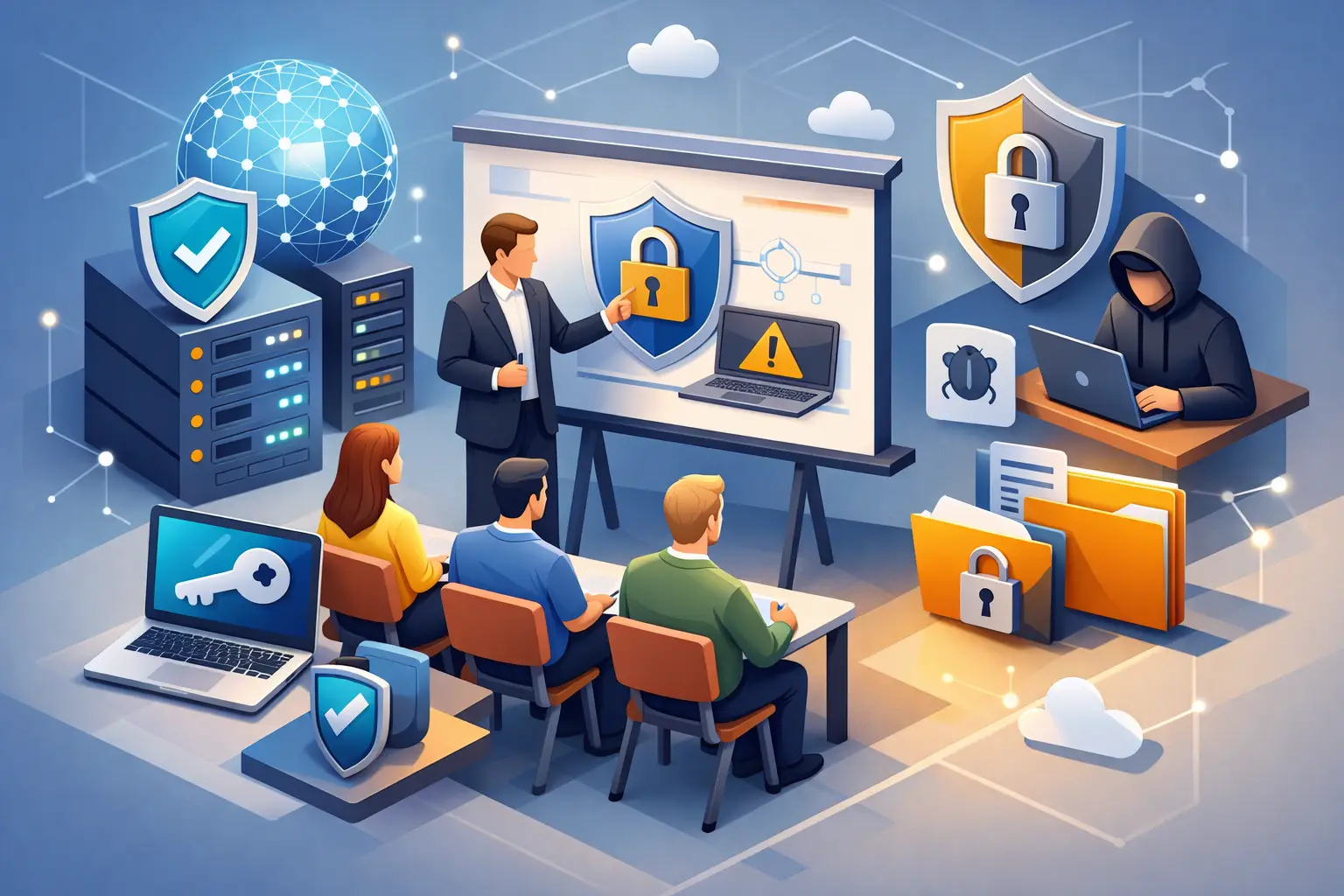
What Is NIS2 Employee Training and Who Needs It?
A phishing email that reaches the right employee can bypass a substantial investment in security tools within minutes. That is why the answer to what is NIS2 employee training is not simply “a compliance course.” It is a structured, evidence-based program that helps people recognize cyber risk, follow secure procedures, and make better decisions before an incident becomes a business disruption.
For organizations in scope of the EU’s NIS2 Directive, workforce readiness is part of cyber resilience. The directive raises the bar for risk management and leadership accountability. Training gives those requirements an operational reality: employees know what to do, managers can reinforce expectations, and leadership can demonstrate oversight.
What NIS2 Employee Training Means in Practice
NIS2 employee training is cybersecurity education designed around the directive’s risk-management expectations and the national laws that implement them. It should provide relevant employees, managers, and senior leaders with the knowledge needed to reduce cyber incidents, report suspicious activity quickly, and protect critical systems and information.
The legal detail matters. NIS2 is an EU directive, not a single rulebook applied identically in every country. Each member state transposes it into national law, and the precise requirements, supervisory approach, and penalties can vary. A training program must therefore reflect the jurisdictions where an organization operates, its sector, and its risk profile.
Still, the central expectation is clear. Article 21 identifies cyber hygiene practices and cybersecurity training among the measures organizations should address. Training is not a standalone control that excuses weak identity management, missing incident response plans, or unpatched systems. It is one layer in a broader security program. But it is a layer that directly affects whether technical and procedural controls work when people are under pressure.
Why NIS2 Makes Training a Leadership Issue
Under NIS2, management bodies have explicit responsibilities for approving and overseeing cybersecurity risk-management measures. They are also expected to follow training so they have sufficient knowledge to understand cyber risks and assess the organization’s approach.
That changes the conversation. Security awareness cannot sit quietly with HR, IT, or compliance as an annual administrative task. Executives and board members need training that speaks to their decisions: risk appetite, third-party exposure, incident escalation, continuity planning, funding priorities, and accountability.
Employee learning, meanwhile, must connect to the decisions people make in their actual jobs. A finance team facing invoice fraud needs more than generic phishing advice. An operations team with access to industrial or critical systems needs to understand safe remote access, change control, and escalation procedures. Developers, administrators, procurement teams, and customer-facing staff all encounter different threats.
The goal is not to turn every employee into a security analyst. The goal is to create a workforce that can spot warning signs, avoid predictable mistakes, and escalate concerns without delay or uncertainty.
Who Needs NIS2 Training?
Training should reach more than the users who receive a company-wide awareness email. The right audience depends on the organization, but a NIS2-ready program usually includes three levels.
All Employees and Long-Term Contractors
Anyone with access to company systems, data, facilities, or suppliers can affect the organization’s risk exposure. Core learning should cover phishing and social engineering, strong authentication, password and credential practices, device security, data handling, safe use of collaboration tools, and incident reporting.
Contractors deserve particular attention. A contractor may have privileged access, work remotely, or operate across multiple clients. If they are part of a business process or technology environment, leaving them outside the training program creates an obvious gap.
High-Risk and Privileged Roles
Role-based training goes deeper. IT administrators need practical instruction on privileged access, patching discipline, logging, secure configuration, and incident containment. Procurement and vendor-management teams need to recognize supply-chain risk. HR and finance teams need defenses against impersonation, payment diversion, and sensitive-data exposure.
This is where generic training often fails. The same short module for everyone is easy to deploy, but it rarely reflects the decisions that create the most significant risk. Broad awareness establishes a baseline; role-specific education addresses the threats that matter most.
Senior Leaders and Management Bodies
Leadership training should be concise, relevant, and decision-focused. It should explain the organization’s obligations, the material threat landscape, incident reporting and escalation, crisis roles, and the business impact of security failures.
Leaders do not need a technical certification to provide effective oversight. They do need enough knowledge to challenge assumptions, ask for meaningful evidence, approve sensible risk treatment, and respond decisively when an incident occurs.
What a Strong NIS2 Training Program Covers
A credible program combines foundational awareness with targeted learning and practice. The core curriculum should address how attacks happen, how employees should respond, and where internal policies apply.
For most organizations, this means training on social engineering, phishing, malware and ransomware behaviors, multi-factor authentication, secure remote work, data classification, physical security, reporting channels, and basic incident response actions. It should also explain why certain controls exist. People are more likely to follow a verification procedure for payment changes when they understand how business email compromise works.
The program should then map specialized modules to role and risk. An administrator may need a lesson on access control and secure configuration. A manager may need guidance on handling a suspected incident in their team. A procurement lead may need training on supplier due diligence and contractual security expectations.
Interactive learning is more effective than passive completion. Realistic scenarios, short knowledge checks, simulated phishing exercises, and certifications create evidence that employees engaged with the material and understood it. They also help security teams identify where behavior or knowledge needs reinforcement.
Frequency, Evidence, and Measurement
NIS2 does not make a once-a-year slide deck a meaningful security program. Threats change, staff turnover occurs, and people forget information they never use. Initial training should be followed by regular reinforcement, timely updates when threats or policies change, and additional instruction after incidents or near misses.
The right cadence depends on risk. A lower-risk office population may benefit from periodic microlearning and simulations, while teams with privileged access or critical operational responsibilities may require more frequent, specialized instruction. The point is consistency, not training volume for its own sake.
Evidence matters because compliance leaders need to show that training happened and that it is managed. Maintain records of enrollment, completion, quiz performance, certifications, reminders, and role-based assignments. Document the curriculum, update dates, and the rationale for different learning paths. If a regulator, customer, insurer, or auditor asks how the organization addresses human risk, these records turn good intentions into defensible proof.
Completion rates alone are not enough. A 100% completion rate can coexist with poor reporting behavior or repeated phishing failures. Track practical indicators such as simulation trends, reporting rates, time to report, assessment results, repeat errors, and completion by department or role. Use the findings to improve the program, not to shame employees.
Common Mistakes That Undermine Compliance
The most common mistake is treating NIS2 training as a box-checking exercise. When content is generic, too long, disconnected from employees’ work, or delivered only once, people learn how to complete a module rather than how to make secure decisions.
Another mistake is excluding leadership. If executives do not understand their oversight role, training may be underfunded, inconsistent, or disconnected from enterprise risk management. Security culture follows visible leadership behavior.
Organizations also lose ground by failing to localize. A workforce spread across Europe may need different language options, local examples, and country-specific compliance context. Translation alone is not always enough. Training should be understandable, culturally relevant, and aligned to the policies employees must follow.
Finally, do not confuse awareness training with the whole NIS2 program. Training supports resilience, but it cannot replace technical safeguards, supplier controls, vulnerability management, incident response planning, or governance. The best programs connect people, process, and technology rather than asking employees to compensate for weak controls.
Building a Program That Holds Up Under Scrutiny
Start with a practical assessment of your people risks. Identify the roles with access to critical systems, sensitive information, payment processes, operational technology, or supplier relationships. Review recent incidents, phishing reports, audit findings, and recurring policy violations. Those signals should shape the curriculum.
Next, define learning paths for employees, high-risk roles, and leadership. Assign clear ownership across security, compliance, HR, and learning teams. Security should define risk priorities, but HR and L&D are essential for enrollment, accessibility, reminders, and durable adoption.
Then measure, adapt, and document. CISO EDU’s approach to interactive modules, quizzes, and certifications supports this discipline by making training relevant to role, region, and regulatory requirements. The result should be more than proof of participation. It should be a workforce that recognizes threats early and knows exactly how to respond.
NIS2 raises a direct challenge for organizations: prove that cybersecurity is governed, practiced, and understood. Build training around the real decisions your people make, reinforce it before a crisis, and give every employee a clear path from uncertainty to action.
FAQ
Is NIS2 employee training mandatory?
NIS2 does not prescribe a single mandatory training course, but it clearly emphasizes cybersecurity awareness, cyber hygiene practices, and cybersecurity training as part of broader cybersecurity risk-management measures. Organizations within the scope of NIS2 are expected to provide appropriate training and demonstrate that employees and leadership understand their cybersecurity responsibilities.
How often should employees complete NIS2 cybersecurity training?
There is no fixed frequency defined by NIS2. Best practice is to provide onboarding training for new employees, ongoing awareness activities throughout the year, regular refresher training, and targeted education whenever significant threats, incidents, or policy changes occur.
Does NIS2 training apply only to employees?
No. Organizations should also consider contractors, consultants, temporary staff, and other individuals who have access to systems, data, facilities, or business processes. Anyone who can influence cybersecurity risk should receive training appropriate to their role and level of access.
What evidence should organizations keep to demonstrate NIS2 training compliance?
Useful records include training completion certificates, attendance logs, assessment scores, phishing simulation results, curriculum documentation, role-based training assignments, and historical records of content updates. Together, these provide evidence of a structured and actively managed training program.
What is the difference between general security awareness training and NIS2 employee training?
General security awareness training typically focuses on topics such as phishing, passwords, and safe online behavior. NIS2 employee training goes further by aligning learning activities with regulatory expectations, risk management objectives, incident reporting requirements, role-specific responsibilities, and management accountability.
How can organizations measure the effectiveness of NIS2 employee training?
Organizations should look beyond completion rates and measure practical outcomes. Effective metrics include phishing simulation performance, incident reporting rates, reporting speed, assessment results, repeat mistakes, and long-term behavioral improvements. These indicators provide a more accurate picture of whether training is strengthening cyber resilience across the organization.

Written By
Yavor Y. Zlatev
CEO & Executive Director at Advanced Vision IT
Yavor leads strategic growth and technology operations at Advanced Vision IT, specializing in enterprise cybersecurity, cloud infrastructure, NIS2 compliance, and managed security service delivery. Find out more about me