


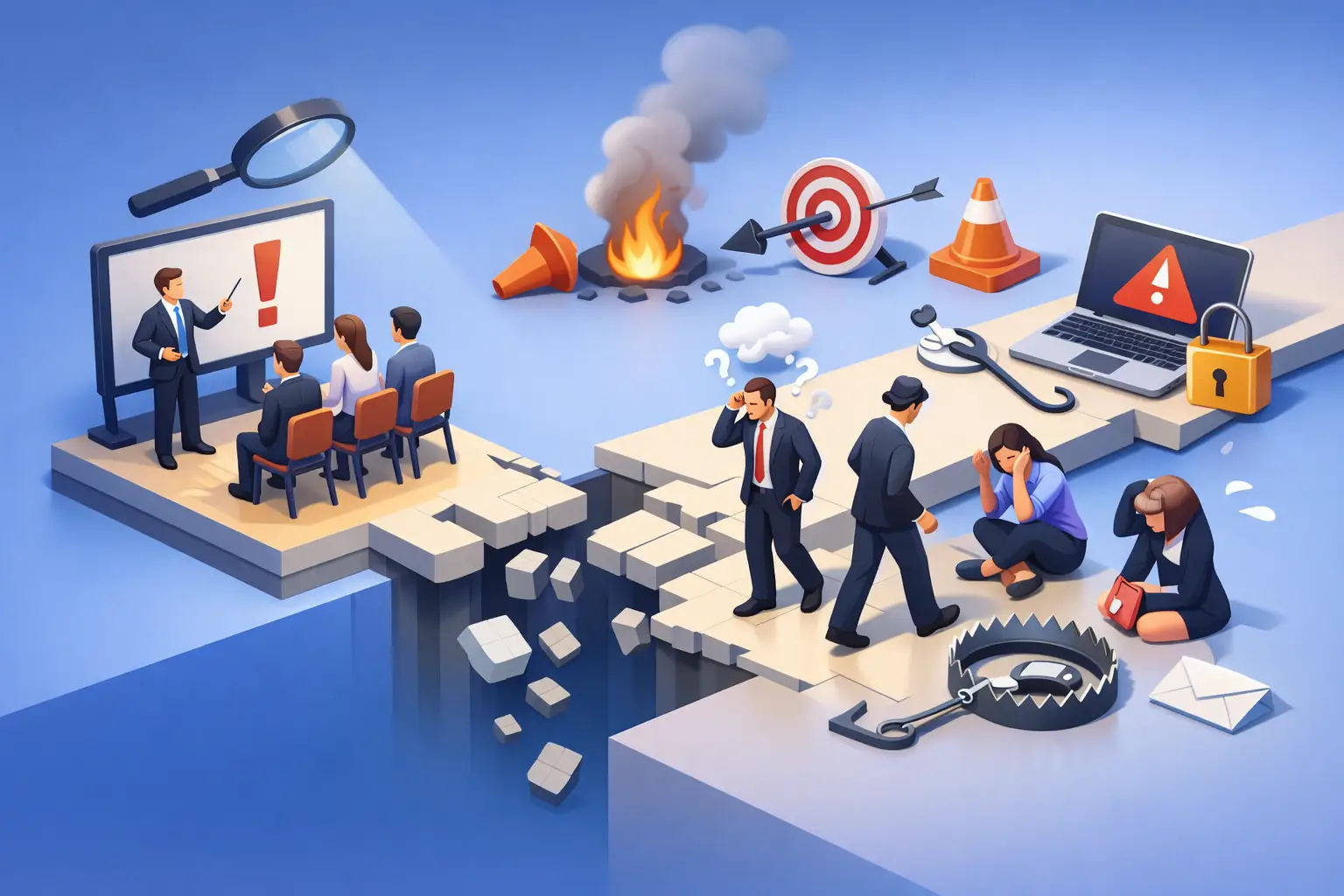
Why Awareness Training Fails in Business
An employee completes a 20-minute security course, scores 100% on the quiz, and receives a certificate. Three weeks later, they approve a fraudulent Microsoft 365 login prompt because it arrives during a busy deadline. This is why awareness training fails: passing content is not the same as changing behavior when pressure, distraction, and uncertainty are real.
For CISOs, compliance leaders, and L&D teams, this distinction matters. Human error remains a route into costly incidents, yet many organizations still treat training as a once-a-year administrative task. They can prove completion. They cannot confidently show that people will recognize, report, and resist a credible attack.
Cybersecurity starts with people, not tools. But people need training designed for the decisions they actually make.
Awareness Training Fails When It Measures Attendance, Not Readiness
Completion rates are easy to report to the board, auditors, and regulators. They show that the organization assigned a course and employees opened it. They do not show whether employees can apply the lesson in a realistic moment.
A short quiz can also create false confidence. If every question has an obvious answer, learners quickly identify the expected response without understanding the risk. They remember that phishing is bad. They may not know what to do when an email appears to come from a known vendor, uses an existing invoice thread, and asks for a payment detail to be changed.
The measurement problem grows when organizations rely on a single annual phishing simulation. Click rate has value, but it is only one signal. Employees may ignore a suspicious message, report it, delete it, or act on it through another channel. A meaningful program tracks the behaviors that reduce exposure: accurate reporting, response time, repeat-risk patterns, role-based improvement, and whether teams know the correct escalation path.
Compliance evidence still matters. NIS2, sector requirements, customer questionnaires, and internal audit obligations all make documented education necessary. But evidence of training should support security outcomes, not replace them. A certificate proves participation. Readiness is demonstrated through safer decisions.
Generic Content Misses the Risk at the Point of Work
Most employees do not need a lecture on every cyber threat. They need clear guidance for the risks embedded in their role.
A finance team needs to recognize business email compromise, payment diversion, invoice fraud, and urgent executive impersonation. Developers need practical guidance on credential handling, dependency risk, code repositories, and reporting exposed secrets. HR teams need to protect candidate and employee data. Executives need to understand targeted social engineering, travel risks, and the decisions that shape organizational resilience.
When everyone receives identical content, it often becomes too broad to be useful and too long to retain. Employees disengage because the examples do not resemble their work. Security leaders lose a chance to address the attack paths that matter most.
Localization is equally important. A globally distributed workforce may face different regulatory expectations, languages, cultural norms, and regional attack patterns. A program that works for a U.S.-based office may not be sufficient for teams operating across Europe or the GCC. The goal is consistency of security standards without pretending every employee faces the same context.
Training should use scenarios employees recognize: a message from a regular supplier, a QR code in a shared workspace, a request delivered through a collaboration platform, or an AI-generated voice message that sounds like a senior leader. Relevance turns an abstract warning into a decision employees can make correctly.
One Annual Course Cannot Compete With Daily Pressure
Attackers do not operate on an annual training calendar. They exploit rushed approvals, new hires, system changes, travel, seasonal workloads, and moments when employees are overloaded.
A single, lengthy course creates a familiar pattern: employees complete it quickly, retain a portion of it, and return to work. Months later, the details have faded. That is normal human memory, not employee negligence.
Effective awareness programs reinforce a small number of behaviors over time. Short interactive modules, timely reminders, practical simulations, and targeted follow-up help employees retrieve what they learned when it counts. This approach requires more planning than a yearly rollout, but it is more aligned with how behavior changes.
Frequency alone is not the answer. Constant alerts and repetitive tests can create fatigue or resentment. The right cadence depends on risk, role, incident trends, and organizational change. A high-risk finance function may need more frequent scenario-based reinforcement than a team with limited access to sensitive systems. The program should be proportionate, not noisy.
Fear-Based Training Can Reduce Reporting
Employees often hesitate to report suspicious activity because they fear being blamed, slowing down work, or looking inexperienced. If training frames every mistake as carelessness, people learn to hide uncertainty rather than escalate it.
That is a security failure. Early reporting can stop a compromised account, isolate a malicious attachment, or reveal a wider campaign before damage spreads. Employees must understand that reporting a suspected threat is a positive action, even when the message turns out to be legitimate.
Security teams need to pair expectations with psychological safety. Make the reporting process simple. Explain what happens after someone reports. Acknowledge useful reports quickly. Avoid public shaming after simulation failures. When remediation is needed, deliver it in a focused, respectful way that improves the next decision.
Culture is not a soft add-on to awareness training. It determines whether employees use the knowledge they have. A workforce that feels safe asking, “Does this look right?” is harder to manipulate than one that feels compelled to act fast and stay silent.
Leaders Can Undermine the Program Without Realizing It
Employees watch what leaders do under pressure. If executives bypass approval procedures, demand urgent exceptions, share sensitive information through unapproved channels, or dismiss security checks as obstacles, training loses credibility.
This is especially relevant for senior leaders, who are frequent targets of impersonation and business email compromise. Executive education should not be a simplified version of employee training. It should address strategic risk, decision rights during incidents, vendor exposure, communication protocols, and the financial impact of cyber events.
Leadership support also means giving employees permission to pause. A finance manager who delays a questionable wire transfer should be protected, not criticized for missing a deadline. A service desk employee who verifies an executive request should not be punished for challenging authority. Those signals shape behavior faster than any slide deck.
How to Build Training That Changes Decisions
A stronger program begins with risk, not a catalog of courses. Identify the human actions that could lead to the most significant business impact, then design training around those actions. Review incident data, near misses, phishing reports, audit findings, help desk trends, and changes to technology or regulation.
From there, build learning journeys by role and exposure level. Give employees concise instruction, then let them practice through realistic choices and immediate feedback. Use quizzes to test judgment, not recall. If someone selects the wrong action, explain why it was risky and what they should do next time.
Four operating practices make the difference:
- Set behavior-based objectives, such as improving suspicious-message reporting or reducing risky approval actions.
- Tailor scenarios, language, and examples to each workforce segment and regional requirement.
- Reinforce learning throughout the year with short, relevant interventions tied to current threats and business events.
- Report outcomes to leadership using trends that connect learning activity to risk reduction, not completion alone.
Technology can make this scalable, but platform features are not the strategy. Interactive lessons, certifications, automation, and dashboards have value when they support a clear program design. Without that design, organizations simply automate low-impact training.
CISO EDU approaches awareness as a business control: practical education that connects workforce behavior, compliance expectations, and measurable readiness. The aim is not to make every employee a security specialist. It is to ensure they can recognize risk, take the right next step, and become an active line of defense.
The next time your organization reviews a training dashboard, ask a harder question than “Did everyone finish?” Ask whether the people most likely to face a high-impact decision have practiced that decision recently, know where to report it, and trust the organization to support them when they do.
FAQ
1. Why does security awareness training often fail?
Security awareness training often fails because organizations focus on course completion rather than behavioral change. Employees may understand security concepts during training but struggle to apply them in real-world situations involving time pressure, distractions, or sophisticated social engineering attacks.
2. How can organizations measure the effectiveness of awareness training?
Effective measurement goes beyond completion rates and quiz scores. Organizations should track metrics such as phishing reporting rates, response times, repeated risky behaviors, escalation accuracy, and improvements within specific departments or roles. These indicators provide a clearer picture of workforce readiness.
3. How often should employees receive awareness training?
Annual training alone is rarely sufficient. Most organizations achieve better results through continuous learning, including short training sessions, realistic simulations, periodic reminders, and role-specific reinforcement throughout the year. The ideal frequency should reflect the organization's risk profile and business needs.
4. What role does company culture play in cybersecurity awareness?
A strong security culture encourages employees to report suspicious activity, ask questions, and follow security procedures without fear of blame. When employees feel supported, they are more likely to identify and report threats before they become incidents.
5. What are the key elements of an effective awareness training program?
An effective program combines role-based content, realistic scenarios, continuous reinforcement, measurable behavioral objectives, leadership support, and clear reporting processes. The goal is not just to increase knowledge but to help employees make safer decisions that reduce organizational risk.

Written By
Yavor Y. Zlatev
CEO & Executive Director at Advanced Vision IT
Yavor leads strategic growth and technology operations at Advanced Vision IT, specializing in enterprise cybersecurity, cloud infrastructure, NIS2 compliance, and managed security service delivery. Find out more about me