


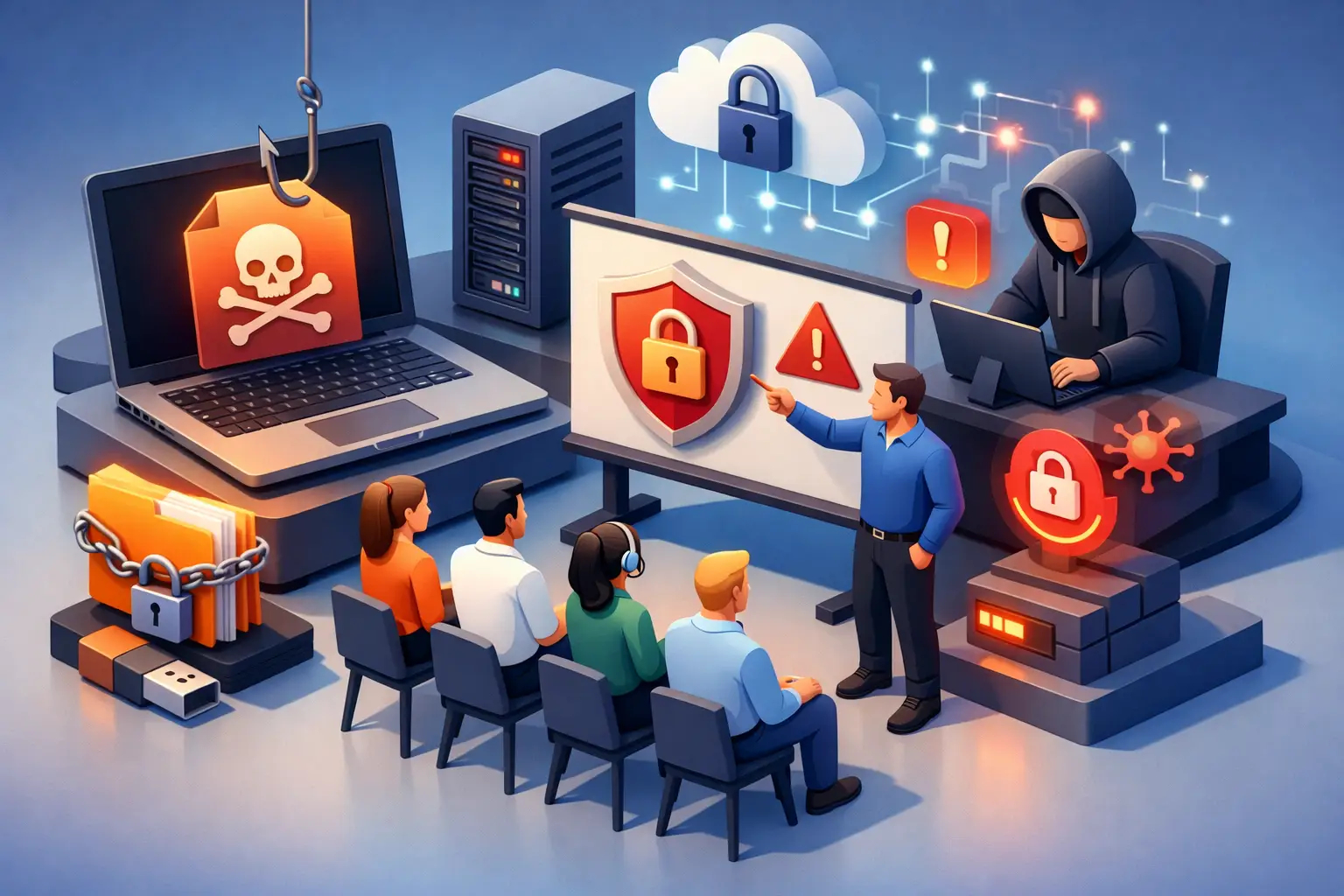
Workforce Ransomware Awareness Lessons That Work
A finance employee receives an email that appears to be an urgent payment request from a familiar supplier. The branding is correct, the sender name looks right, and the request arrives during a busy reporting period. One click can give an attacker the foothold needed to encrypt systems, steal data, and pressure the business into a costly decision. Effective workforce ransomware awareness lessons prepare employees for that moment before it happens.
Ransomware is not only a technology problem. Attackers target people because people approve payments, open files, share credentials, and make fast decisions under pressure. Security controls matter, but a workforce that recognizes suspicious behavior, reports it quickly, and knows what not to do can stop an incident before it becomes a business crisis.
Why Ransomware Training Must Change Behavior
Annual compliance training can establish a baseline, but passive completion is not evidence of readiness. Employees may remember that phishing is dangerous without recognizing a highly targeted message, a fake multi-factor authentication prompt, or an unusual request from a senior executive. Ransomware awareness must move beyond rules and teach judgment.
The strongest programs connect cyber behavior to operational consequences. A delayed report can allow an attacker to move laterally. A reused password can expose several business applications. An employee who disconnects a suspicious device promptly may prevent encryption from reaching shared systems. These are not abstract security concepts. They are decisions that affect revenue, customer trust, regulatory exposure, and business continuity.
This is especially relevant for organizations subject to NIS2 or similar resilience requirements. Compliance leaders need evidence that training is relevant, recurring, measurable, and aligned with the organization’s actual risk profile. A generic module for every employee may satisfy a completion metric, but it will not adequately prepare privileged users, finance teams, executives, or customer-facing staff for the threats they face.
Workforce Ransomware Awareness Lessons to Prioritize
Training should reflect the attack paths most likely to reach your organization. The goal is not to turn every employee into a security analyst. It is to make the safe action clear when a situation feels unusual, urgent, or too good to be true.
Teach employees to verify, not just detect
Many phishing messages no longer contain obvious spelling errors or poor design. Attackers research vendors, leadership teams, job titles, and current events. They can imitate common business workflows with alarming accuracy.
Employees need a simple verification habit: pause, inspect, and confirm through a known channel. If a vendor requests changed banking details, call the number already held in company records. If an executive requests sensitive information by email or text, verify through an established internal channel. If a login page appears after an unexpected email, access the service through the normal bookmark or approved portal instead.
This lesson matters because detection is uncertain. Verification is a reliable business process. It removes the attacker’s advantage even when a message looks convincing.
Make reporting fast and psychologically safe
Employees often hesitate to report a suspicious email because they are unsure whether it is serious enough, do not know where to send it, or worry about being blamed for clicking. That delay works in the attacker’s favor.
Every employee should know exactly how to report a suspicious email, link, file, phone call, or device behavior. The reporting route should be visible, simple, and consistent across the organization. Just as important, leaders must reinforce that fast reporting is valued, including when someone has made a mistake. A culture of blame drives incidents underground. A culture of rapid reporting gives security teams time to investigate and contain them.
Training scenarios should state the expected response plainly: stop interacting, report immediately, and follow the incident instructions. Employees should not attempt to investigate malware themselves, forward a suspicious attachment to colleagues, or continue working on a device that may be compromised.
Explain the risk behind credential theft
Ransomware groups frequently begin with stolen credentials rather than a visible malware attachment. A fake sign-in page, password reuse, or an approval of a fraudulent multi-factor authentication request can provide initial access without triggering obvious alarms.
Awareness lessons should show employees what a legitimate authentication request looks like and when to deny it. They should understand that an unexpected prompt is not an inconvenience to clear quickly. It is a potential attack signal. Password manager use, unique passwords, and multi-factor authentication all reduce risk, but employees must know how attackers attempt to bypass those controls.
For administrators and privileged users, training must go further. Their accounts carry a higher impact if compromised, so their lessons should address privileged access, secure remote administration, credential handling, and immediate escalation of unusual account activity.
Address everyday entry points beyond email
Email remains a major delivery channel, but ransomware campaigns also arrive through collaboration platforms, text messages, social media, compromised websites, malicious ads, and fake support calls. Employees who only associate ransomware with email may lower their guard elsewhere.
Use realistic examples based on the tools your teams actually use. A sales team may need to recognize a malicious shared-document notification. HR may need to assess a fraudulent resume attachment. IT staff may encounter fake help desk calls or remote access requests. Finance may face invoice fraud combined with account takeover. Relevance makes the lesson more memorable and more likely to influence behavior.
Reinforce the first minutes of a suspected incident
When ransomware is suspected, speed and discipline matter. Employees should know the organization’s approved first steps, including when to disconnect a device from the network, how to contact IT or the security team, and why they should preserve evidence rather than delete messages or files.
The exact procedure depends on the organization’s incident response plan. Some environments require employees to leave a device powered on for investigation, while others may direct them to disconnect network access immediately. Training should never invent a universal technical response. It should teach employees to recognize the warning signs and follow the organization’s documented process without delay.
Build Lessons Around Roles, Risks, and Decisions
A single ransomware course cannot carry the full burden of workforce readiness. The core principles may be shared, but the scenarios, depth, and frequency should vary by role.
Executives need to understand business email compromise, impersonation, crisis communications, and their responsibilities during an extortion event. Finance and procurement teams need more practice with supplier verification and payment-change fraud. IT teams need role-specific education on identity protection, remote access, patching discipline, and escalation paths. New hires need early exposure to reporting expectations, while high-risk roles require recurring, scenario-based reinforcement.
Localization also matters. A multinational organization should not merely translate content. It should account for regional regulations, common fraud patterns, language preferences, and local work practices. Employees engage more readily when a scenario reflects the reality of their role and environment.
Measure Readiness, Not Attendance
Completion rates tell you who opened a course. They do not tell you whether the workforce will respond correctly to a real attack. Security leaders need measures that connect training to observable behavior.
Start with knowledge checks that test decisions rather than definitions. Then use controlled simulations to identify patterns: which departments report suspicious messages, which users repeatedly engage with risky content, and where reporting delays occur. Results should guide the next lesson, not become a tool for public shaming.
Useful metrics include reporting rates, time to report, repeat-risk behavior, completion by role, quiz performance on high-risk topics, and simulation results over time. Consider these indicators alongside technical telemetry and incident data. If users struggle with fake authentication prompts, for example, targeted reinforcement is more valuable than repeating a broad cybersecurity course.
The trade-off is clear: more tailored training requires planning and coordination. Yet generic training can create a false sense of readiness. For high-risk functions and regulated environments, targeted instruction is usually the more defensible investment.
Turn Awareness Into an Operating Habit
The best ransomware training is not a once-a-year event. It is a sustained program that places short, relevant decisions in front of employees throughout the year. Interactive lessons, brief quizzes, realistic simulations, and role-based certification can reinforce the behaviors that matter without overwhelming busy teams.
CISO EDU approaches workforce education as a practical layer of cyber resilience: training should support compliance while strengthening the human decisions that technology alone cannot make. Leaders should use results to improve processes as well as people. If employees routinely struggle to verify vendor requests, the payment workflow may need a clearer control. If reporting is slow, the reporting mechanism may be too difficult to find.
A prepared workforce does not eliminate ransomware risk. It gives the organization more chances to interrupt an attack early, respond with confidence, and protect the business when pressure is highest. Make the next lesson specific enough that an employee can use it before the next suspicious message reaches their inbox.
FAQ
1. What is ransomware awareness training?
Ransomware awareness training is a cybersecurity education program designed to help employees recognize, avoid, and report ransomware-related threats. It teaches staff how attackers use phishing emails, malicious links, credential theft, and social engineering techniques to gain access to business systems.
2. Why is ransomware awareness important for employees?
Employees are often the first line of defense against ransomware attacks. A single click on a malicious link or attachment can lead to encrypted systems, data theft, operational disruption, and significant financial losses. Effective awareness training helps employees identify threats before they become incidents.
3. How often should organizations conduct ransomware awareness training?
Ransomware awareness should be an ongoing process rather than a once-a-year activity. Organizations benefit most from regular refresher sessions, phishing simulations, scenario-based exercises, and updates on emerging ransomware tactics throughout the year.
4. What should an employee do if they suspect a ransomware attack?
Employees should stop interacting with the suspicious email, file, or website immediately and follow the organization's incident reporting procedure. Prompt reporting can help security teams contain the threat before it spreads across systems and affects business operations.
5. How can organizations measure the effectiveness of ransomware awareness training?
Organizations should look beyond training completion rates and measure real-world behaviors. Useful indicators include phishing simulation results, suspicious activity reporting rates, time-to-report metrics, reductions in risky user actions, and improvements in employees' responses to security-related scenarios.

Ivan Energiev
IT Project Coordinator at Advanced Vision ITIvan orchestrates end-to-end project execution and operations governance, specializing in IT service delivery, process optimization, cross-functional team leadership, and Microsoft 365 enterprise environments. Find out more about me