


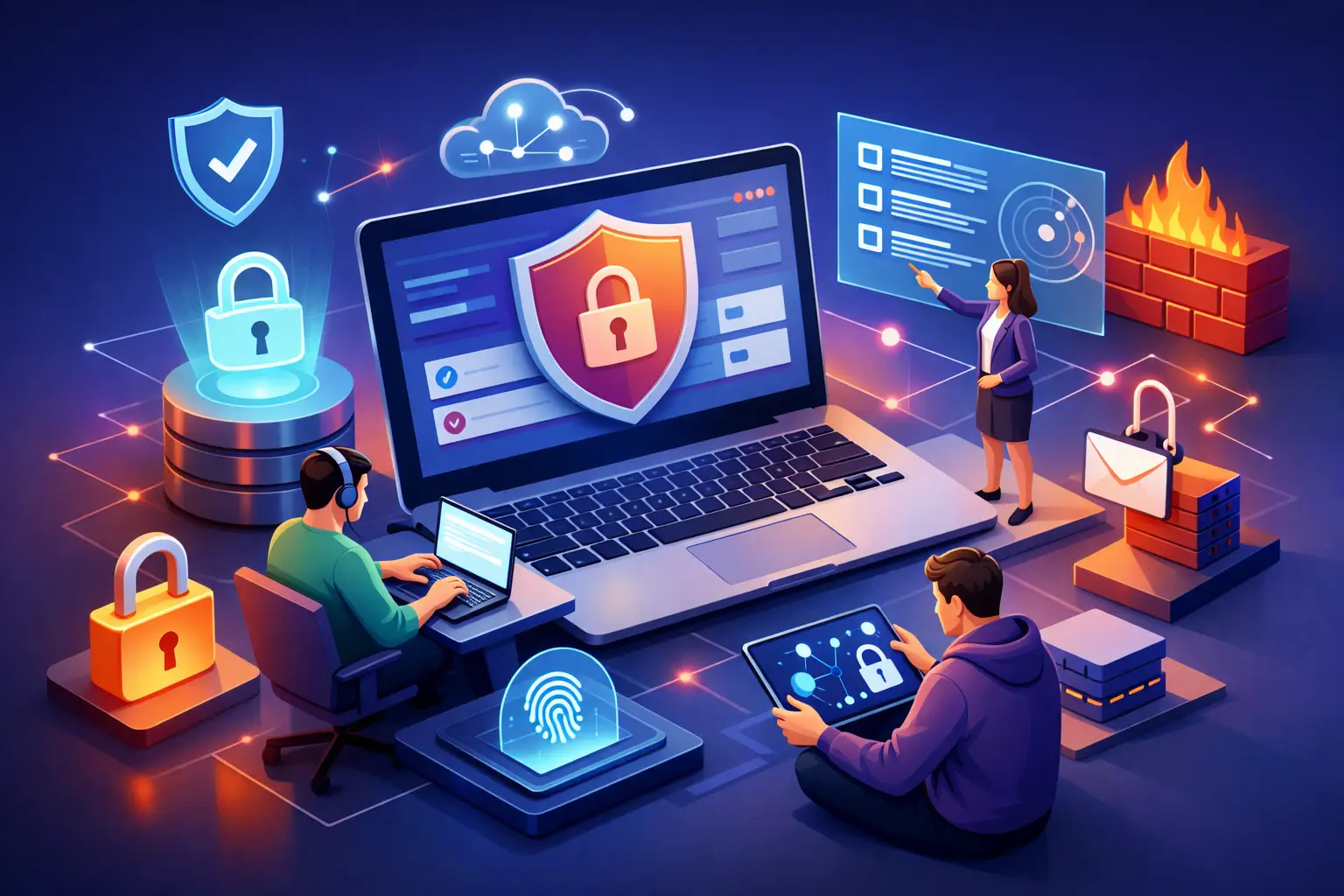
Choosing an Interactive Cybersecurity Training Platform
One failed click can trigger a breach, a regulatory inquiry, and an expensive week for every team that has to clean it up. That is why an interactive cybersecurity training platform is no longer a nice-to-have for awareness programs. If your training still looks like a yearly slide deck and a completion checkbox, you are not reducing risk. You are documenting exposure.
For CISOs, IT leaders, compliance owners, HR teams, and executives, the real question is not whether to train employees. It is whether the training changes behavior, supports compliance, and scales across roles, regions, and regulatory demands. That is where interactive learning earns its place.
What an interactive cybersecurity training platform should actually do
A true interactive cybersecurity training platform does more than host videos and issue certificates. It creates active participation. Employees answer scenario-based questions, work through realistic choices, test what they know, and receive feedback that helps the lesson stick. That matters because cyber risk is usually not theoretical. It shows up in routine decisions - opening an attachment, approving a payment request, sharing credentials, using personal devices, or mishandling sensitive data.
Passive training often gives organizations a false sense of progress. Completion rates look neat in a report, but they do not tell you whether your finance team can spot business email compromise or whether a manager understands the reporting path for a suspected incident. Interactivity closes that gap by forcing decisions in context.
The best platforms also adapt to how businesses operate. A frontline employee, a senior executive, a developer, and a procurement lead do not face the same risks. They should not receive the same training in the same format. Effective programs align content to role, exposure level, geography, and compliance requirements.
Why interactivity changes security outcomes
Cybersecurity starts with people - not tools. Security controls matter, but human behavior still shapes whether those controls hold or fail. An employee who recognizes a phishing lure prevents a ticket, an escalation, and potentially a breach. An executive who understands business risk can make faster, better-funded security decisions. A trained workforce becomes part of your control environment.
Interactivity improves retention because it turns learning into action. Quizzes, branching scenarios, and practical exercises force attention in a way static modules rarely do. That does not mean every lesson needs to feel like a game. In many organizations, especially regulated ones, a serious and direct format works better. The point is engagement with judgment, not entertainment for its own sake.
There is also a measurement advantage. If users repeatedly miss the same scenario, you have identified a real weakness. If one region performs well on password hygiene but poorly on data handling, you have a specific training issue to address. Better data leads to better remediation.
How to evaluate an interactive cybersecurity training platform
Most buyers do not need more content libraries. They need evidence that a platform can support risk reduction and compliance in a practical way. That requires a sharper evaluation lens.
Look past course volume
A vendor with hundreds of modules may still be a poor fit if the content is generic, outdated, or irrelevant to your environment. A smaller, better-structured catalog with role-based paths, regulatory relevance, and localized content can deliver stronger outcomes. Breadth matters less than applicability.
Check for role and region alignment
If your organization operates across the US, Europe, or the GCC, training has to reflect legal and operational reality. NIS2-focused organizations need content that connects cyber hygiene to resilience obligations. Global companies need localization that goes beyond translation and reflects local examples, terminology, and expectations. The same principle applies to executives versus end users. Context drives adoption.
Demand measurable outcomes
You should be able to track more than completions. Look for assessments, quiz performance, certification status, campaign reporting, and user-level insights that show whether the workforce is improving over time. If the reporting cannot help a CISO, compliance officer, or board-facing leader explain progress, it is not enough.
Assess ease of deployment
The most sophisticated training program will fail if rollout becomes an administrative burden. Integration with your existing processes, clear user management, automated reminders, and flexible assignment paths all matter. The right platform reduces friction for lean security and compliance teams.
Review content tone and credibility
Employees tune out patronizing or overly technical material. Leaders tune out content that lacks business relevance. Strong training speaks clearly, reflects real risk, and treats the audience like adults with operational responsibilities. That balance is hard to get right, but it separates useful programs from ignored ones.
Interactive cybersecurity training platform features that matter most
Not every feature deserves equal weight. Some look impressive in a demo but add little operational value. Others directly support adoption, risk reduction, and audit readiness.
Scenario-based learning is near the top of the list because it mirrors real decision-making. Quizzes and knowledge checks matter because they verify understanding rather than assume it. Certifications help document completion and can support internal policy enforcement or external expectations.
Localization is another high-value feature, especially for multinational companies. So is compliance alignment. If your training program has to support frameworks, internal controls, or sector requirements, your platform should help connect learning activity to those obligations.
A strong platform should also support different audiences under one umbrella. Many organizations need workforce awareness for all employees, deeper education for privileged users, and strategic content for leadership. When those needs are fragmented across too many vendors, consistency suffers and reporting becomes messy.
That is one reason some buyers prefer providers that can serve both operational training and executive-level cybersecurity education. CISO EDU, for example, reflects that broader model by combining workforce learning, compliance-focused training, and strategic content for decision-makers.
Where buyers often get it wrong
The most common mistake is buying for procurement simplicity instead of security impact. A low-cost platform with generic modules can satisfy a budget line and still leave your workforce underprepared. Cheap training becomes expensive when it fails under pressure.
Another mistake is treating awareness as a once-a-year event. Threats evolve, staff change roles, regulations tighten, and memory fades. Effective programs use recurring training, periodic assessments, and targeted refreshers. Frequency should be calibrated to risk, not to calendar convenience.
There is also a tendency to overfocus on phishing alone. Phishing is critical, but it is not the whole problem. Employees need guidance on password practices, data handling, device security, social engineering, reporting suspicious activity, remote work behavior, and emerging threats shaped by their function. A narrow program creates blind spots.
Finally, some organizations fail to involve the right stakeholders. Security may own the risk, but HR, compliance, legal, L&D, and business leadership often influence rollout and accountability. The strongest programs are cross-functional from the start.
The business case is stronger than many teams assume
An interactive cybersecurity training platform is often framed as an awareness expense. That undersells it. In practice, it supports loss prevention, audit readiness, policy adoption, and stronger incident reporting culture. It can also reduce the hidden costs of confusion when employees do not know what to do.
For regulated organizations, the value is even clearer. Training supports evidence of due diligence and helps demonstrate that security expectations are communicated and reinforced. It will not solve every compliance requirement, and it should not be marketed as a magic shield. But it is a material part of a defensible security posture.
The ROI discussion should stay realistic. Training will not eliminate human error. It should reduce avoidable mistakes, improve reporting speed, and raise baseline judgment across the business. If a vendor promises perfection, that is a red flag. If it can show measurable improvement, practical alignment, and scalable delivery, that is worth attention.
What good looks like after rollout
A good deployment does not just produce more completed modules. It creates clearer expectations, better manager visibility, and stronger employee confidence in handling suspicious situations. People report sooner. Repeat mistakes decline. Leaders can see where risk is concentrated and where intervention is working.
Good also means the program remains relevant. New threats, new regulations, and new business models require updates. Training should evolve with your environment, not sit untouched while the risk landscape moves on.
If you are evaluating platforms right now, focus on one standard above all others: behavior change you can verify. The right program will not just train your workforce. It will help your organization think, respond, and operate with more discipline when cyber risk shows up in everyday work.
ADVANCED VISION IT - MALTA Address: Suite 8, Ta’ Mallia Buildings, Triq In‑Negozju, Zone 3, Central Business District, Birkirkara, CBD 3010, Malta
Registration number: C111282, VAT Number: MT31713827
Phone:+35679224404
Email: office@advisionit.com
ADVANCED VISION IT - BULGARIA
Address: 35 Dimitar Hadzhikotsev str. Ent A, Lozenets, Sofia, Bulgaria
ID No: 205789039, VAT No: BG205789039
Phone: +359 888 258 530
Email: office@advisionit.com