


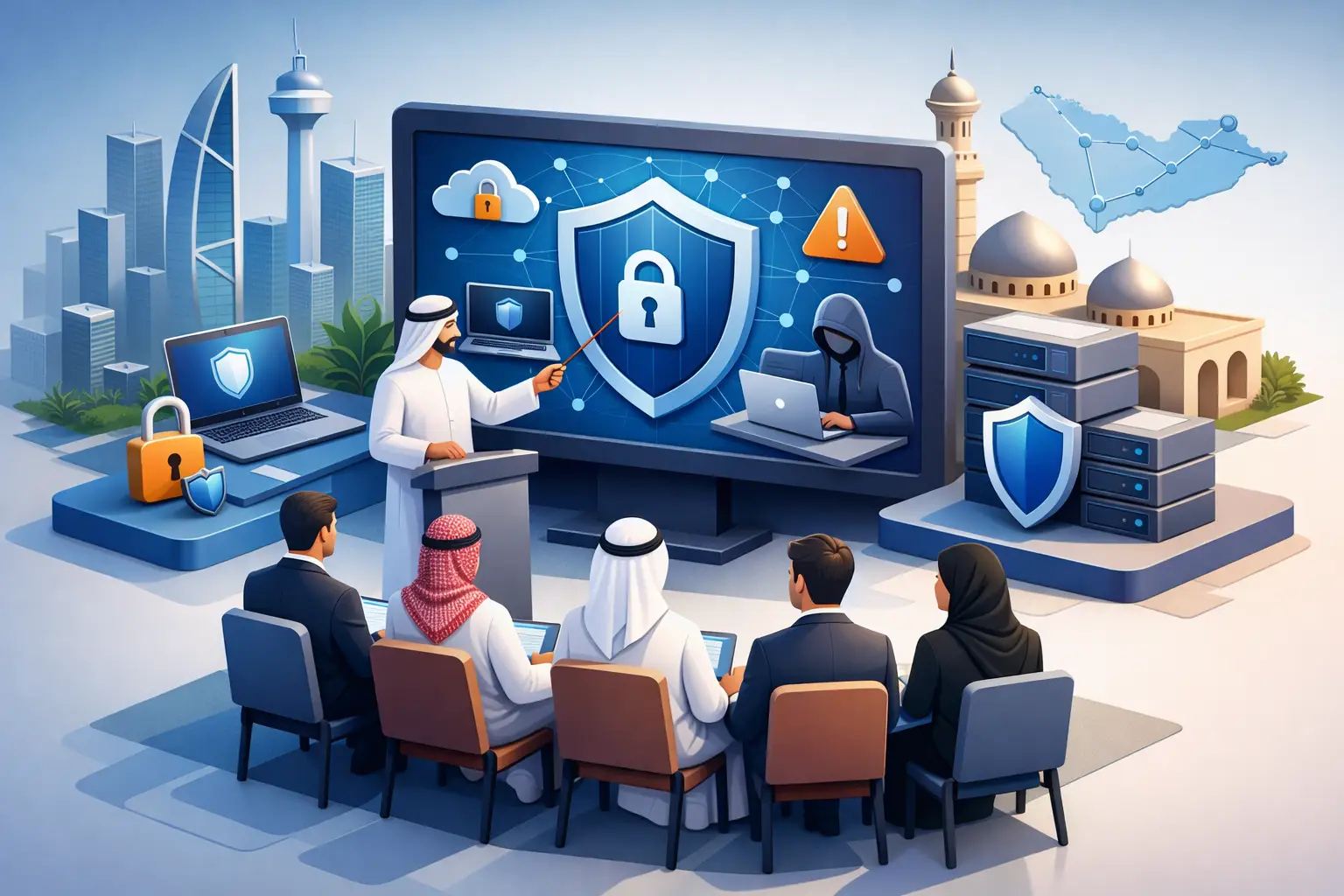
Cybersecurity Training for GCC Companies
A phishing email written in flawless Arabic, an invoice scam targeting a finance team in Dubai, a WhatsApp impersonation attempt aimed at a regional executive - this is the operating environment many Gulf businesses face now. Cybersecurity training for GCC companies cannot be treated as a generic HR checkbox. It has to reflect how people work, how attackers operate in the region, and what regulators increasingly expect.
For security leaders, HR teams, and executives, the real issue is not whether training exists. It is whether the training changes behavior. If employees still click, overshare, reuse passwords, or approve suspicious requests under pressure, the program is not reducing risk. A modern training strategy should make employees more alert, managers more accountable, and leadership more prepared to support secure decisions across the business.
Why cybersecurity training for GCC companies needs a regional model
Too many organizations still buy awareness content built for a broad global audience and assume it will translate. Usually, it does not. The examples feel distant, the language misses local nuance, and the compliance framing is too generic to be useful for teams operating across Saudi Arabia, the UAE, Qatar, Kuwait, Bahrain, and Oman.
GCC organizations face a mix of fast digital transformation, high-value target profiles, multinational workforces, and tightening regulatory expectations. That creates a specific training challenge. Your workforce may include native Arabic speakers, English-speaking expats, contractors, frontline staff, and executives with very different exposure to cyber risk. One-size-fits-all content tends to satisfy procurement, not security outcomes.
A regional model matters because attacker tactics are contextual. Business email compromise in the Gulf often exploits hierarchy, urgency, and trust in executive communication. Payment fraud attempts may reference local suppliers, local banks, or regionally relevant business processes. Mobile-first communication habits also change the threat surface. Training has to reflect those realities if you want recognition, retention, and action.
What effective cybersecurity training should actually change
Good training does more than explain threats. It changes what people do when they are busy, distracted, under pressure, or convinced a message came from someone important. That distinction matters because most incidents tied to human behavior do not happen when employees are calm and analytical. They happen in the middle of normal work.
For GCC companies, the first goal is to reduce preventable human error. That includes phishing clicks, unsafe password practices, accidental data exposure, and weak handling of sensitive customer or business information. The second goal is compliance readiness. Training should support legal and sector-specific obligations, document participation, and demonstrate that the organization is taking reasonable steps to educate its workforce. The third goal is resilience. Employees need to know how to report issues early, not hide mistakes until they become incidents.
If a program is working, you should see practical shifts. Reporting rates improve. Repeat mistakes decline. Managers stop bypassing process for convenience. New joiners understand what is expected from day one. Executives become less vulnerable to impersonation and social engineering. These are operational outcomes, not learning vanity metrics.
The building blocks of strong cybersecurity training for GCC companies
The strongest programs are localized, role-based, measurable, and continuous. Miss one of those elements and the results weaken quickly.
Localization comes first. That means more than translation. It means examples that reflect regional working patterns, references employees recognize, and scenarios that feel credible in the GCC business context. A bilingual approach is often necessary, especially in larger organizations with mixed workforces. If employees have to mentally convert the content before applying it, you are losing effectiveness.
Role-based design is just as important. Finance teams need focused exposure to invoice fraud and payment manipulation. HR teams need training on payroll scams, sensitive data handling, and impersonation attempts. Executives need short, high-impact modules on mobile security, travel risk, and targeted social engineering. IT and security teams need a different level of depth than general staff. Equal access to training is good. Identical training for everyone is usually not.
Measurement has to go beyond completion rates. A company can achieve 98 percent participation and still have a weak human firewall. Measure phishing simulation performance, reporting behavior, repeat-risk users, and departmental trends. Review where mistakes cluster. If one business unit repeatedly fails around credential theft or data handling, the answer is not another generic annual module. It is targeted intervention.
Continuity is where many programs fail. Annual awareness training might satisfy a policy requirement, but it does not keep pace with changing tactics. People forget. Threats evolve. Business processes shift. Training should be delivered in a rhythm employees can absorb - onboarding modules, quarterly refreshers, short topical updates, simulations, and role-specific reinforcement.
Compliance pressure is rising, and training is part of the answer
Across the GCC, cybersecurity expectations are becoming more structured, more visible, and more tied to operational accountability. The exact obligations vary by country and sector, but the direction is clear. Regulators and customers increasingly expect organizations to show that cybersecurity is being managed systematically, not informally.
That is why awareness training should be treated as a compliance control as well as a risk reduction measure. In regulated sectors such as finance, healthcare, energy, telecom, and government-linked industries, the workforce is part of the control environment. If employees do not understand secure handling requirements, reporting obligations, or basic attack indicators, the gap becomes both a security issue and a governance issue.
There is a practical balance to strike here. Compliance-aligned training should not become dry policy recitation. Employees do not become safer because they memorize terminology. They become safer when policy is translated into everyday choices - how to verify a request, when to escalate, what not to share, and how to respond when something feels off.
Common mistakes GCC companies make with training
The first mistake is treating awareness as a one-time course. That creates temporary visibility, not long-term behavior change. The second is buying global content that ignores regional language, culture, and attacker patterns. The third is assuming technical controls can compensate for poor workforce readiness. They cannot. Filters help, but one successful impersonation or one mishandled file can still create major exposure.
Another common issue is failing to involve leadership. If executives skip training, override process, or treat security as an IT issue, employees notice. Security culture follows behavior at the top. The same applies to managers. A frontline employee is far more likely to report suspicious activity when their manager supports that behavior instead of punishing delays or questioning caution.
Finally, many companies do not connect training to business outcomes. Security teams understand the value, but other stakeholders need a clearer case. Show how training reduces fraud exposure, improves audit readiness, shortens incident response time, and lowers the cost of human-error events. That is how awareness earns budget and executive support.
How to choose the right training approach
Start with your risk profile, not your course catalog. Look at the threats your people actually face, the regulations that shape your responsibilities, and the groups inside the business with the highest exposure. Then build from there.
A smaller company in the GCC may need a lean program focused on phishing, password hygiene, mobile security, and reporting behavior. A large enterprise may need bilingual content, role-based learning paths, executive modules, compliance tracking, phishing simulations, and certifications that support internal governance. Neither approach is inherently better. The right model depends on business complexity, regulatory pressure, and workforce structure.
The delivery format also matters. Interactive modules, short quizzes, scenario-based learning, and certifications tend to create stronger engagement than passive slide decks. Employees remember what they practice. They ignore what feels disconnected from their jobs. That is one reason platforms such as CISO EDU focus on practical, localized learning experiences tied to real business risk.
Training is not the finish line
Cybersecurity starts with people - not tools. But people perform better when training is supported by clear policy, consistent leadership, and realistic process design. If staff are trained to verify payment changes but the business rewards speed over validation, training alone will not hold.
The real goal is a workforce that can recognize risk, respond early, and make safer decisions without constant intervention from the security team. For GCC companies, that means building training around the region you operate in, the regulations you answer to, and the behaviors you need to change now - not after an incident explains the gap for you.
ADVANCED VISION IT - MALTA Address: Suite 8, Ta’ Mallia Buildings, Triq In‑Negozju, Zone 3, Central Business District, Birkirkara, CBD 3010, Malta
Registration number: C111282, VAT Number: MT31713827
Phone:+35679224404
Email: office@advisionit.com
ADVANCED VISION IT - BULGARIA
Address: 35 Dimitar Hadzhikotsev str. Ent A, Lozenets, Sofia, Bulgaria
ID No: 205789039, VAT No: BG205789039
Phone: +359 888 258 530
Email: office@advisionit.com