


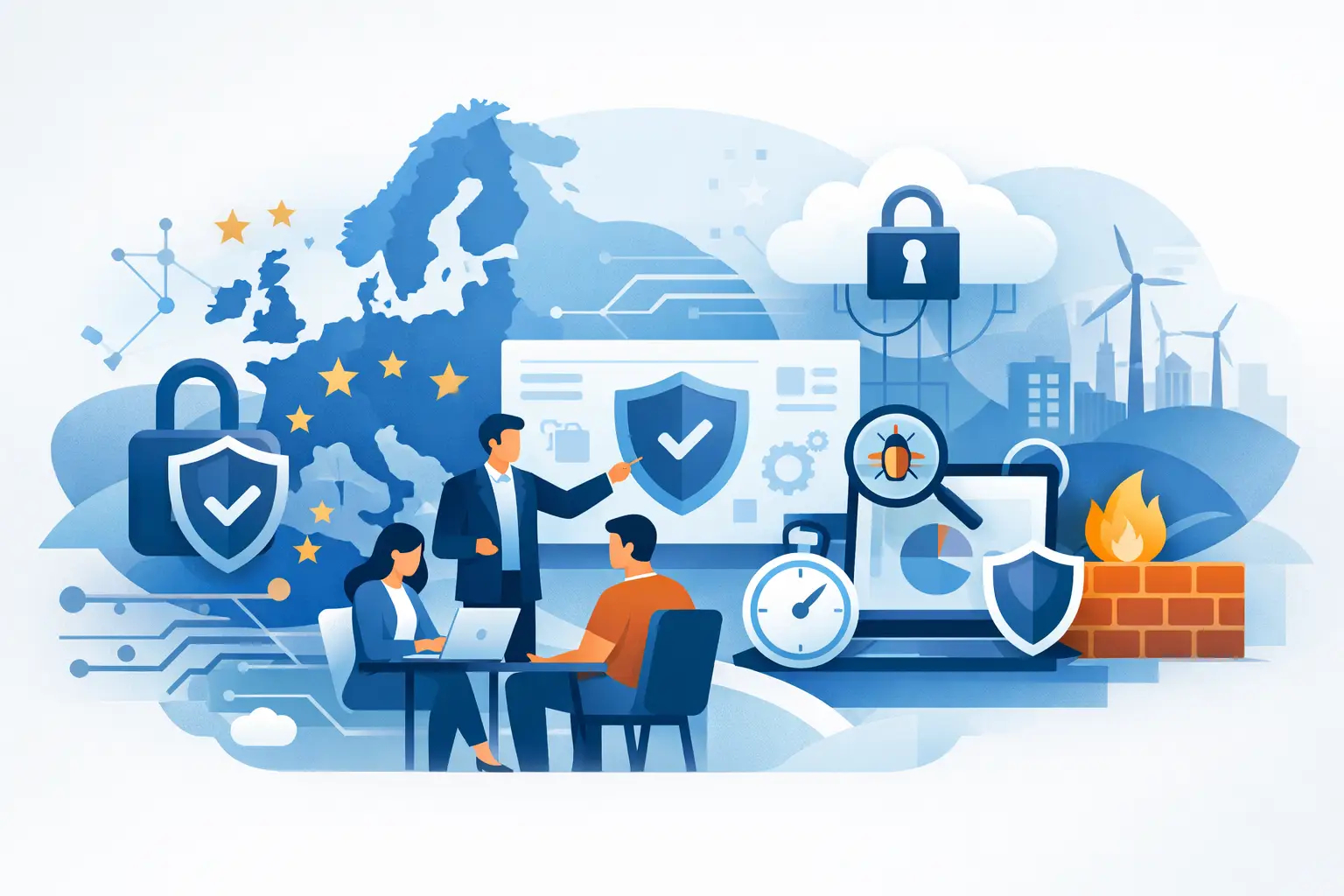
Cyber Resilience Training Europe Needs Now
A ransomware event does not care whether your security stack is modern, your policies are approved, or your board has seen last quarter’s risk report. If your people do not know how to recognize, report, and respond under pressure, your exposure stays high. That is why cyber resilience training Europe organizations can actually use has moved from a nice-to-have awareness program to a core business control.
For companies operating across the EU, the pressure is not theoretical. NIS2, sector-specific oversight, cross-border operations, third-party risk, and multilingual workforces have changed what “good enough” looks like. Training now has to do more than raise awareness. It has to create repeatable behaviors, support compliance, and help teams keep operating when incidents happen.
What cyber resilience training in Europe really means
Cyber resilience training in Europe is not just phishing education with a regional label. It is workforce education designed for the European regulatory environment, the realities of distributed operations, and the fact that resilience is broader than prevention.
That distinction matters. Traditional awareness training tends to focus on stopping mistakes. Resilience training also prepares people to limit damage, escalate quickly, follow continuity procedures, and recover with discipline. In practical terms, that means employees need to know what suspicious activity looks like, where to report it, how to handle sensitive data, and what their role is during disruption.
For leadership teams, the scope is wider still. Executives, managers, IT teams, HR, legal, and procurement all affect resilience outcomes. A finance employee clicking a malicious attachment is one problem. A manager delaying incident escalation, a procurement team onboarding a weak vendor, or an executive bypassing process can be just as costly.
Why Europe requires a different training approach
Many global training programs fall short in Europe because they assume one language, one legal context, and one operating model. European organizations rarely have that luxury.
A company with staff in Germany, France, Spain, and the Netherlands may face different working norms, different privacy expectations, and different levels of cyber maturity across teams. Add hybrid work, contractors, and regulated supply chains, and generic annual awareness content starts to look dangerously thin.
NIS2 has also raised the bar. Even where specific obligations fall more heavily on leadership, security teams, or regulated entities, the message is clear: resilience is now an operational requirement. Organizations need evidence that they are educating their workforce in a way that supports governance, incident readiness, and risk reduction.
This is where many programs break down. They are too broad to be relevant, too static to change behavior, or too detached from regional obligations to satisfy compliance stakeholders. Training that works in Europe has to be localized, role-based, and aligned with the business risks that matter most.
What effective cyber resilience training Europe programs include
The strongest programs are not built around content volume. They are built around outcomes.
First, they teach the basics well. Employees still need clear instructions on phishing, password hygiene, MFA, social engineering, device security, data handling, and safe collaboration. But the difference is in the delivery. Short, practical modules outperform bloated slide decks because people retain what they can apply immediately.
Second, they reflect European regulatory reality. That does not mean turning every lesson into a legal briefing. It means training employees in ways that support requirements around incident reporting, governance, data handling, supply chain vigilance, and business continuity. People should understand the actions expected of them, not just the policy language behind those actions.
Third, they are role-specific. A senior executive needs different training than a frontline employee. HR teams need guidance on sensitive data exposure and impersonation fraud. Procurement teams need awareness of third-party risk. IT and security teams need a deeper operational track. One-size-fits-all training is easy to buy and hard to defend.
Fourth, they are measurable. Completion rates alone do not tell you whether risk is falling. The better metrics are behavior-led: reporting rates, repeat error patterns, quiz performance by role or region, incident escalation timing, and trends in simulated attack responses. If you cannot measure change, you cannot prove resilience is improving.
The compliance question: training is not the same as readiness
This is the point many buyers need to hear clearly. Training supports compliance, but training by itself does not make an organization compliant.
That is not a weakness. It is a reality. Regulations and frameworks set expectations around governance, reporting, controls, and accountability. Training helps operationalize those expectations across the workforce. It gives employees the knowledge to act in ways that reduce risk and support documented processes.
The trade-off is that compliance-focused training can become too narrow if it is designed only to satisfy an audit trail. When programs are built around check-the-box completion, employees learn how to finish a module, not how to make better decisions.
The right approach balances both needs. You need records, certifications, and clear alignment to obligations. You also need practical education that changes behavior under pressure. The organization that gets both right is in a stronger position - operationally and regulatorily.
Why localization matters more than most vendors admit
Localization is often reduced to translation. That is not enough.
A translated course may still miss region-specific threats, legal expectations, and workplace context. Employees notice that gap quickly. If examples feel imported or unrealistic, engagement drops and retention follows.
Effective localization means adapting terminology, scenarios, and compliance framing to the regions where your teams operate. It also means recognizing that communication styles differ. Some teams respond to direct procedural training. Others respond better to scenario-based learning with clear business consequences.
For multinational organizations, this can create tension between consistency and relevance. Central teams want standardization. Regional teams want fit. The answer is not choosing one over the other. It is building a common control framework with localized delivery. That preserves governance while making training useful to the people taking it.
How buyers should evaluate a training provider
If you are sourcing cyber resilience training for Europe, the most important question is not how large the content library is. It is whether the provider understands your risk environment.
Start with alignment. Can the provider support European regulatory expectations, including NIS2-related workforce education needs? Can they localize content by region and language without stripping out relevance? Can they train different audiences, from employees to executives?
Then look at usability. Busy organizations do not need content that is theoretically comprehensive and operationally ignored. They need short modules, clean reporting, manageable deployment, and enough flexibility to fit onboarding, annual refreshers, and targeted campaigns.
Finally, ask how the provider measures outcomes. If reporting stops at completions and certificates, you are buying administration, not resilience. A serious provider should help you see where risk is concentrated, which teams need reinforcement, and how training supports broader security and compliance goals.
This is where platforms such as CISO EDU stand out when they combine awareness training, regional compliance alignment, interactive assessments, and executive-level education in one model. That structure reflects how cyber risk actually moves through an organization.
Building a program that sticks
The best program is rarely the most complicated. It is the one people remember when something goes wrong.
That usually means a steady rhythm rather than a single annual event. New hires need immediate baseline training. Employees need periodic refreshers. High-risk teams need targeted content. Leaders need a separate path that covers decision-making, reporting obligations, and crisis behavior.
It also means connecting training to operational reality. If your incident reporting process is unclear, training should reinforce it. If business continuity depends on certain teams following defined steps, training should reflect those scenarios. The closer the education is to real workflows, the more likely it is to influence action.
And yes, culture matters. Not the vague version of culture, but the practical one. Do employees feel safe reporting suspicious activity? Do managers reinforce secure behavior? Do executives model discipline? Training can support that environment, but leadership has to make it credible.
Europe’s cyber threat landscape is not getting simpler, and regulatory expectations are not moving backward. Organizations that treat training as a slide deck problem will keep seeing human error show up in incident reviews. Organizations that treat it as a resilience capability will be better prepared to absorb disruption, respond faster, and protect the business where it is most vulnerable - at the human layer.
If you are responsible for security, compliance, HR, or learning strategy, the next step is straightforward: stop asking whether your teams completed training and start asking whether they are ready to act when pressure hits.
ADVANCED VISION IT - MALTA Address: Suite 8, Ta’ Mallia Buildings, Triq In‑Negozju, Zone 3, Central Business District, Birkirkara, CBD 3010, Malta
Registration number: C111282, VAT Number: MT31713827
Phone:+35679224404
Email: office@advisionit.com
ADVANCED VISION IT - BULGARIA
Address: 35 Dimitar Hadzhikotsev str. Ent A, Lozenets, Sofia, Bulgaria
ID No: 205789039, VAT No: BG205789039
Phone: +359 888 258 530
Email: office@advisionit.com