


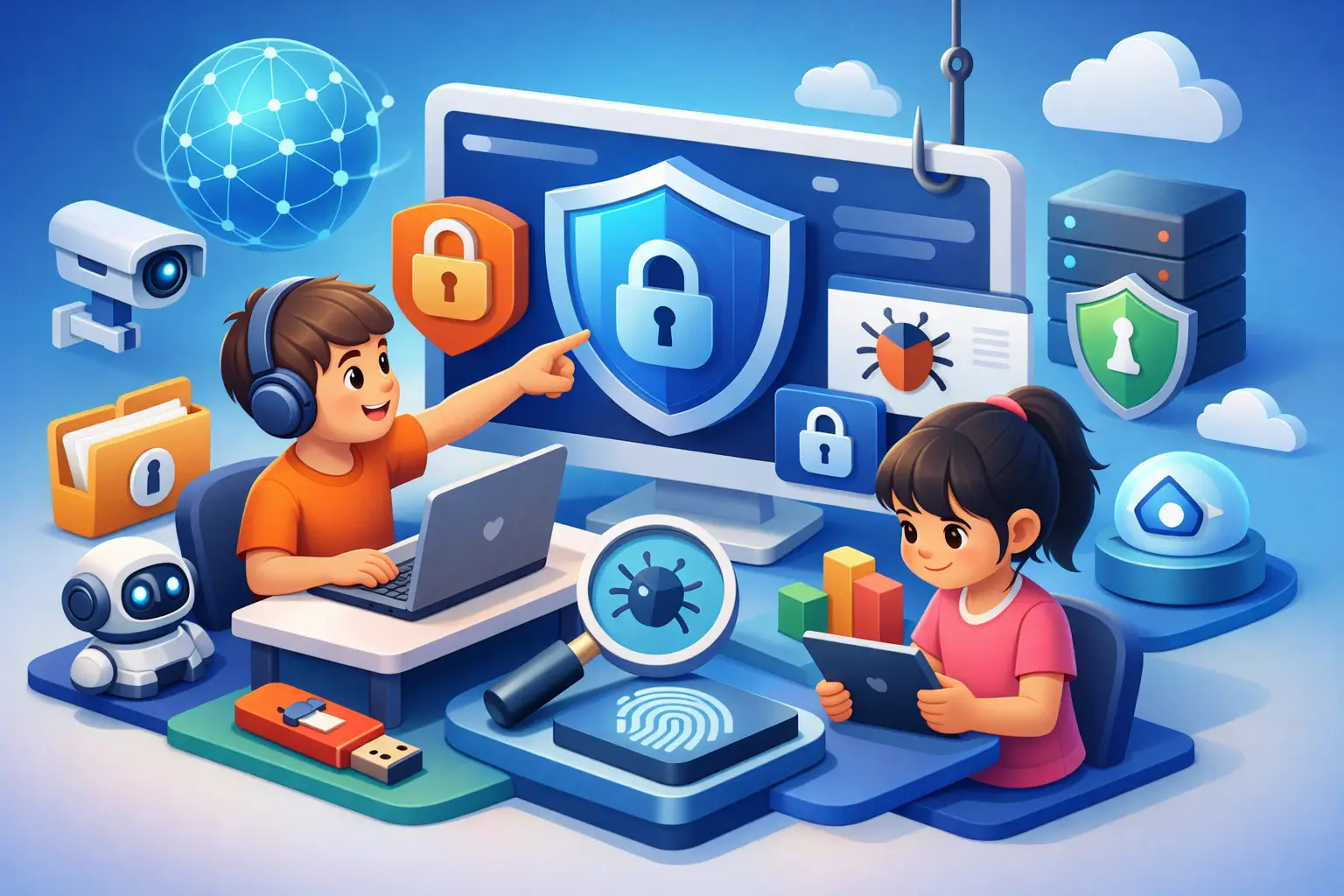
Cybersecurity Education for Kids That Works
A child gets a new tablet, downloads a game, clicks a bright pop-up, and hands over more personal data than most adults realize. That is exactly why cybersecurity education for kids cannot be treated as a nice extra. It is early risk management. The behaviors children build online - how they trust, share, click, install, and respond to pressure - often become the habits they carry into school, work, and daily life.
For organizations, this matters more than it may seem. Parents are employees. Employees are part of your attack surface. And the same human factors that drive phishing success in the workplace - curiosity, urgency, trust, distraction, reward-seeking - show up even earlier in childhood. If security starts with people, then the pipeline starts long before onboarding.
Why cybersecurity education for kids matters now
Kids are not using the internet in a limited, supervised way anymore. They are gaming, messaging, streaming, learning, shopping, and creating accounts across multiple devices. In many households, children move between school platforms, family devices, smart TVs, voice assistants, and mobile apps without a clear boundary between entertainment and risk.
That environment creates exposure to scams, fake downloads, oversharing, account takeover, cyberbullying, and social engineering. The threat is not only malware. It is manipulation. Children are frequent targets because they are still learning how to judge credibility, protect privacy, and recognize when someone is trying to pressure them.
There is also a business case for paying attention. Employers increasingly invest in workforce awareness, but many overlook the family side of digital behavior. A parent who understands how to teach safe online habits at home is often more engaged with security at work. A company that supports digital safety beyond the office strengthens culture, not just compliance.
What good cybersecurity education for kids actually teaches
The goal is not to turn children into junior analysts. It is to teach judgment. That starts with a few core behaviors that scale with age.
Young children need simple rules they can remember under pressure. Ask before clicking. Do not share your real name, school, address, or photos without permission. If something feels strange, stop and tell a trusted adult. Strong cybersecurity education at this stage is concrete, repeated, and tied to real situations they recognize.
As kids get older, the training should expand. They need to understand passwords, multi-factor authentication, scams, impersonation, privacy settings, location sharing, and why free offers are often not free. They should learn that people online can pretend to be friends, game moderators, classmates, or even family members. That lesson is uncomfortable, but necessary.
Teenagers need a more mature framework. They are managing social media reputations, direct messages, digital payments, school accounts, and often their first independent devices. At this point, cybersecurity education should include account recovery, secure browsing, device updates, data permanence, and the legal or personal consequences of poor online decisions. The message changes from rules to responsibility.
The biggest mistake adults make
Most adults teach internet safety only after a problem happens. A scam, a hacked game account, an inappropriate message, or a school warning triggers the conversation. That is reactive security, and it usually arrives too late.
The better model is preventive and continuous. Children should hear the same security principles in small doses, over time, in language they can use. The most effective programs do not rely on one lecture, one school assembly, or one parental warning. They build repetition, practice, and memory.
Another common mistake is leading with fear. Fear gets attention, but it does not always produce good decisions. Kids who feel judged may hide incidents. Kids who feel overwhelmed may tune out. Security education works better when it gives children a clear action path. Pause. Check. Ask. Report. Change the password. Block the account. Tell an adult.
How organizations can support digital safety beyond the workplace
For employers, children’s cyber education may look outside the usual training scope. It is not. It sits at the intersection of culture, resilience, and employee support.
A practical approach is to extend awareness initiatives into family-facing resources. That can mean short digital safety modules for parents, age-based guidance they can use at home, or seasonal campaigns tied to back-to-school periods, gaming trends, and holiday device purchases. The value is straightforward: when security becomes part of daily family life, it stops feeling like a compliance box at work.
This also aligns with broader resilience goals. Human risk does not stop at the corporate firewall. Employees make decisions from homes full of connected devices, shared networks, and children using the same digital ecosystem. Helping families build safer habits reduces noise, lowers stress, and reinforces security as a practical discipline.
For compliance-driven organizations, the benefit is cultural rather than regulatory. You may not have a formal requirement to train employees’ children, but you do have a strong operational reason to build a security-minded workforce. Companies that understand this tend to outperform those that treat awareness as a once-a-year obligation.
What effective kids' cyber training looks like
The format matters. Children do not learn well from policy language, abstract warnings, or corporate-style presentations. They learn from scenarios, repetition, and immediate feedback.
Interactive lessons work because they simulate choices. A child sees a message from a stranger in a game. Do they respond, ignore it, or report it? They get a suspicious link promising free in-game currency. Do they click, ask an adult, or delete it? Those moments teach pattern recognition, which is what most cyber defense depends on in real life.
Quizzes also help, but only if they reinforce behavior rather than trivia. The right question is not "What does phishing mean?" It is "What should you do if someone says you must click right now or lose your account?" That is how habits are formed.
Localization matters too. Children use different platforms, slang, payment tools, and devices depending on region and age group. A training program that reflects real digital behavior will always outperform generic awareness content. That is one reason structured providers such as CISO EDU position digital safety as part of a broader education strategy rather than a disconnected side topic.
Trade-offs parents and schools need to handle honestly
There is no perfect balance between protection and independence. Too much restriction can leave children unprepared when they eventually gain more freedom. Too little oversight can expose them before they have the judgment to manage risk.
That is why the answer often depends on age, maturity, and context. A ten-year-old on a shared family tablet needs different guardrails than a sixteen-year-old with a smartphone, social accounts, and school-managed apps. The principle stays the same, but the controls should evolve.
Schools also face trade-offs. They want students to use technology productively, but every new app, portal, or collaboration tool creates another privacy and security consideration. The right response is not to avoid digital learning. It is to pair access with education. If a school issues devices but does not teach safe password use, scam awareness, and reporting behavior, it has only solved half the problem.
A smarter framework for teaching kids digital judgment
The strongest model is simple: teach children to protect information, question requests, and ask for help fast.
Protect information means understanding that names, birthdays, locations, passwords, photos, and school details have value. Question requests means slowing down when someone asks them to click, download, share, pay, or keep a secret. Ask for help fast means they know exactly who to tell and feel safe doing it.
That framework scales well because it works across ages and platforms. Whether the risk appears in a game, a social app, a school portal, or a text message, the child has a repeatable response. That is what strong awareness training should deliver - not perfect knowledge, but dependable action.
Cybersecurity education for kids is not about creating fear around technology. It is about preparing the next generation to use it with judgment. For businesses, schools, and families, that is not a side issue. It is long-term resilience built at the earliest stage, where habits are easiest to shape and the return on education lasts the longest.
ADVANCED VISION IT - MALTA Address: Suite 8, Ta’ Mallia Buildings, Triq In‑Negozju, Zone 3, Central Business District, Birkirkara, CBD 3010, Malta
Registration number: C111282, VAT Number: MT31713827
Phone:+35679224404
Email: office@advisionit.com
ADVANCED VISION IT - BULGARIA
Address: 35 Dimitar Hadzhikotsev str. Ent A, Lozenets, Sofia, Bulgaria
ID No: 205789039, VAT No: BG205789039
Phone: +359 888 258 530
Email: office@advisionit.com