



How Often Should Security Training Happen?
A finance employee receives an urgent email that appears to come from the CEO. The message requests a same-day payment change, uses familiar language, and arrives during a busy close period. Whether that employee pauses, verifies, and reports the request depends less on what they learned 11 months ago than on what their organization has reinforced recently. So, how often should security training happen? Often enough to shape decisions when pressure is high, threats are changing, and a single mistake can create operational, financial, and regulatory consequences.
For most organizations, annual training alone is not enough. It may satisfy a minimum policy requirement, but it does not create lasting security habits. Effective awareness programs combine a reliable annual foundation with short, role-specific reinforcement throughout the year and immediate training when risk signals demand it.
Security Training Is Not an Annual Event
Employees forget information that they do not use. Attackers understand this. They change their lures, impersonate trusted suppliers, exploit new collaboration tools, and use current events to make fraudulent messages feel credible. A once-a-year course cannot keep pace with that environment.
Security training should operate like any other business-critical control. Organizations test backups, review access, patch systems, and assess vendors on a recurring basis. Human risk deserves the same discipline. The goal is not to keep people in training. The goal is to make secure behavior familiar enough that employees recognize danger and act correctly without hesitation.
A strong cadence also gives leadership evidence that the organization is actively managing workforce risk. That matters when customers, auditors, insurers, regulators, and boards ask how the business reduces exposure from phishing, credential theft, data mishandling, and social engineering.
How Often Should Security Training Happen? Use a Layered Cadence
The right frequency depends on your threat profile, workforce size, regulatory obligations, and the sensitivity of the information employees handle. Still, a practical baseline works for most organizations: comprehensive training annually, targeted reinforcement quarterly, short awareness touchpoints monthly, and event-driven training whenever conditions change.
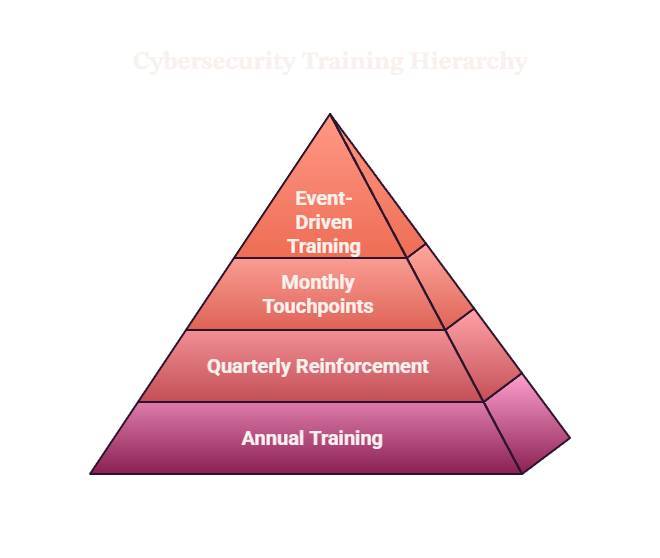
Annual training establishes the baseline
Every employee should complete a core cybersecurity awareness course at least once a year. This provides a consistent baseline on phishing, passwords and multi-factor authentication, data protection, device security, incident reporting, acceptable use, and common social engineering tactics.
Annual training is also the right place to document policy acknowledgement, assess understanding through quizzes, and issue completion certificates. For regulated businesses, those records help demonstrate that training is managed, assigned, completed, and measured.
But annual training should not be treated as the entire program. Long courses can create completion without retention, especially when they are generic or disconnected from employees' actual work.
Quarterly reinforcement keeps risk visible
Quarterly modules are a practical rhythm for most workforces. Each session can focus on one current risk, such as invoice fraud, QR-code phishing, password reuse, secure file sharing, AI-related data exposure, or suspicious help desk requests.
The training should be short and relevant. Five to 15 minutes of focused learning is more likely to fit operational realities than another broad course. It also lets security and compliance teams respond to emerging trends without rebuilding their full annual curriculum.
For higher-risk populations, quarterly training may need to be more specialized. Finance teams need realistic business email compromise scenarios. HR teams need guidance on protecting candidate and employee data. Developers need secure coding and secrets-management education. Executives need training on impersonation, travel risk, and high-value account protection.
Monthly touchpoints build recognition
Monthly awareness messages, microlearning exercises, or simulated phishing campaigns keep security present without overwhelming employees. These touchpoints work best when they are specific and actionable: identify one warning sign, explain one reporting step, or show one safe behavior employees can use immediately.
A monthly cadence is particularly valuable because threats do not wait for the next quarterly session. When employees see security as a regular part of work rather than a yearly compliance task, reporting rates tend to improve and risky behavior becomes easier to correct early.
Trigger-based training addresses real risk
Some training cannot wait for the calendar. Launch targeted education when your organization introduces a new system, adopts a new collaboration or AI tool, changes remote-work practices, enters a new market, or experiences a security incident or near miss.
Trigger-based training is also appropriate after a phishing simulation reveals a pattern, when a department sees repeated data handling errors, or when a major threat campaign targets your industry. The message should be direct: this is what is happening, this is how it affects your role, and this is what to do next.
Match Training Frequency to Employee Risk
Not every employee needs the same training at the same interval. A blanket program is easy to administer, but it can waste time and miss the people who present the greatest exposure.
Start with an annual course for everyone, then assign additional learning according to role, access, and business context. Employees who process payments, manage payroll, handle customer records, administer systems, approve vendors, or work with confidential intellectual property should receive more frequent and more realistic training.
New hires are another priority. Security training should be part of onboarding, ideally before access to sensitive systems or data is granted. Waiting until the next company-wide campaign leaves a preventable gap during the period when new employees are still learning processes and are most likely to follow an attacker’s instructions without recognizing a red flag.
Executives require a separate approach. Their schedules are limited, but their identity, authority, and access make them prime targets. Brief executive sessions should focus on the scenarios they are most likely to face: impersonation, fraudulent wire requests, account takeover, unsafe travel practices, and the risks of sharing sensitive information through unverified channels.
Compliance Sets a Floor, Not the Finish Line
Many organizations ask about frequency because they need to meet a compliance obligation. That is a valid starting point, but compliance language often defines a minimum standard rather than an effective operating model.
For organizations affected by NIS2 or similar resilience requirements, regular cybersecurity training supports the broader expectation that risk management measures are appropriate, documented, and maintained. The exact training obligation can vary by jurisdiction, sector, and organizational role, so legal and compliance teams should confirm applicable requirements.
The operational principle is clear: if you cannot show who was trained, what they learned, how often training occurred, and how outcomes improved, your program will be difficult to defend. Completion rates matter, but they are not enough. Leaders should also be able to see whether employees report suspicious activity, whether repeat failures are declining, and whether high-risk groups are receiving additional support.
Make Frequency Improve Behavior, Not Just Completion
More training is not automatically better training. If employees receive repetitive, irrelevant content, they will disengage. Frequency works only when the program respects people’s time and connects security to the choices they make every day.
Interactive modules, realistic scenarios, brief quizzes, and role-based examples make training more memorable than policy-heavy presentations. A procurement employee should practice spotting supplier bank-detail fraud. A customer support employee should recognize account recovery scams. A manager should know how to report a lost device or suspected data exposure quickly.
Measure the program at several levels. Track completion and quiz performance, but also review phishing simulation trends, reporting volume, time to report, repeat error patterns, and outcomes by department. If a team repeatedly struggles with the same scenario, do not simply assign the same course again. Identify the workflow, pressure point, or unclear process behind the behavior.
This is where security, HR, compliance, and learning teams need to work together. Security identifies the risk. HR and L&D help deliver learning in a way employees can absorb. Compliance ensures the program aligns with obligations and evidence requirements. Leadership reinforces that secure behavior is expected, supported, and recognized.
Common Mistakes That Weaken Training Programs
Organizations usually do not fail because they train too little in a single month. They fail because the program is treated as a checkbox instead of a managed risk control. Watch for four common problems:
- Assigning one generic annual course to every employee, regardless of role or access.
- Measuring completion while ignoring reporting behavior and repeat-risk patterns.
- Sending threat alerts without explaining the action employees should take.
- Waiting for an incident before providing targeted training.
A better approach is structured but flexible. Set a predictable baseline, use data to identify where reinforcement is needed, and adjust quickly when the threat landscape or business environment changes.
Build a Training Calendar That Can Respond
Set your annual program first. Define the core course, onboarding requirements, quarterly role-based modules, monthly awareness topics, simulations, and reporting metrics. Then leave room for emerging risks. A fixed calendar provides accountability; flexibility keeps the program useful.
CISO EDU supports this model through localized, regulation-aligned learning that can be tailored by role, region, and risk. The objective is not simply to train a workforce. It is to create cyber-smart teams that recognize threats, protect sensitive information, and know exactly how to respond.
The most effective cadence is the one your organization can sustain, measure, and improve. Start with annual training, reinforce it throughout the year, and intervene immediately when risk changes. Every timely lesson gives employees another chance to stop an attack before it becomes a business crisis.
FAQ
1. Is annual training enough?
No. Annual training is only a baseline, not a habit‑forming program
2. What is the optimal training cadence?
Annual foundation → quarterly modules → monthly touchpoints → event‑driven training.
3. Why are quarterly modules important?
They keep risk visible and focus on current threats with short, relevant content.
4. What are monthly touchpoints?
Microlearning, awareness messages, phishing simulations that maintain continuous awareness.
5. What is trigger‑based training?
Training launched after new systems, new tools, incidents, near misses, or emerging threats.

Ivan Energiev
IT Project Coordinator at Advanced Vision ITIvan orchestrates end-to-end project execution and operations governance, specializing in IT service delivery, process optimization, cross-functional team leadership, and Microsoft 365 enterprise environments. Find out more about me