


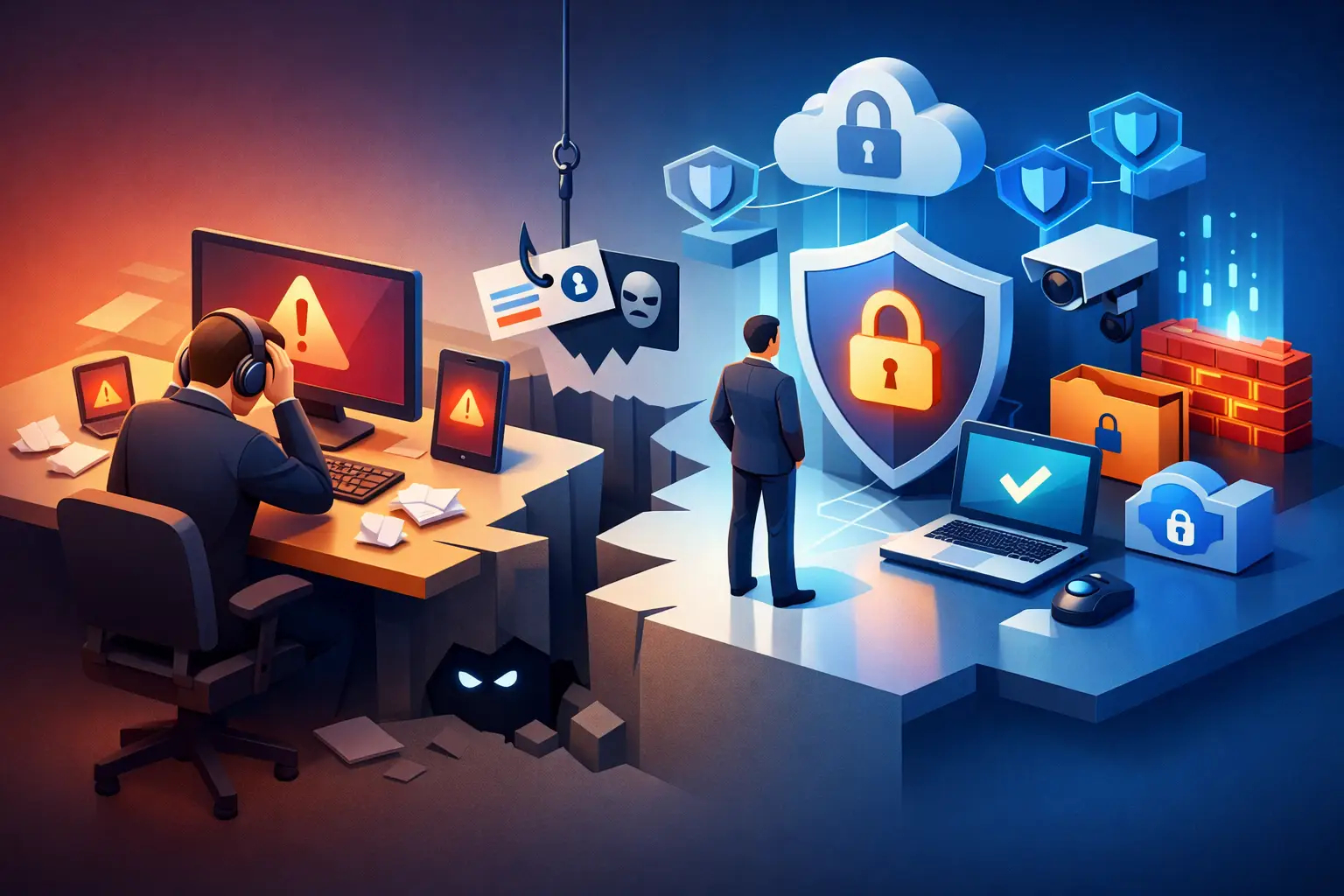
How to Reduce Human Error in Cybersecurity
One wrong click can trigger a ransomware event, expose customer data, or create a reportable compliance failure. That is why leaders keep asking how to reduce human error cybersecurity risk without slowing the business down. The real answer is not more fear, more policy PDFs, or more tools layered on top of confusion. It is a system that makes secure behavior easier, clearer, and measurable.
Why human error keeps causing security incidents
Most employees do not create risk because they are careless. They create risk because the environment around them makes mistakes likely. People work fast, juggle priorities, trust familiar brands, and respond to urgency. Attackers know this. They build phishing emails around payroll, invoices, executive requests, MFA prompts, and shared documents because those patterns fit everyday work.
This matters for security leaders because the issue is rarely just awareness in the abstract. It is decision-making under pressure. An employee who knows phishing exists can still approve a malicious login request when they are in a meeting, on a phone, and trying to keep work moving. A finance user can still send sensitive data through the wrong channel if policy is vague and the secure option feels slower.
That is the core challenge. Human error in cybersecurity is usually a design problem before it becomes a people problem.
How to reduce human error cybersecurity risk at the source
If you want fewer mistakes, start by removing the conditions that produce them. Training matters, but training alone will not fix a poor process, an overloaded inbox, or a confusing approval workflow. The strongest programs combine education, technical safeguards, and operational discipline.
Build around high-risk behaviors, not generic awareness
Annual awareness training has value, but broad content rarely changes specific behaviors. Start with the incidents and near misses your organization actually sees. That usually includes phishing clicks, weak password practices, MFA fatigue, accidental data sharing, misdirected emails, unsafe use of cloud collaboration tools, and unauthorized software use.
From there, align training to job function. Finance teams need different scenarios than developers. Executives need different decision support than frontline staff. HR handles a distinct set of privacy and impersonation risks. When training reflects real workflows, employees recognize themselves in it. That is when awareness starts becoming judgment.
This is also where many companies underinvest. They buy a platform, assign a course, and treat completion as success. Completion is not the outcome. Reduced error rates, faster reporting, and better policy adherence are the outcomes.
Make secure behavior the easiest behavior
Employees usually choose the path of least resistance. Security programs should do the same. If reporting a suspicious email takes six steps, people will ignore it. If secure file sharing is harder than using a consumer app, people will route around policy. If password rules are hard to understand and impossible to remember, users will reuse patterns.
Reducing human error means reducing friction in the secure path. That can include one-click phishing reporting, password managers, clear data handling labels, conditional access rules, and default security settings that require less user judgment. It can also mean rewriting policies in plain language so people know what to do in the moment, not just what the company prohibits.
This is one of the most practical answers to how to reduce human error cybersecurity exposure. Do not ask employees to overcome bad system design through willpower.
Training that changes behavior
Security awareness works best when it is continuous, role-based, and tied to business context. Short, repeated learning moments outperform one annual event because they fit how people actually absorb information. A five-minute lesson on invoice fraud before quarter-end is more useful than a generic module completed six months earlier.
Use scenarios that employees recognize immediately
Realistic scenarios matter because people do not make mistakes in theory. They make mistakes in Slack messages, Teams chats, expense approvals, CRM exports, and urgent email threads. Good training mirrors these environments and shows the consequences of small decisions.
Interactive modules, quick knowledge checks, and phishing simulations can all help, but only when they are used responsibly. If simulations feel like traps designed to embarrass employees, reporting rates drop and resentment grows. If they are framed as coaching tools, they strengthen vigilance. The difference is cultural.
Train leaders differently from the workforce
Executives are high-value targets, and their risk profile is different. They face impersonation attacks, travel-related exposure, privileged access abuse, and pressure-based fraud. They also set the tone. When leaders bypass process in the name of speed, the rest of the organization gets the message.
That is why executive cybersecurity education should focus on decision quality, escalation expectations, and business trade-offs. Security leaders do not need senior teams to memorize technical vocabulary. They need them to recognize risk, support controls, and respond consistently under pressure.
Policy, process, and compliance all shape human error
Organizations often separate awareness, policy, and compliance into different workstreams. In practice, employees experience them as one thing. If the policy says one thing, the process rewards another, and training teaches a third, people improvise. Improvisation is where errors grow.
A better approach is to align all three. Your training should explain the policy in operational terms. Your policy should reflect the realities of how teams work. Your compliance obligations should be translated into concrete behaviors for each role.
For organizations dealing with NIS2, regional privacy requirements, or industry-specific controls, this is especially important. Regulations raise the stakes, but they also provide a useful forcing function. They push companies to define accountability, document controls, and prove that the workforce has been prepared. That preparation should not be limited to check-the-box completion records. It should show that employees understand how to handle data, report incidents, and follow approved channels.
Measure what actually reduces mistakes
You cannot manage human error if you only measure training completion. Completion tells you who sat through content. It does not tell you whether cyber risk is going down.
Track behavior and outcomes instead. Look at phishing report rates, repeat click patterns, policy exception trends, misdirected email incidents, unauthorized app usage, time to report suspicious activity, and performance by role or region. Those signals reveal where controls are failing and where coaching is needed.
There is a trade-off here. More metrics can create more administration, and not every signal is equally useful. Focus on a small set tied to your most material risks. For one organization, business email compromise may be the dominant issue. For another, it may be data handling errors in a distributed workforce. The right metrics depend on threat exposure, regulatory pressure, and operational model.
Culture matters, but culture is not a slogan
Many companies say they want a strong security culture. Fewer define what that means in day-to-day behavior. In practical terms, a healthy security culture is one where people report concerns quickly, managers reinforce secure habits, and employees are not punished for raising a hand early.
That requires trust. If workers believe reporting a mistake will damage their reputation, they will wait. Delay turns small incidents into major ones. A mature program treats reporting as a control, not a confession.
This is where HR, compliance, IT, and security need to work together. Cybersecurity is not just a technical function. It is a business behavior function. The organizations that reduce human error consistently are the ones that make secure conduct part of onboarding, manager expectations, and operational routines.
A practical model for reducing human error
If you need an operating model, keep it simple. Identify your top human-risk scenarios. Map them to roles. Train those roles with short, relevant content. Support that training with controls that reduce friction and limit blast radius. Measure real behavior, then adjust.
For many organizations, that means moving beyond generic awareness to a structured education program with localized, role-based content and measurable outcomes. That is where platforms like CISO EDU fit naturally - not as a content library alone, but as part of a broader effort to turn employees into an active line of defense.
The biggest mistake leaders make is treating human error as inevitable. It is not. Some level of risk will always remain because people are human and attackers adapt. But most avoidable mistakes can be reduced when training, policy, and system design point in the same direction.
Cybersecurity starts with people, but it does not end there. Build an environment where the right action is the obvious one, and your workforce becomes stronger with every decision it makes.
ADVANCED VISION IT - MALTA Address: Suite 8, Ta’ Mallia Buildings, Triq In‑Negozju, Zone 3, Central Business District, Birkirkara, CBD 3010, Malta
Registration number: C111282, VAT Number: MT31713827
Phone:+35679224404
Email: office@advisionit.com
ADVANCED VISION IT - BULGARIA
Address: 35 Dimitar Hadzhikotsev str. Ent A, Lozenets, Sofia, Bulgaria
ID No: 205789039, VAT No: BG205789039
Phone: +359 888 258 530
Email: office@advisionit.com