



Localized Training vs Global Modules: What Works?
A phishing simulation written for a U.S. workforce can fail before an employee even opens it in Riyadh, Frankfurt, or São Paulo. The language may be clear, but the payment methods, business etiquette, regulations, and threat patterns may not be familiar. That is the operational reality behind localized training vs global modules. The question is not whether your organization needs standardization. It does. The question is where standardization stops helping and starts creating blind spots.
Cybersecurity starts with people - not tools. If training does not reflect the decisions employees actually make in their region, role, and regulatory environment, completion rates may look healthy while risk remains unchanged.
Localized training vs global modules: the real trade-off
Global modules offer consistency. They give every employee a shared baseline for recognizing phishing, protecting passwords, handling sensitive information, reporting incidents, and using company systems safely. For organizations with distributed teams, that baseline matters. It establishes common language, simplifies administration, and makes it easier to demonstrate that training has been delivered at scale.
But global content often assumes that the same examples, laws, and workplace norms apply everywhere. They do not. A generic lesson on data handling may be adequate as an introduction, yet insufficient for an employee who must understand GDPR obligations in Europe, NIS2-related responsibilities in a regulated environment, or sector-specific data expectations in the GCC.
Localized training adapts the learning experience to the audience. That can include language, local threat examples, regional regulations, cultural context, and job-specific scenarios. It makes the training feel less like a corporate requirement and more like practical guidance for the next email, vendor request, customer interaction, or security incident.
The trade-off is clear. Global modules are faster to deploy and easier to govern. Localized programs take more planning, content oversight, and review. However, the lowest-effort program is not always the lowest-risk option. A training strategy should be measured by behavior change and audit readiness, not simply by the number of completion certificates issued.
Where global modules deliver value
A global module is not a weak module by definition. It is the right tool when the learning objective is universal and the expected behavior is consistent across the organization.
Core topics such as password hygiene, multi-factor authentication, safe browsing, social engineering awareness, and incident reporting usually benefit from a common global standard. Every employee should know how to identify a suspicious link, verify an unusual request, and report a potential incident quickly. These fundamentals should not vary by geography.
Global modules also help security teams establish a dependable operating rhythm. They allow centralized reporting, consistent certification, and rapid rollout during emerging threats. If a major phishing campaign targets the company, a concise global awareness module can be deployed immediately while more targeted regional guidance is prepared.
For smaller organizations or teams early in their security awareness journey, a well-designed global foundation may be the best first step. The mistake is treating that foundation as the complete program. Security maturity requires more than a once-a-year course that speaks to everyone in the same way.
When localization becomes a security requirement
Localization matters most when an employee’s local context affects the security decision they need to make. Regulations are an obvious example, but they are not the only one.
A finance employee in one region may regularly receive invoice fraud attempts referencing local banks, tax authorities, or payment workflows. A procurement team may face vendor impersonation tactics that exploit regional business customs. A customer support representative may need to understand distinct privacy expectations before disclosing account information. A global lesson that uses unfamiliar names, currencies, and processes can feel theoretical at precisely the moment training needs to be memorable.
Regulatory alignment raises the stakes further. Organizations operating under NIS2, GDPR, or regional cyber resilience requirements need employees to understand what relevant policies mean in practice. Legal language alone does not create compliance. People need scenario-based instruction that shows when to escalate, how to handle sensitive data, what constitutes a reportable event, and which actions can create organizational exposure.
Localization is also critical for language accessibility. Translation is necessary, but translation alone is not localization. A literal translation can preserve words while losing meaning. Effective localized training uses examples, terminology, visuals, and scenarios that make sense to the learner's environment. It avoids asking employees to mentally translate both the language and the business context before they can act.
Measure behavior, not attendance
Completion data has a place in compliance reporting, but it cannot be the primary definition of success. Employees can complete a module without recognizing a real attack two weeks later.
Track whether learners improve in the behaviors your organization needs most. That may include phishing reporting rates, time to report suspicious activity, quiz performance on high-risk scenarios, repeat error patterns, policy acknowledgments, and the results of targeted simulations. Review results by region and role. If one location completes training but continues to struggle with invoice fraud, the content or supporting controls need attention.
Qualitative feedback matters as well. Ask employees whether scenarios reflect the messages they receive, the systems they use, and the decisions they are expected to make. If training feels disconnected from work, employees will treat it as an administrative task. If it helps them avoid a real mistake, it becomes part of the security culture.
CISO EDU approaches this through interactive lessons, quizzes, and certifications that can be aligned to roles, regions, and compliance needs. The goal is not to produce more training. It is to build cyber-smart teams that recognize risk early, respond correctly, and reduce the cost of human error.
Build a layered program, not an either-or choice
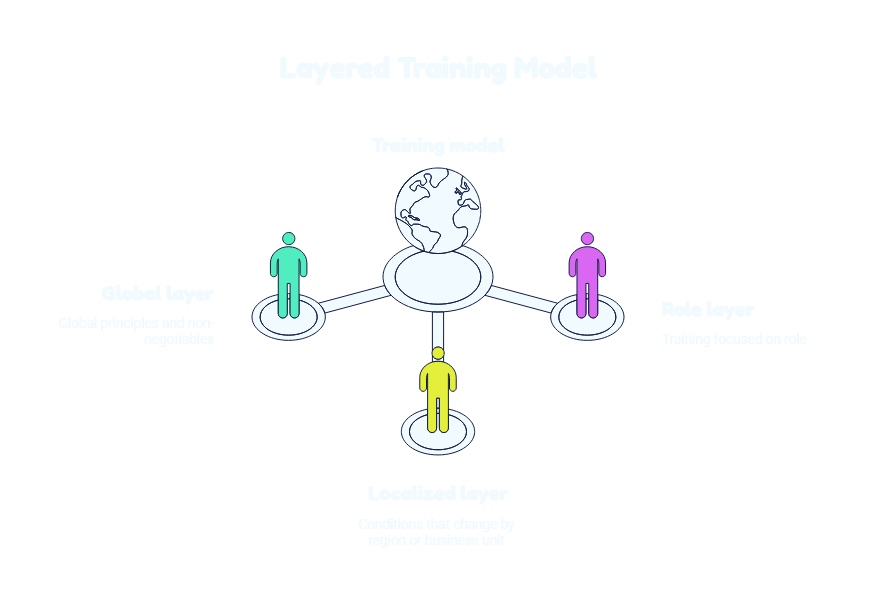
The strongest answer to localized training vs global modules is usually a layered model. Start with global principles, then add targeted learning where risk, regulation, or workforce context demands it.
The global layer should cover the non-negotiables: security culture, phishing awareness, authentication, device security, data classification, reporting procedures, and acceptable use. Keep the language direct. Employees should leave knowing what good security behavior looks like and how to get help.
The localized layer should address the conditions that change by region or business unit. This includes local regulations, region-specific fraud methods, market-relevant examples, local reporting channels, and policies that require different handling. For organizations subject to NIS2, localized content can connect broad cyber hygiene to resilience duties, incident escalation, and accountability expectations that affect operations.
A third layer should focus on role. A developer, executive assistant, HR manager, finance approver, and frontline sales representative do not face the same threats. Training that reflects their authority, access, and workflows is more likely to influence daily decisions. Executives, for example, need focused guidance on targeted impersonation, confidential communications, board-level risk, and high-value approval fraud. Their learning should respect both their time and their level of exposure.
This structure protects consistency without forcing sameness. It also gives security, compliance, HR, and learning teams a clearer way to divide responsibility. The central team defines the baseline and measures outcomes. Regional and functional stakeholders validate relevance before training reaches employees.
Avoid two common mistakes
The first mistake is over-localizing every topic. Rebuilding basic password or phishing instruction for every country can create unnecessary cost and inconsistent standards. Localize where context changes the decision, not where the message is already universal.
The second mistake is assuming a global module is automatically inclusive because it is available to everyone. Availability is not relevance. If the examples, policy references, and threat scenarios do not match an employee’s reality, the module may satisfy a distribution requirement without improving readiness.
Security leaders should also avoid treating localization as a one-time project. Threats evolve, regulations change, and business processes shift. Review high-risk modules regularly, particularly after an incident, a regulatory update, a merger, or expansion into a new market. The most useful training program is one that learns from the organization it is protecting.
A global baseline creates alignment. Localized learning creates relevance. When both are designed around the real decisions employees make, training stops being a compliance obligation and becomes an active layer of defense.
FAQ
1. What is the difference between localized training and global training modules?
Global training modules provide a consistent cybersecurity foundation for all employees across the organization. Localized training adapts content to specific languages, regional regulations, cultural norms, threat landscapes, and business practices.
2. Which approach is more effective for cybersecurity awareness?
Neither approach is sufficient on its own. The most effective strategy combines a global baseline with localized content that reflects the risks, regulations, and situations employees encounter in their daily work.
3. When does localization become necessary?
Localization becomes essential when security decisions are influenced by local regulations, industry requirements, cultural expectations, regional threats, or country-specific business processes.
4. Is translating training content enough?
No. Translation only changes the language. True localization adapts examples, scenarios, terminology, regulations, visuals, and business context so employees can easily relate the training to their real-world environment.
5. What topics work best as global modules?
Topics such as password security, multi-factor authentication (MFA), phishing awareness, safe browsing practices, device security, acceptable use policies, and incident reporting procedures are typically appropriate for global training.

Ivan Energiev
Published on: August 28, 2026 | Last Updated: August 28, 2026IT Project Coordinator at Advanced Vision IT
Ivan orchestrates end-to-end project execution and operations governance, specializing in IT service delivery, process optimization, cross-functional team leadership, and Microsoft 365 enterprise environments. Find out more about me