


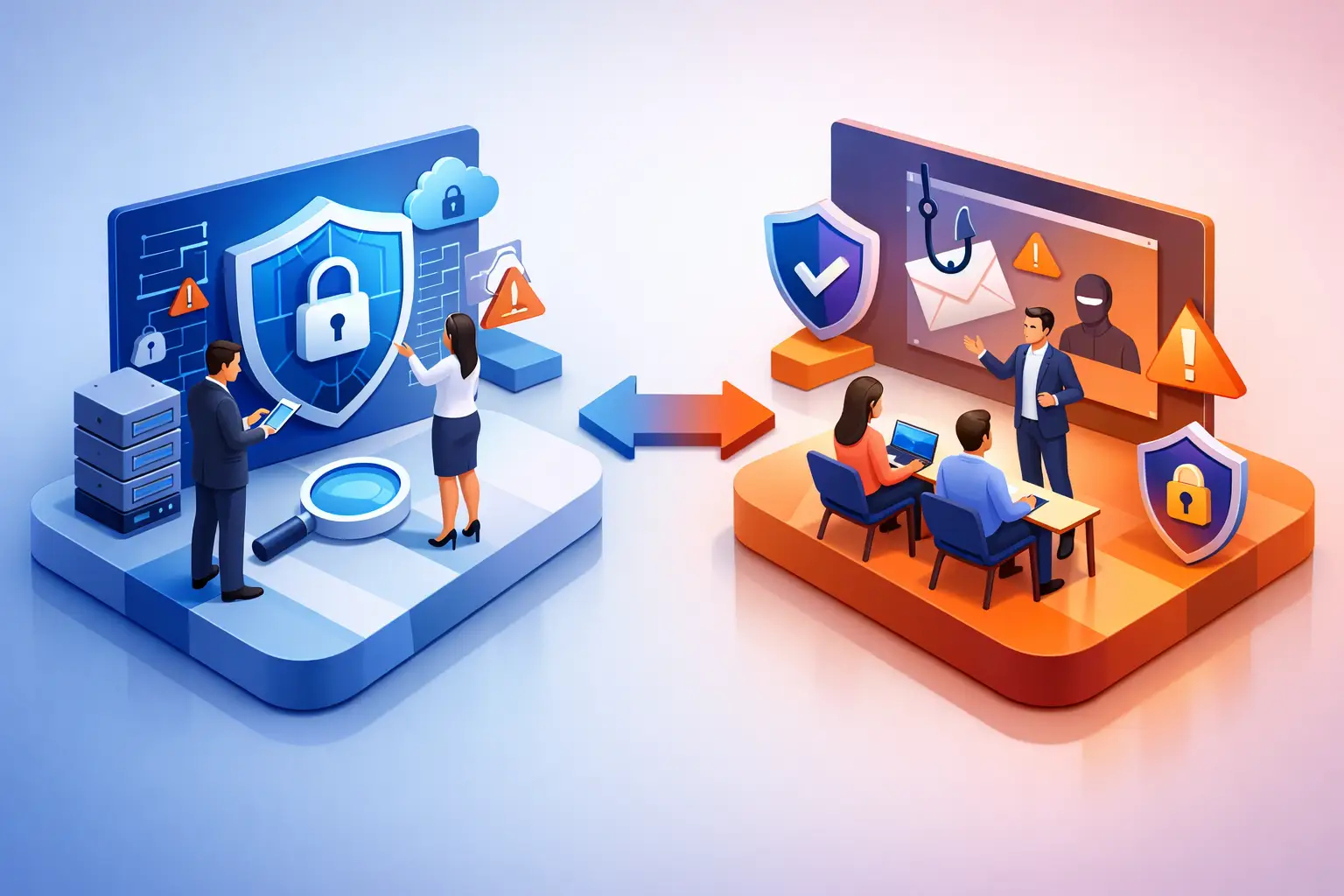
NIS2 Training vs Awareness Training Explained
A successful phishing attack rarely starts with a missing policy. It starts when an employee overlooks a warning sign, a manager delays reporting, or a privileged user does not understand the impact of their access. That is why the NIS2 training vs awareness training discussion matters. Organizations need both, but they serve different purposes - and treating them as interchangeable creates compliance gaps and unnecessary risk.
Awareness training helps people make safer decisions in their everyday work. NIS2-aligned training goes further by connecting learning to governance, risk management, role-specific responsibilities, and demonstrable compliance. For leaders accountable for resilience, the question is not which one to choose. It is how to combine them into a program that changes behavior and stands up to scrutiny.
What awareness training is designed to do
Cybersecurity awareness training equips employees to recognize and respond to common threats. Its purpose is practical: reduce the likelihood that routine human actions become an entry point for attackers.
A well-designed awareness program covers the situations employees actually face. That includes phishing and business email compromise, password and authentication practices, safe data handling, social engineering, suspicious links, remote-work risks, and incident reporting. Training should be short enough to fit into the workday, realistic enough to be remembered, and repeated often enough to influence behavior.
The strongest programs do not measure success only by course completion. They use interactive scenarios, quizzes, targeted refreshers, and phishing simulations to identify where risk remains. If one department repeatedly struggles with invoice fraud or credential-harvesting messages, that group needs focused reinforcement rather than another generic annual module.
Awareness training is essential because cybersecurity starts with people - not tools. However, awareness by itself does not prove that an organization has prepared its leadership, critical-function owners, or technical teams to meet their responsibilities under NIS2.
What makes NIS2 training different
NIS2 is the European Union directive designed to strengthen cybersecurity and resilience across essential and important entities. Its exact application depends on national laws implementing the directive, organizational size, sector, and service profile. Still, its central message is clear: cybersecurity is a management responsibility, not a task that can be delegated entirely to IT.
NIS2 places particular weight on risk-management measures, incident handling, business continuity, supply-chain security, vulnerability management, access controls, and the use of cyber hygiene practices and cybersecurity training. It also requires management bodies to approve and oversee cybersecurity risk-management measures and to follow training so they can identify risks and assess the consequences of their decisions.
That requirement changes the training model. NIS2 training is not simply a broader phishing course with a compliance label. It is structured education that helps specific audiences understand their duties, make informed risk decisions, and produce evidence that learning occurred.
For example, board members and executives need to understand accountability, escalation thresholds, regulatory exposure, and the business consequences of weak oversight. IT and security teams may need deeper learning on incident coordination, third-party controls, identity management, and continuity plans. Employees need clear guidance on the security behaviors relevant to their roles. Each group contributes to resilience differently.
NIS2 training vs awareness training: the practical difference
The simplest distinction is this: awareness training changes everyday employee behavior, while NIS2 training builds and documents the broader organizational capability required to manage cybersecurity risk.
Awareness training asks, “Can this employee spot and report a suspicious email?” NIS2 training also asks, “Do our leaders understand their oversight obligations? Can the incident team act within defined processes? Have critical roles been trained for the controls they own? Can we demonstrate that this training is current and effective?”
The difference is also visible in the evidence organizations need to retain. A basic awareness platform may show that staff completed a course. A NIS2-ready learning program should support a more complete record: assigned training by role, completion status, assessment outcomes, certifications where appropriate, refresh schedules, and remediation for people who do not meet the required standard.
Neither program needs to be bloated. In fact, overloading employees with legal language or technical detail usually lowers retention. The goal is relevance. A finance employee needs to recognize payment redirection fraud. A facilities manager may need to understand physical access and supplier risks. A senior executive needs to know when a cyber incident becomes a governance and regulatory issue.
Why one annual course is rarely enough
Annual awareness training can establish a baseline, but it is not a complete resilience strategy. Threats shift throughout the year, employee roles change, and attackers adapt their tactics. A single course may also fail to reach the people who need specialized knowledge most.
NIS2 raises the stakes because a security program must be more than a policy library and a completion report. Organizations need a repeatable training process tied to their actual risk environment. That means onboarding training for new hires, periodic awareness reinforcement for all staff, and deeper instruction for management and high-risk roles.
It also means avoiding a common compliance mistake: assigning identical content to everyone. Uniform training is easy to administer, but it may not be defensible when a critical function has clear responsibilities for incident response, supplier management, privileged access, or continuity planning. Role-based learning requires more planning, but it produces better operational readiness.
Build one program with two layers
The most effective approach is to treat NIS2 training and awareness training as connected layers of one workforce resilience program. The foundation is organization-wide awareness. Above that sits targeted NIS2 education for leadership, security teams, and roles that own or operate key controls.
Start with a risk-based training map. Identify the audiences that need different learning outcomes, then align training topics to the controls, processes, and decisions they influence. Four groups usually require distinct treatment:
- All employees need practical awareness of common threats, data protection expectations, and how to report concerns.
- Managers need to reinforce secure behavior, recognize operational risk, and escalate issues quickly.
- Technical and operational control owners need role-specific instruction tied to systems, incident procedures, suppliers, and continuity responsibilities.
- Executives and board members need training that supports informed oversight, investment decisions, and accountable governance.
Next, define how learning will be measured. Completion is necessary, but it is not enough. Use knowledge checks to confirm understanding, track certification or attestation where needed, and review phishing simulation or incident-reporting trends for behavior signals. If results show recurring weaknesses, update the training plan instead of treating the report as an administrative exercise.
Finally, keep the evidence organized. During an audit, assessment, or customer review, teams should be able to show who was trained, what they were assigned, when they completed it, how comprehension was assessed, and what follow-up occurred. This is where scalable learning platforms provide real value: they turn training from a spreadsheet exercise into a managed, measurable security control.
Avoid the compliance theater trap
There is a difference between being able to show training records and being genuinely prepared. Compliance theater happens when organizations focus on completion rates while employees remain unsure how to report an incident, managers do not know who owns a risk decision, or leadership cannot explain how cybersecurity is governed.
A more mature approach connects training to operational moments. Test whether staff know the reporting channel. Run incident-response exercises with the teams that will make time-sensitive decisions. Review supplier-risk scenarios with procurement and business owners. Give leaders concise, relevant education before they are asked to approve major security investments or respond to a serious event.
The level of depth should match the organization. A smaller entity may need a focused program with clear role assignments and regular reinforcement. A large, complex organization may need localized content, separate learning paths, multilingual delivery, and reporting by entity, department, and risk group. The principle remains the same: training must reflect the risks people are expected to manage.
Make training part of how risk is managed
NIS2 readiness is not achieved when everyone clicks “complete.” It is built when employees recognize threats, teams follow practiced procedures, and leaders can make informed decisions under pressure. Awareness training gives the workforce the daily habits that prevent incidents. NIS2 training gives the organization the governance and role-based capability to manage the incidents that still occur.
Build both into the same security program, measure whether learning is working, and keep improving where behavior or oversight falls short. That is how training becomes more than a compliance requirement - it becomes a line of defense.
FAQ
1. What is the core difference between NIS2 training and awareness training?
Awareness training improves daily employee behavior. NIS2 training builds organizational capability, governance readiness, role‑specific responsibility, and defensible compliance.
2. Why is awareness necessary but insufficient?
It reduces phishing, social engineering, and data‑handling mistakes — but does not prepare leaders or control owners for NIS2 obligations.
3. What makes NIS2 training different?
It focuses on management accountability, risk decisions, incident coordination, supplier oversight, continuity, and regulatory exposure.
4. Which groups require different learning paths?
All employees → awareness
Managers → escalation and operational risk
Technical/control owners → systems, suppliers, incident processes
Executives/board → oversight, governance, regulatory impact
5. Why is annual training not enough?
Because behavior changes through continuous reinforcement, and NIS2 requires ongoing readiness, not one‑time completion.

Written By
Yavor Y. Zlatev
CEO & Executive Director at Advanced Vision IT
Yavor leads strategic growth and technology operations at Advanced Vision IT, specializing in enterprise cybersecurity, cloud infrastructure, NIS2 compliance, and managed security service delivery. Find out more about me