


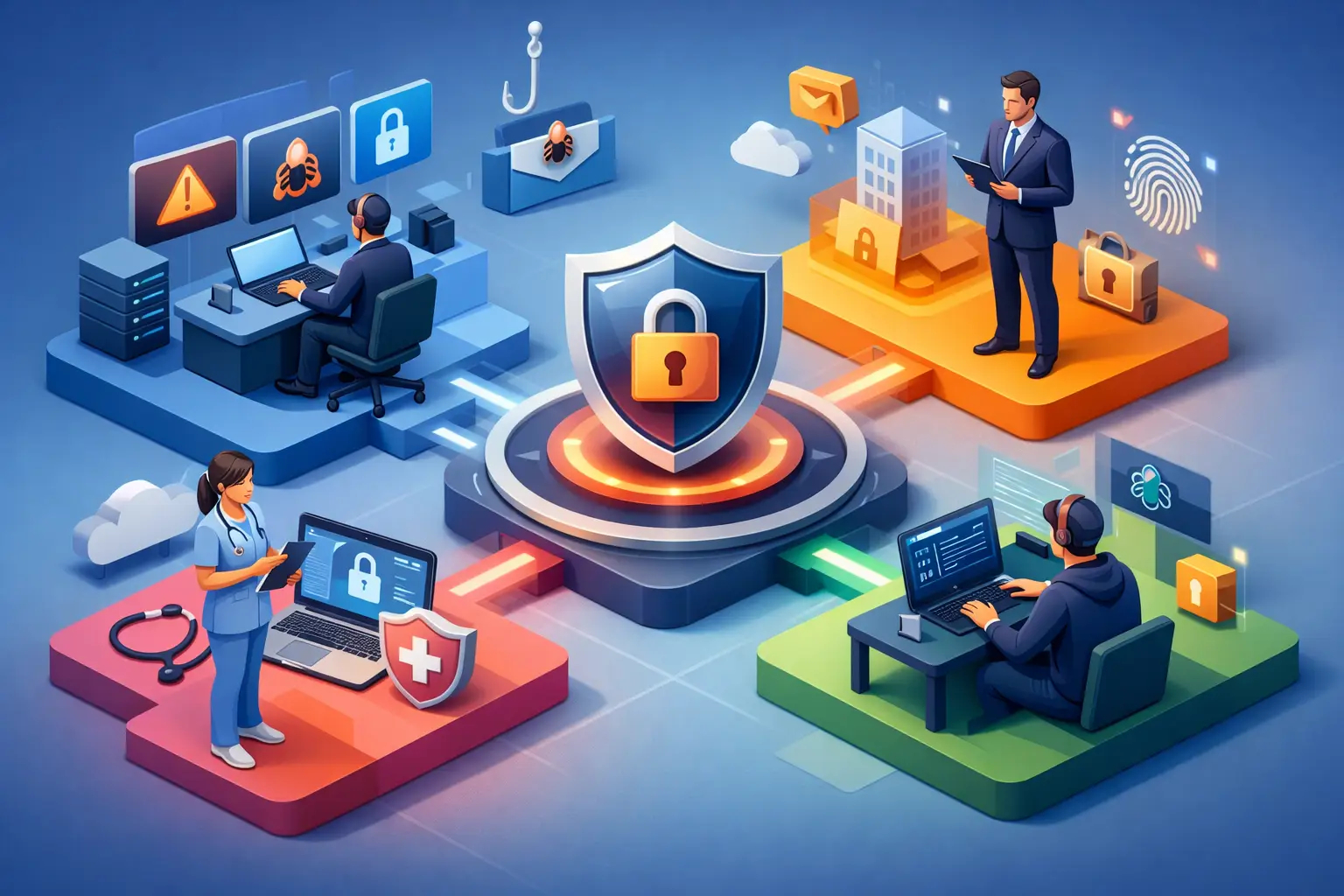
Why Role Based Security Awareness Training Works
One phishing email hits the finance team, and the risk is wire fraud. The same email hits an engineer, and the risk is source code exposure. Send both teams the same generic lesson, and you train neither well. That is why role based security awareness training matters. It treats human risk as a business problem with different failure points, different incentives, and different consequences.
Most organizations already know broad security awareness has value. The gap is precision. Annual training that tells everyone to use strong passwords and avoid suspicious links may satisfy a checkbox, but it rarely changes behavior where it counts. Real exposure sits inside roles - payroll staff approving invoices, HR teams handling sensitive employee data, developers working with repositories and cloud infrastructure, and executives targeted with polished social engineering campaigns.
What role based security awareness training actually means
Role based security awareness training is not just a different slide deck for different departments. It is a training strategy built around how people work, what systems they touch, what data they handle, and what attackers want from them.
That distinction matters. A marketer may need practical guidance on managing social accounts, third-party platforms, and brand impersonation. A customer support team needs to spot account takeover attempts and social engineering tactics that exploit urgency. Legal teams need tighter awareness around sensitive documents, privilege, and data handling. Senior leaders need training on mobile risk, impersonation, and business email compromise because attackers know where approval authority sits.
When training matches the role, employees do not have to guess which lessons apply to them. The guidance feels relevant, and relevance is what drives retention and action.
Why generic awareness training breaks down
Generic training fails for a simple reason - it assumes all employees create the same level and type of risk. They do not.
A broad baseline still has a place. Every employee should understand phishing, password hygiene, device security, and reporting procedures. But baseline awareness should be the floor, not the full program. If your finance team receives the same content as warehouse staff, you are flattening risk in a way attackers never do.
This also creates a credibility problem. Employees tune out when examples do not reflect their work. If security education feels disconnected from real tasks, it gets treated like compliance theater. Completion rates may look fine. Behavior change usually does not.
For CISOs, compliance leaders, and L&D owners, that creates a false sense of coverage. The program exists, but the highest-risk user groups still lack role-specific decision support.
The business case for role based security awareness training
The strongest argument for role based security awareness training is not academic. It is operational.
Security incidents tied to human behavior rarely happen because people have never heard of phishing. They happen because someone in a specific role makes a high-impact mistake inside a familiar workflow. An AP manager processes a fraudulent invoice. A recruiter opens a weaponized resume. An administrator approves an MFA prompt under pressure. A developer exposes credentials in code. Those are not random mistakes. They are role-linked failure scenarios.
Training built around those scenarios helps reduce business risk in a more measurable way. It can improve reporting quality, lower click rates in targeted simulations, reduce policy violations, and support audit readiness. It also gives leaders a clearer way to explain investment decisions. You are not buying content for content's sake. You are reducing loss exposure in the workflows most likely to be exploited.
For regulated organizations, the case gets even stronger. Frameworks and regulations increasingly expect evidence that cybersecurity education is appropriate, repeatable, and aligned to risk. A generic annual module may check the minimum box, but it will not always stand up well when regulators, auditors, or boards ask whether your training approach reflects actual business operations.
Which roles should get specialized training first
Not every role needs the same level of specialization on day one. Start where business impact is highest.
Finance is usually near the top because it sits directly in the path of payment fraud, invoice scams, and impersonation attacks. HR follows closely because it handles sensitive personal data, onboarding workflows, and document-heavy communications that attackers can mimic easily. IT and engineering teams need deeper instruction on access control, cloud hygiene, credential handling, and secure configuration behavior. Executives need focused content on targeted phishing, travel risk, public exposure, and approval-chain abuse.
Customer-facing teams also deserve attention. Sales, support, and account management are common targets because they work fast, respond to unknown contacts, and often hold access to sensitive customer records. In some sectors, procurement, legal, and operations are equally high risk.
The right prioritization depends on your threat landscape, industry, and regulatory exposure. A hospital, manufacturer, bank, and SaaS company will not rank roles the same way. That is exactly the point. The training model should follow risk, not tradition.
How to build a program that actually changes behavior
The most effective role based security awareness training programs start with a role-risk map. Identify which teams handle sensitive data, approve transactions, administer systems, or interact with high-value external communications. Then map those responsibilities to common attack paths and policy requirements.
From there, design content around realistic decisions, not abstract warnings. Employees remember situations they recognize. A finance lesson should address invoice red flags, account change procedures, and escalation rules. A developer module should cover secrets management, dependency risk, and access misuse. An executive module should reflect the reality of mobile approvals, conference travel, and spoofed requests from trusted contacts.
Frequency matters too. Short, role-specific training delivered throughout the year tends to outperform one annual event. People need reinforcement close to the moment of risk. That may include microlearning, simulations, targeted refreshers after incidents, and certifications for sensitive roles.
This is also where many programs get overcomplicated. The goal is not to create dozens of training tracks that become impossible to manage. The goal is to establish a smart baseline, then add focused role layers for your highest-risk groups. A manageable program that stays active is better than an ambitious one that stalls.
What to measure beyond completion rates
If the only metric you track is who finished the course, you are measuring administration, not risk reduction.
A stronger model looks at behavior indicators tied to specific roles. For finance, that might mean fewer exceptions in payment verification or better reporting of suspicious requests. For IT admins, it may mean reduced policy drift, faster response to suspicious prompts, or cleaner credential practices. For executives, it could mean improved reporting of impersonation attempts and fewer risky approval shortcuts.
Phishing simulation results can be useful, but only if they are role-aware and interpreted carefully. A simulation should test likely attack patterns for that audience, not random trick questions designed to produce failure. The purpose is to improve judgment, not to embarrass employees.
Qualitative feedback matters as well. If teams say the content reflects their work and helps them make better decisions, that is a strong signal the program is becoming part of operations rather than a side task.
Common mistakes to avoid
One common mistake is confusing job titles with actual access and behavior. Two employees with similar titles may face different risks depending on systems, authority, and geography. Another is treating role based content as a one-time build. Threats change, regulations evolve, and business processes shift. The training has to keep pace.
Localization is another factor many organizations underestimate. A global workforce does not just need translated content. It needs training that respects local regulations, attack patterns, and cultural context. That is especially relevant for organizations operating across the US, Europe, and the GCC, where compliance expectations and threat conditions can vary meaningfully.
The final mistake is isolating training from the broader security program. Awareness works best when it supports reporting workflows, incident response, access policies, and leadership expectations. If employees are taught to report suspicious activity but the reporting path is unclear or ignored, trust erodes quickly.
Role based security awareness training is a leadership decision
This is not only an L&D project or a compliance exercise. It is a leadership decision about how seriously your organization treats human risk.
When security leaders tailor training to roles, they send a clear message: we understand how work gets done here, we know where the risk sits, and we are giving teams practical guidance they can use. That builds credibility with employees and confidence with boards, regulators, and customers.
At CISO EDU, that principle is central. Cybersecurity starts with people - not tools. The organizations that reduce human-driven incidents most effectively are the ones that stop treating the workforce as a single training audience and start training people according to the decisions they actually make.
If your program still looks the same for every employee, that is not simplicity. It is blind spot management. Start where the risk is highest, make the training fit the role, and give your people a real chance to act as your first line of defense.
ADVANCED VISION IT - MALTA Address: Suite 8, Ta’ Mallia Buildings, Triq In‑Negozju, Zone 3, Central Business District, Birkirkara, CBD 3010, Malta
Registration number: C111282, VAT Number: MT31713827
Phone:+35679224404
Email: office@advisionit.com
ADVANCED VISION IT - BULGARIA
Address: 35 Dimitar Hadzhikotsev str. Ent A, Lozenets, Sofia, Bulgaria
ID No: 205789039, VAT No: BG205789039
Phone: +359 888 258 530
Email: office@advisionit.com